Manduka PRO vs GRP Adapt 1.0: Which One Should You Buy?
This matchup is about sweat. The PRO is Manduka's immortal PVC slab: dense, closed-cell, guaranteed for life, and famously unhelpful when your palms are wet. The GRP Adapt is the company's answer to exactly that complaint: a polyurethane top layer over natural rubber that absorbs moisture and grips hardest when things get damp. This page covers the original GRP Adapt 1.0, which stays on sale at $94 and is the version Amazon carries; Manduka's redesigned GRP Adapt 2.0 sells alongside it at $128.
As an Amazon Associate, we earn from qualifying purchases made through links on this page. How this works
The quick answer
The PRO is thicker (6 mm vs 5), lasts decades, and carries the lifetime guarantee, but its closed-cell surface keeps sweat on top and needs a break-in period besides. The GRP Adapt 1.0 grips from day one, absorbs sweat instead of pooling it, weighs almost 2 pounds less, and costs $50 less, but polyurethane tops wear faster than PVC, it needs to dry before rolling, and there's no warranty behind it.
If you do hot yoga or your palms sweat in any class, get a GRP Adapt; the 1.0 at $94 is the value pick while it lasts, and the PRO will genuinely frustrate you in a hot room. For everyone else the PRO's cushion and lifespan make it the better long-term buy.
Get the PRO if...
- Your practice is mostly dry and you want one mat for a decade or more
- You want the thicker, firmer 6 mm cushion
- The lifetime guarantee matters to you
- You want zero care rules beyond an occasional wipe
Get the GRP Adapt 1.0 if...
- You do hot yoga or sweat through your palms in any class
- You want real traction on day one, no break-in
- You'd rather carry 5.8 pounds than 7.5
- You'd rather keep the $50
Side by side
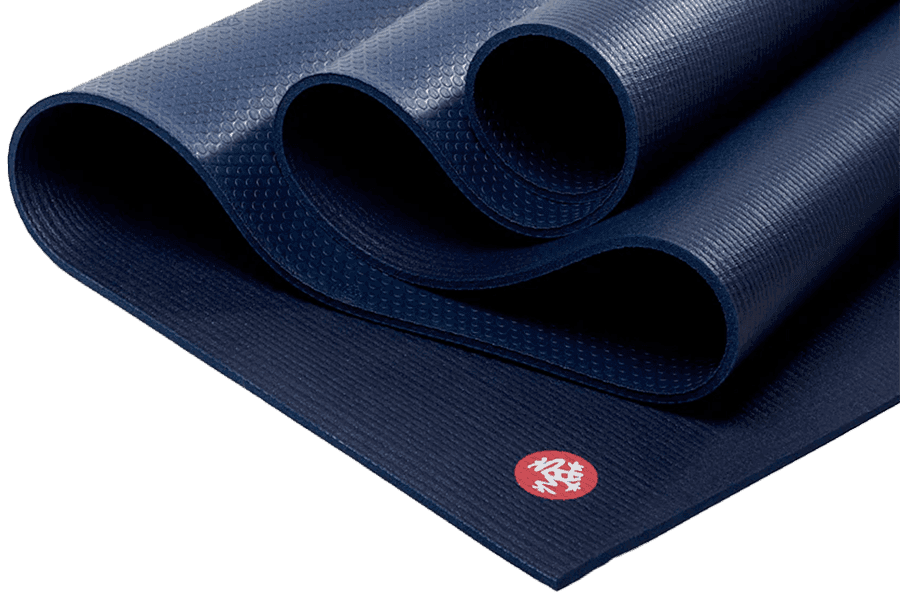
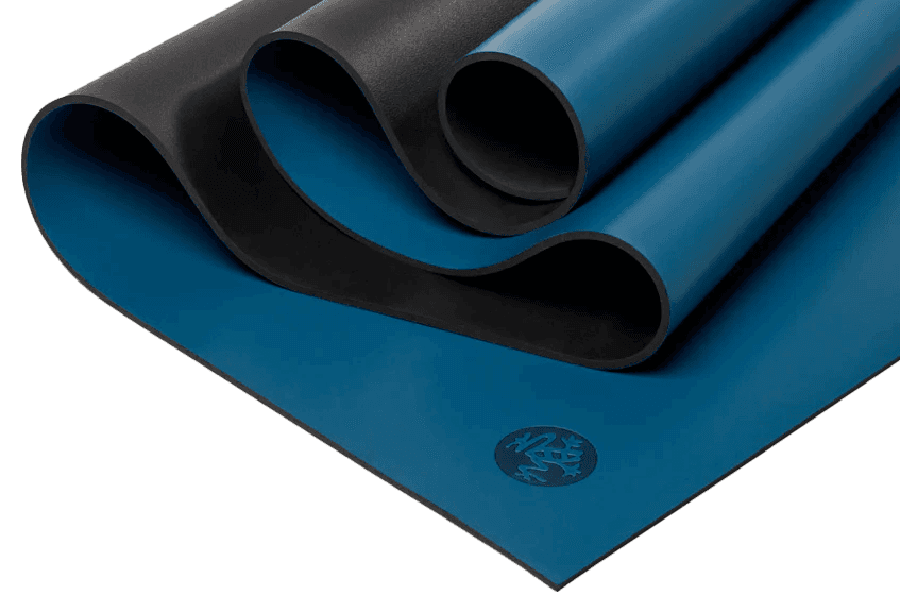
Price
The GRP Adapt 1.0 lists for $50 less.
$144
List price · check price at Amazon
$94
List price · check price at Amazon
Thickness
The PRO is 20% thicker.
6 mm0.24″
5 mm0.2″
Weight
The GRP Adapt 1.0 is 2.2 lbs lighter.
8 lbs3.6 kg
5.8 lbs2.6 kg
Size
Same length; same width.
Same on both
- Made by Manduka
- Same 71" × 26" footprint
- Firm, stable feel rather than squishy
- Lies flat without curling
Full specs
Dimensions
Materials & build
Buying
Sweat decides this one
The PRO’s one performance weakness has never been a secret: its closed-cell PVC surface absorbs nothing, so sweat pools on top and wet palms slide. For dry practices that’s a feature, since the mat wipes clean and never gets funky. In a heated room it means draping a towel over a $144 mat.
The GRP Adapt is Manduka’s own fix. Its polyurethane top layer drinks moisture the way the PRO sheds it, over a natural rubber body made in Spain, and it grips from the first practice with no break-in. This page covers the original GRP Adapt 1.0, which at $94 is $50 cheaper than the PRO. So why doesn’t everyone buy it? Because absorbent surfaces trade lifespan and easy care for that grip, and the PRO gives up neither. How much you sweat really is the whole decision.
The 1.0 and the 2.0, side by side on the shelf
Manduka redesigned this mat recently, and both generations sell today. The GRP Adapt 2.0 lists at $128 with an upgraded Satin Grip surface, faster moisture absorption, 20% recycled content, and a 79″ Long option. The 1.0 covered here remains on sale at $94 in two colorways, standard size only, and it’s the version the Amazon listing carries at last check.
Same idea in both generations: polyurethane over rubber, built for sweat. But reviews and awards you read may cover either one. OutdoorGearLab’s hot yoga top pick, for example, is specifically the 2.0. Check which version a price or a review attaches to before you compare, and if you’re weighing the 1.0 against the 2.0 itself, the $34 question is whether the upgraded surface and extra colorways matter to you; the core sweat-handling design is the same.
Grip: wet, dry, and week one
The GRP Adapt wins the grip conversation twice. On day one, its smooth polyurethane surface has real traction while a new PRO is at its slick, frustrating worst. And when sweat arrives, the GRP pulls moisture into the mat and keeps gripping; GearLab found the 2.0’s combined wet and dry traction the best of the smooth-topped mats it tested, and the 1.0 is built on the same absorbent design. The PRO’s surface, once broken in, grips very well dry and keeps improving for years, but wet is wet: sweat sits on top and your hands go with it.
If your practice is dry, the gap mostly closes after the PRO’s break-in weeks. If it isn’t, no amount of patience fixes the PRO, and the towel you’ll buy is a permanent accessory.
Cushioning: the PRO is still the benchmark
Both are firm mats, and the spec gap looks small: 6 mm of dense PVC against 5 mm of rubber and polyurethane. On hard floors the PRO’s extra millimeter and density still tell, especially in kneeling work, and its perfect comfort score in GearLab’s rankings wasn’t an accident. The GRP Adapt is supportive rather than plush, closer to the PRO’s feel than to any soft mat, and most practitioners won’t miss the difference on a studio floor. Concrete-and-tile home practices will.
Weight and footprint
Same generous 71″ × 26″ footprint on both, which is two inches wider than most of the category. The GRP Adapt carries it at 5.8 pounds by Manduka’s current spec, the PRO at 7.5. Neither is a travel mat, but the GRP is the one you can carry to a studio without resenting it, and hot yoga practitioners usually are carrying their mat somewhere. If you want genuinely light, this isn’t the pair to shop; Manduka’s PROlite and eKO Lite live in that conversation.
Durability, care, and the warranty gap
The PRO lasts decades and demands nothing: wipe it, leave it in a hot car, ignore it. GearLab found working instructors on PRO mats up to twenty years old, and Manduka’s lifetime guarantee, about ten years of regular use with one replacement in the fine print, backs the claim.
The GRP Adapt gets a 30 day return window, and its care list is real: air-dry fully before rolling, clean regularly so absorbed sweat doesn’t build up, keep harsh cleaners away from the polyurethane. GearLab also noted the 2.0 scuffs easily and can squeak underfoot when wet. None of this is disqualifying for a mat built to be sweated on, but it’s the opposite of the PRO’s indifference, and Manduka’s warranty terms tell you which construction it expects to outlive the other.
One more note for allergy sufferers: the GRP Adapt contains natural rubber latex and Manduka doesn’t recommend it for latex sensitivities. The PRO’s PVC is the safe pick there.
Sizes and colors
The PRO family is deep: around fourteen colorways in the standard size, plus an 85″ Long and two oversized home-studio cuts. The GRP Adapt 1.0 is down to two colorways, La Rana and Terracotta, in the standard size only, and its Long cut was discontinued; a long GRP now means the 2.0 Long at $138, in Carbon Black. If color choice matters, this one’s lopsided.
Price and value
List prices are $144 for the PRO and $94 for the GRP Adapt 1.0, with the 2.0 at $128. Check the current price on the PRO and the GRP Adapt 1.0 at Amazon before deciding, and note which GRP version a listing carries.
Per year, the PRO is the cheaper mat; it simply refuses to wear out. The GRP Adapt’s value case is that it solves a problem the PRO can’t solve at any price. A $94 mat that works in a hot room beats a $144 mat plus a towel habit, and the 1.0 at $94 is quietly the bargain of the line while it lasts.
Bottom line
Count your sweat. If your practice is heated, vigorous, or just reliably damp-palmed, get a GRP Adapt and don’t look over your shoulder at the PRO’s lifespan; a mat you slide on is worthless no matter how long it lasts. The 1.0 at $94 is the value pick; the 2.0 at $128 is the better mat and the one with the current award.
If your practice is dry, the PRO remains the smarter long-term buy: more cushion, no care rituals, and the only guarantee in the conversation. Break it in once and it outlives every other mat on this site.
Manduka PRO
List price $144
Frequently Asked Questions
- What's the difference between the GRP Adapt 1.0 and the GRP Adapt 2.0?
- Manduka redesigned the mat in the past couple of years. The 2.0 sells for $128 with an upgraded Satin Grip surface, faster moisture absorption, 20% recycled content, and a Long size; it's the version OutdoorGearLab named its top pick for hot yoga. The original 1.0, covered on this page, stays on sale at $94 in two colorways, standard size only. Same concept and materials in both: polyurethane top, natural rubber body, made in Spain. Check which version a retailer is selling before you compare prices.
- Is the GRP Adapt actually better than the PRO for hot yoga?
- Yes, and it isn't close. The GRP Adapt's polyurethane surface absorbs sweat and keeps traction as the room heats up; OutdoorGearLab named the current GRP Adapt 2.0 its top hot yoga pick for exactly that wet-and-dry grip. The PRO's closed-cell surface absorbs nothing, so sweat pools and palms slide, and most hot yoga practitioners end up draping a towel over it. If heated classes are your main practice, this comparison has a clear winner.
- Does the GRP Adapt 1.0 have the lifetime guarantee?
- No. Manduka's lifetime guarantee covers the PRO series only. The GRP Adapt gets the standard 30 day return window, and the reason is the materials: absorbent polyurethane tops grip well but wear faster than dense PVC, especially under daily heavy use.
- How do you clean a mat that absorbs sweat?
- Carefully, and this is the GRP Adapt's main downside. It should air-dry fully before being rolled, wants regular cleaning so absorbed sweat doesn't build up, and harsh cleaners will damage the polyurethane. The PRO is the opposite: closed-cell, wipe and done. If you want a zero-maintenance mat, that's a genuine point for the PRO.
- Is the GRP Adapt 1.0 safe for someone with a latex allergy?
- No. Manduka lists the materials as polyurethane and natural rubber latex and does not recommend the mat for people with latex sensitivities. The PRO's PVC construction is the safer pick for allergy sufferers.
- Which is heavier, the PRO or the GRP Adapt 1.0?
- The PRO, at 7.5 pounds to the GRP Adapt's 5.8 by Manduka's current spec. Both share the same roomy 71" × 26" footprint, so neither rolls up small, but the GRP Adapt is noticeably easier to carry to a studio. Neither is a travel mat.
Related comparisons
- Manduka GRP Adapt 1.0 vs Suga SugaMat
- Manduka PRO vs Alo Warrior
- JadeYoga Harmony 68" vs Manduka GRP Adapt 1.0
- Manduka PRO vs b, halfmoon B Mat Strong 6mm
- Manduka PRO vs Yoloha Unity Pro Cork
- JadeYoga Harmony 74" vs Manduka GRP Adapt 1.0
- Manduka GRP Adapt 1.0 vs Gaiam Performance Dry-Grip Long & Wide
- Manduka GRP Adapt 1.0 vs JadeYoga Harmony 2.0 68"
- Manduka GRP Adapt 1.0 vs 42 Birds The Robin