Manduka PRO vs Jade Harmony 2.0: Which One Should You Buy?
The Manduka PRO and Jade Harmony 2.0 are current award winners with different strengths. The 6mm PRO is a roomy, dense PVC mat built for support and long ownership. The 4.8mm Harmony 2.0 is lighter FSC-certified natural rubber with immediate grip and a lower price.
As an Amazon Associate, we earn from qualifying purchases made through links on this page. How this works
The quick answer
The PRO is the better stationary mat for sensitive joints and long-term ownership. It is thicker, larger, easier to clean and backed by a lifetime guarantee, but eight pounds is burdensome and its surface needs time to break in. Harmony 2.0 grips hard from the first class, weighs 3.2 pounds less and costs $34.05 less, though its texture can feel abrasive and the warranty lasts one year.
Get the PRO for a home practice where support and durability matter most. Get the Harmony 2.0 for immediate traction, natural rubber and a mat you can carry to class without resenting it.
Get the Manduka PRO if...
- You want the deeper 6mm support for knees and wrists
- Your mat mostly stays in one place
- You want a written lifetime guarantee
- You need a latex-free surface
Get the Harmony 2.0 if...
- You want forceful grip from the first practice
- You carry your mat to class
- FSC-certified natural rubber matters to you
- You would rather save about $34
Side by side
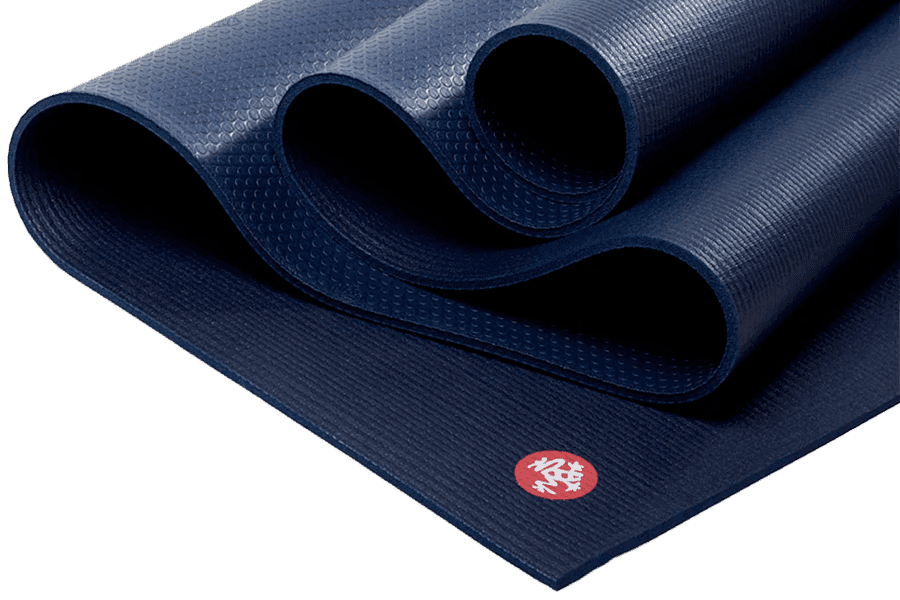
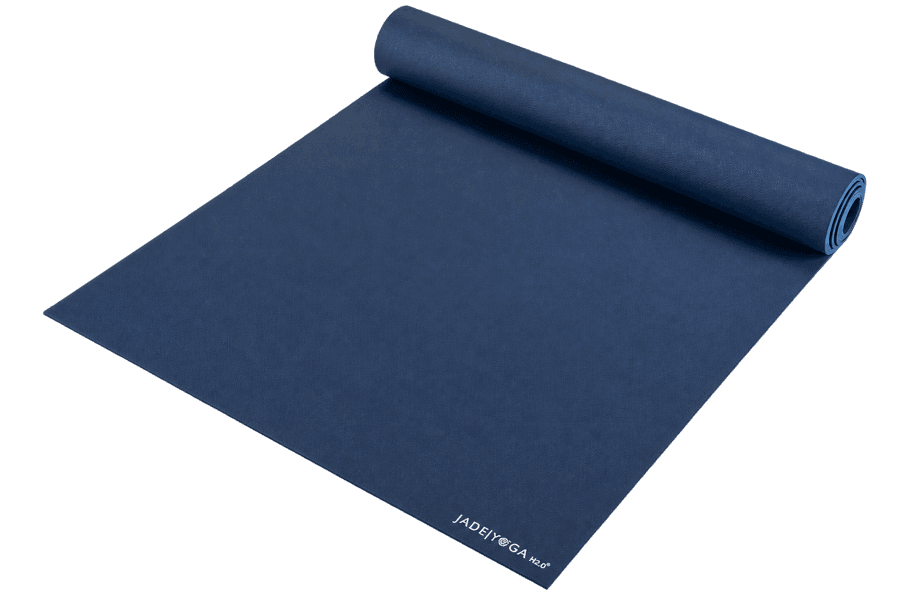
Price
The Harmony 2.0 lists for about $34 less.
$144
List price · check price at Amazon
$109.95
List price · check price at jadeyoga.com
Thickness
The PRO is 25% thicker.
6 mm0.24″
4.8 mm0.19″
Weight
The Harmony 2.0 is 3.2 lbs lighter.
8 lbs3.6 kg
4.8 lbs2.18 kg
Size
The PRO is 3″ longer; the PRO is 2″ wider.
Same on both
- Firm, stable support rather than soft foam
- OEKO-TEX certification
- Longer size available
- Current GearLab award winner
- Need a towel in very wet practice
Full specs
Dimensions
Materials & build
Buying
The PRO wins on support and lifespan, the Harmony on immediate grip
These are two of the strongest mats in GearLab’s current lineup, but they get there differently. The Manduka PRO is 6mm of dense, closed-cell PVC with a lifetime guarantee. The Harmony 2.0 is a 4.8mm open-cell natural-rubber mat that Jade says is tougher and grippier than the original Harmony.
The PRO is the better permanent practice surface. It cushions hard floors, offers more room, and has decades of ownership history. The Harmony is easier to trust during the first down dog and much easier to carry. Choosing between them means deciding whether extra support and longevity outweigh day-one traction, lower weight, and a $34.05 saving.
Harmony grip is immediate and unusually assertive
Harmony 2.0 uses tacky open-cell rubber. GearLab’s testers praised its exceptional traction for inversions and named it their eco-friendly dry-grip pick. They also found the texture could feel abrasive and too grabby during smooth transitions. This is not a neutral surface. People who want their hands locked down will love it more than people who slide their feet between poses.
The PRO arrives with a smoother fabric-like finish that needs use before it reaches its best grip. Manduka has retired the old salt scrub advice, so patience is the current break-in method. GearLab still rates the broken-in PRO highly, but the Harmony is the safer choice when immediate dry traction is non-negotiable.
Open-cell rubber handles light sweat more naturally
The Harmony’s open cells take in moisture instead of leaving all of it between skin and mat. That helps damp hands keep contact, though the mat then needs time to dry. Heavy hot-yoga sweat can overwhelm any rubber surface, so a towel remains sensible in a very wet class.
The PRO absorbs nothing. That is excellent for hygiene and cleanup, but sweat stays on top. GearLab’s current testers found the PRO dependable across practices, yet pooled moisture still gives a closed surface less help than absorbent rubber. If heated classes dominate your schedule, the Harmony is better here, while a purpose-built absorbent mat such as the GRP Adapt 2.0 goes further.
The PRO gives joints the better floor barrier
Six millimeters of dense PVC gives the PRO more protection than the Harmony’s 4.8mm rubber body. GearLab awarded the PRO a perfect cushion score and recommends its supportive platform for sensitive joints and rehabilitation work. It feels firm rather than plush, so standing poses remain stable.
The Harmony is not flimsy. Natural rubber has a little resilience and its moderate depth works well for everyday flows. Repeated kneeling on tile or concrete exposes the difference. We would take the PRO for tender knees, long seated work, or a home floor with no give. Healthy joints and mostly standing practice make Harmony’s thinner cushion an easy trade for stronger early grip.
The PRO is roomier, while Harmony saves 3.2 pounds
The standard PRO measures 71″ × 26″ and weighs 8 pounds. Harmony 2.0 is 68″ × 24″ and about 4.8 pounds by Jade’s exact variant data. The PRO gives broad shoulders two extra inches and taller bodies three more inches before moving to a longer model.
Harmony’s 3.2-pound saving matters more on a commute. It is still a substantial rubber roll, but carrying it across town is reasonable. The PRO is better treated as home or studio equipment. Harmony also comes in a 74-inch Long, while the PRO Long stretches to 85 inches.
The PRO remains the safer decade-long purchase
Manduka’s dense PVC is unusually slow to wear, and the PRO carries a lifetime guarantee. Its terms describe roughly 10 years of regular use, one replacement, proof of purchase from an authorized seller, and exclusions for cosmetic damage. GearLab’s current reporting includes teachers using PRO mats well beyond a decade.
Jade calls the 2.0 rubber tougher and longer lasting, and GearLab considers this version durable enough for frequent indoor practice. It is still a new formula without the PRO’s long ownership record, and Jade keeps warranty coverage at one year. Sun, heat, and harsh cleaners remain natural rubber’s weak points. We expect improvement over the original, but not enough evidence to promise PRO-level longevity.
Harmony has stronger sourcing credentials and stricter care
Harmony 2.0 uses FSC-certified natural rubber, carries OEKO-TEX certification, and is made in Spain with renewable energy according to Jade. Jade also plants a tree for every mat sold. The PRO uses PVC made in Germany and carries OEKO-TEX Standard 100 certification. Its environmental case rests mostly on staying useful for a very long time.
Wipe either mat rather than soaking it. Harmony needs cool storage, shade, gentle cleaner, and full drying before rolling. It has a rubber scent and contains latex, so it is not safe for a latex allergy. The latex-free PRO resists absorbed sweat and asks for much less care. It is the practical choice for a hot car or forgetful ownership, though prolonged heat is poor storage for any mat.
Harmony saves about $34, but the warranties are far apart
The PRO lists for $144; the 68-inch Harmony 2.0 lists for $109.95. Check the current Manduka PRO price at Amazon and the Harmony 2.0 price at JadeYoga. We did not verify an authorized Amazon listing for the 2.0.
Harmony gives you certified rubber, exceptional immediate grip, and easier carrying for less money. The PRO’s premium buys more space, more support, and much stronger long-term coverage. Harmony is the better value when grip is the main need. The PRO is easier to defend when one mat must survive daily practice for many years.
Bottom line
Get the Harmony 2.0 for immediate, forceful grip, natural rubber, easier transport, and the lower price. It is our pick for a dry or lightly sweaty flow when the 68-inch length fits. Accept the rubber smell, careful storage, latex, and one-year warranty.
Get the Manduka PRO for sensitive joints, more practice space, low maintenance, or a mat that should last through years of heavy use. It is expensive, eight pounds, and slow to break in. Once it stays in one room and reaches its best grip, those compromises are much less important.
Manduka PRO
List price $144
Jade Harmony 2.0
List price $109.95
Frequently Asked Questions
- Which has better grip, the Manduka PRO or Harmony 2.0?
- Harmony 2.0 has the easier immediate grip. Its tacky open-cell rubber works without a break-in period, and GearLab named it an eco-friendly dry-grip pick. The PRO improves with regular use and scored highly overall, but a new one can feel slick for several weeks.
- Which mat is better for sensitive knees?
- The Manduka PRO. Its 6mm high-density PVC provides a stronger barrier over hard floors than Harmony's 4.8mm rubber body. GearLab gave the PRO its top cushioning score and recommends the dense support for sensitive joints.
- Is Harmony 2.0 good for hot yoga?
- It handles light sweat better than a sealed PVC surface because its open cells absorb some moisture. Heavy sweat can still overwhelm it, and the mat needs full drying afterward. Frequent hot-yoga students may prefer a purpose-built absorbent mat and should still keep a towel nearby.
- How much lighter is Harmony 2.0 than the PRO?
- About 3.2 pounds. Jade's exact standard-variant data is 2,177 grams, roughly 4.8 pounds, while current standard PRO variants weigh 8 pounds. Harmony is much easier on a shoulder strap, though neither is an ultralight travel mat.
- Does Harmony 2.0 contain latex?
- Yes. Jade explicitly warns that its dry natural rubber may contain latex and should be avoided by people with rubber or latex allergies. The Manduka PRO is latex-free PVC and is the safe choice between these two for a latex allergy.
- Which mat lasts longer?
- The PRO has the stronger evidence and coverage. PRO mats have remained in service for a decade or longer, and Manduka provides a lifetime guarantee with defined terms. Jade says Harmony 2.0 is tougher than the original, but the new formula has less ownership history and a one-year warranty.
Related comparisons
- Manduka PRO Lite Terra 4.7mm vs JadeYoga Harmony 2.0 68"
- Manduka PROlite vs JadeYoga Harmony 2.0 68"
- Lululemon The Mat 5mm vs JadeYoga Harmony 2.0 68"
- Manduka PRO vs Alo Warrior
- Suga SugaMat vs JadeYoga Harmony 2.0 68"
- Manduka PROlite Long vs JadeYoga Harmony 2.0 68"
- Manduka GRP Adapt Lite 2.1 4mm vs JadeYoga Harmony 2.0 68"
- Manduka PRO vs b, halfmoon B Mat Strong 6mm
- Manduka eKO Lite Long vs JadeYoga Harmony 2.0 68"