Manduka PRO vs B Mat Everyday: Which One Should You Buy?
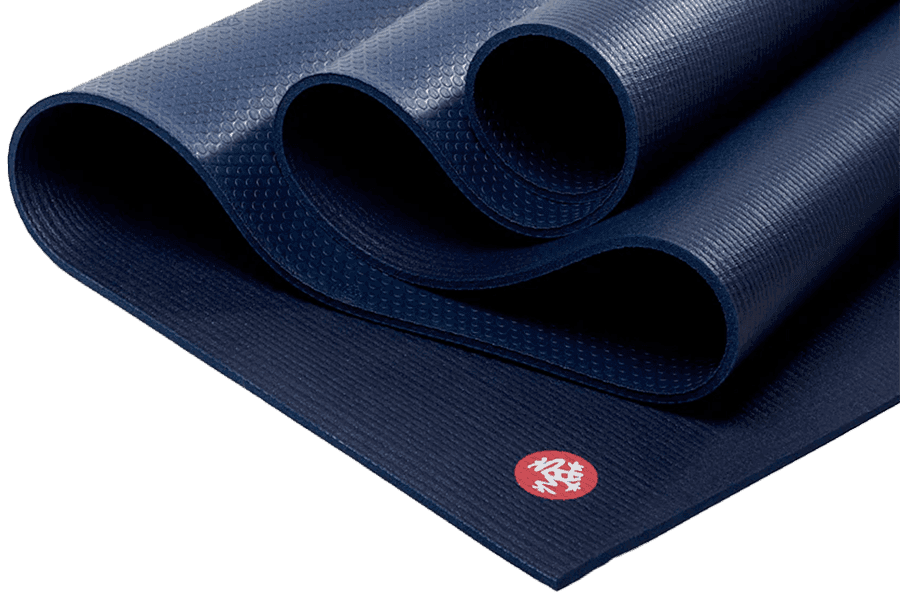
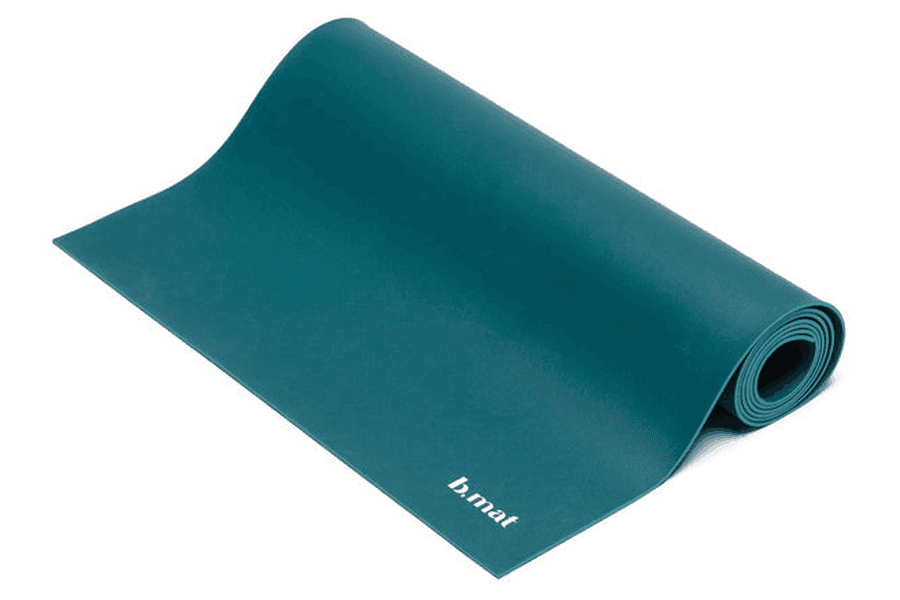
These two cover the exact same 71 by 26 inch footprint and could not feel more different on it. The Manduka PRO is dense PVC that expects to outlive your car, and it makes you wait weeks or months for its grip to arrive. The B Mat Everyday is tacky rubber that holds your hands in the first class and will need replacing while the PRO is still getting started.
As an Amazon Associate, we earn from qualifying purchases made through links on this page. How this works
The quick answer
The PRO is 6 mm of dense PVC at 7.5 pounds, with a lifetime guarantee and a famous flaw: new mats are slick, and the grip builds slowly with use. The B Mat Everyday is 4 mm of rubber at 4.1 pounds that grips hard from the first down dog, and it carries a one-year warranty because the tacky surface wears where your hands and feet land.
If you practice regularly and want to buy one mat this decade, get the PRO and wait out the break-in. If grip this month matters more than a mat in 2036, or you carry your mat to class, get the B Mat Everyday.
Get the Manduka PRO if...
- You want a mat that is still flat and solid after ten years of daily practice
- You'd rather sit through a break-in than replace a mat every few years
- You have a latex allergy; the PRO is PVC with no rubber in it
- You want 6 mm of dense cushion that doesn't bottom out under your knees
Get the B Mat Everyday if...
- You want real grip in your first class, not in three months
- You carry your mat; 4.1 pounds against 7.5 is a different walk to the studio
- You'd rather keep $26 and accept a shorter lifespan
- You want a PVC-free rubber mat made in Spain
Side by side
Price
The B Mat Everyday lists for $26 less.
$144
List price · check price at Amazon
$118
List price · check price at bhalfmoon.com
Thickness
The PRO is 50% thicker.
6 mm0.24″
4 mm0.2″
Weight
The B Mat Everyday is 3.9 lbs lighter.
8 lbs3.6 kg
4.1 lbs1.86 kg
Size
Same length; same width.
Same on both
- Identical 71″ × 26″ footprint
- OEKO-TEX Standard 100 certified
- Sweat sits on the surface instead of soaking in
- Too heavy and bulky to double as travel mats
Full specs
Dimensions
Materials & build
Buying
One mat asks for patience, the other grips immediately
The Manduka PRO and the B Mat Everyday occupy the same premium shelf and the same 71″ × 26″ footprint, and they resolve into opposite mats the moment you put a hand on each. The PRO is dense PVC that arrives slick and earns its grip over weeks or months, then repays you with a decade of service. The B Mat is rubber that holds your palms in the first class and will be showing wear while the PRO is still young.
So the comparison is really a question about time. Buy for the next five years and the two mats rank one way; buy for the next five weeks and they rank the other.
Grip: the B Mat wins the first three months
A new B Mat Everyday grips the way people hope every mat will. GearLab, which tested the 4 mm B Mat, rated it 9 out of 10 for traction and called it one of the grippiest mats it had used, wet or dry. The tack is strong enough that testers stopped sliding between poses and stepped instead, which is worth knowing if your practice leans on flowing transitions.
A new PRO is, famously, slippery. Manduka used to suggest a salt scrub to hurry the surface along; its current position is simply that the slickness resolves with use, and owners describe anywhere from a few weeks to a few months of regular practice before the top layer feels trustworthy. A broken-in PRO grips well with dry hands, which is one reason GearLab named it Best for a Daily Practice in its March 2026 roundup. The B Mat skips that waiting period entirely, and for a lot of people that settles it.
Sweat: both stay dry inside, only one stays grippy
Neither mat absorbs sweat. The PRO is closed-cell PVC and the B Mat is dense rubber, so on both, moisture stays on the surface where you can wipe it. That is where the similarity ends. The B Mat keeps gripping through a wet patch; GearLab found the rubber held even with a puddle under a palm. The PRO gets slick under wet hands, which is why hot yoga people who love their PROs still drape a towel over them.
If sweat is a defining feature of your practice, the B Mat is the better of these two, and a polyurethane-topped mat like the Manduka GRP Adapt is better still.
Cushion: 6 mm of firm against 4 mm of springy
The PRO is 6 mm of high-density PVC. It reads as thick on paper but feels firm in practice, closer to a good floor than a pad, and that stability is what makes standing balances feel planted. Knees and hips get real protection because the material refuses to compress to nothing under pointy loads.
The B Mat Everyday is 4 mm of rubber with more spring to it. It cushions less in absolute terms, and people with tender knees notice the difference in kneeling poses, though the rubber’s give makes it comfortable for its thickness. If you want the B Mat surface with more under it, the 6 mm B Mat Strong exists for exactly this, at $144.
Weight: 7.5 pounds against 4.1
The PRO weighs 8 pounds, and no one who owns one calls that number exaggerated. It is a mat you leave somewhere: home, the car, a studio cubby. Rolled up it has the heft of a small log, and a daily walk or bike commute with it gets old fast.
The B Mat Everyday weighs 4.1 pounds, which is normal-mat territory and fine on a shoulder every day. If your mat travels with you more days than not, this section is probably your answer.
Durability: a decade against a couple of years
This is the PRO’s whole argument. Dense PVC does not tear, does not flake, and does not care about sweat or sunlight the way rubber does; PROs commonly serve a decade of daily practice, and Manduka backs the mat with a lifetime guarantee. Read the fine print, though: coverage works out to roughly ten years of regular use, one replacement, and proof of purchase from an authorized seller, with Amazon orders qualifying only when sold and shipped by Amazon itself.
b, halfmoon covers the B Mat for one year and says its mats are designed for two or more years of practice when stored properly, excluding the normal wear marks where hands and feet land. GearLab noted owner reports of the surface peeling in high-contact spots. Natural rubber also hates sunlight, so the B Mat needs to live indoors. These are honest numbers, and they are not the PRO’s numbers.
Materials: PVC against rubber, and the allergy question
The PRO is PVC, made in Germany, certified to OEKO-TEX Standard 100. PVC is the least fashionable material in yoga and also the most durable one; it contains no latex, which makes the PRO one of the few premium mats that is safe for a latex allergy.
The B Mat is mostly natural rubber with some synthetic, made in Spain, also OEKO-TEX certified, PVC-free, from a certified B Corp. It is the more biodegradable and, to many buyers, the more defensible material. It is also exactly what you cannot use with a latex allergy. Both mats arrive with a smell: the B Mat’s is a strong rubber odor that GearLab said cleared after two days of airing out, the PRO’s is a milder plastic note that fades on a similar schedule.
Sizes and colors
Both standard mats are 71″ × 26″. The PRO line goes much further: a PRO Long at 85″, a Long & Wide at 79″ × 52″, and the square 78″ × 78″ PRO Squared. b, halfmoon answers with one option, an 85″ Everyday Long.
Color is closer to even: the PRO comes in black plus 13 more colorways at last count, the B Mat Everyday in seven muted ones.
Price and where to buy
The PRO lists at $144; check the current price at Amazon, and remember the guarantee only travels with Amazon orders sold and shipped by Amazon. The B Mat Everyday lists at $118 and is best bought direct from b, halfmoon; its old Amazon listings have gone dead and third-party sellers are not worth the warranty risk.
On lifespan, the PRO is the cheaper mat: one $144 purchase that runs a decade beats a $118 mat replaced every two or three years. That only matters if you practice enough years for it to play out.
Bottom line
Get the Manduka PRO if you practice regularly, mostly in one place, and want this purchase off your list for ten years. It is the more stable, more durable, more allergy-friendly mat, and the break-in is a one-time tax. See how it stacks against the B Mat’s thicker sibling in our PRO vs B Mat Strong comparison.
Get the B Mat Everyday if you want a mat that is excellent on day one: real grip immediately, sweat handled, 3.4 fewer pounds on your shoulder, $26 kept. Just go in knowing it is a mat you will likely replace in a few years, not a decade purchase.
Manduka PRO
List price $144
B Mat Everyday 4mm
List price $118
Frequently Asked Questions
- Is the Manduka PRO really slippery when new?
- Yes, and Manduka no longer pretends otherwise. The company used to recommend a salt scrub to speed up break-in; its current position is that the slickness resolves with regular use. Owners consistently describe weeks to months before the surface feels reliable. It is the main reason to hesitate on the PRO, and GearLab still named it Best for a Daily Practice in its March 2026 roundup because of what the mat becomes after that period.
- Which mat is better for hot yoga?
- The B Mat Everyday, clearly. Its rubber keeps holding with sweat pooled on the surface, and GearLab, which tested the 4 mm B Mat, called it one of the grippiest mats it had used in wet or dry conditions. The PRO's closed-cell surface gets slick under sweat and most hot yoga practitioners lay a towel over it. If hot classes are your main practice, neither is really the specialist; a polyurethane-topped mat like the Manduka GRP Adapt is built for that job.
- How long does the B Mat Everyday last?
- b, halfmoon says its mats are designed to support two or more years of practice when stored properly, and covers them for one year, excluding normal wear like the marks where hands and feet land. GearLab noted owner reports of the surface peeling in high-contact spots. Rubber also degrades in sunlight, so it needs to live indoors. Two to four years of regular practice is a fair expectation; the PRO is on a different clock entirely.
- What does Manduka's lifetime guarantee actually cover?
- Less than the word lifetime suggests. The fine print works out to roughly ten years of regular use, one replacement, and proof of purchase from an authorized seller; an Amazon order qualifies only when it is sold and shipped by Amazon itself. That is still far more coverage than the B Mat's one year, and PROs genuinely do last a decade or more, but read it as a long warranty rather than a forever promise.
- Can I use either mat with a latex allergy?
- The PRO, yes: it is PVC with no natural rubber in it, which makes it one of the safer premium mats for a latex allergy. The B Mat Everyday, no: b, halfmoon builds it from mostly natural rubber, and natural rubber mats are not safe with a latex allergy even when the surface feels like a coating.
- Why is the PRO so much heavier when both mats are the same size?
- Density and thickness. The PRO packs 6 mm of very dense PVC into the same 71 by 26 inches that the B Mat covers with 4 mm of rubber, and that is the whole 3.4 pound difference. The density is also what makes the PRO feel stable under standing poses and last as long as it does. It is a fine trade if the mat lives at home or in a studio cubby, and a bad one if it rides on your shoulder every day.
Related comparisons
- Yoga Design Lab Combo 3.5mm vs b, halfmoon B Mat Everyday 4mm
- b, halfmoon B Mat Everyday 4mm vs Manduka GRP Adapt Lite 2.1 4mm
- Manduka PRO vs Alo Warrior
- Manduka PROlite vs b, halfmoon B Mat Everyday 4mm
- Lululemon The Mat 5mm vs b, halfmoon B Mat Everyday 4mm
- Manduka PROlite Long vs b, halfmoon B Mat Everyday 4mm
- Manduka PRO vs b, halfmoon B Mat Strong 6mm
- b, halfmoon B Mat Everyday 4mm vs Manduka PRO Lite Terra 4.7mm
- b, halfmoon B Mat Everyday 4mm vs JadeYoga Harmony 2.0 68"