Manduka PRO Long & Wide vs PROlite Long & Wide: Which One Should You Buy?
Manduka sells two mats called Long & Wide, and they are nowhere near the same product. Both run 79 inches, both are the same closed-cell German PVC with the same lifetime guarantee, and both come in the same two colors. Then one is 52 inches wide and weighs 22 pounds, and the other is 30 inches wide and weighs 7. The price is exactly double. Width is the whole decision.
As an Amazon Associate, we earn from qualifying purchases made through links on this page. How this works
The quick answer
The PRO Long & Wide is a 52 inch wide, 22 pound practice surface at $288 that realistically never moves once you unroll it. The PROlite Long & Wide gives you 30 inches of width, 6 more than a standard mat, at 7 pounds and $144, and it still rolls up and goes to class. The PVC, the fabric-like top, the break-in, the German manufacturing, and the lifetime guarantee are identical; the PRO adds 6 mm of cushion against the PROlite's 4.7.
For most people the PROlite Long & Wide is the better buy. It fixes the cramped feeling of a standard mat without turning your mat into a fixture, and it costs half as much. Get the PRO Long & Wide only if you have a dedicated practice space and want room to sprawl in it, because 52 inches genuinely changes how a practice feels.
Get the PRO Long & Wide if...
- You have a dedicated home practice space with floor to spare
- You want room to roll side to side, not just extra elbow room
- You practice on tile or concrete and want the full 6 mm
- The mat never leaves the room, so 22 pounds costs you nothing
Get the PROlite Long & Wide if...
- You want more width but your mat still has to travel
- You'd rather keep $144
- 7 pounds fits in a mat bag; 22 pounds does not
- You're tall and 79 inches is the length you came for
Side by side
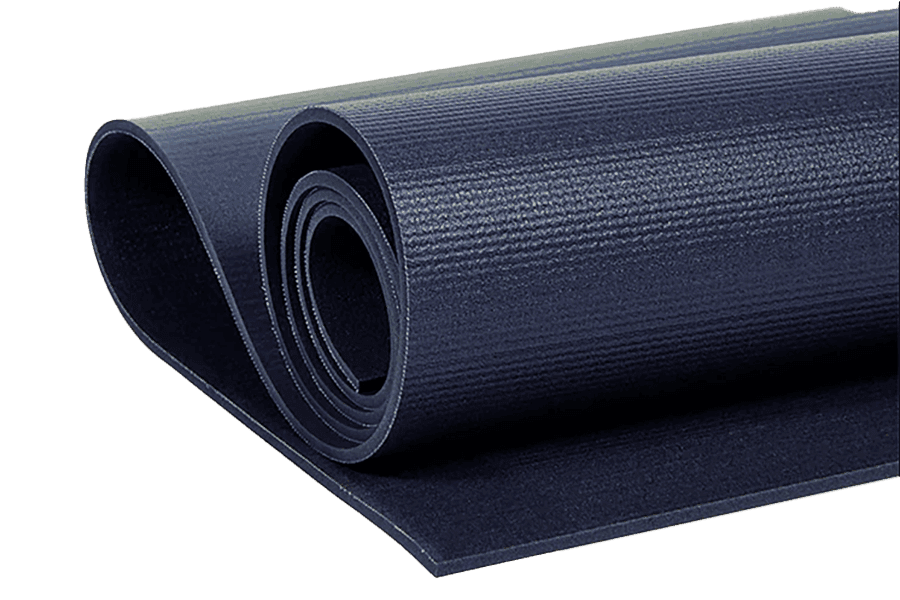
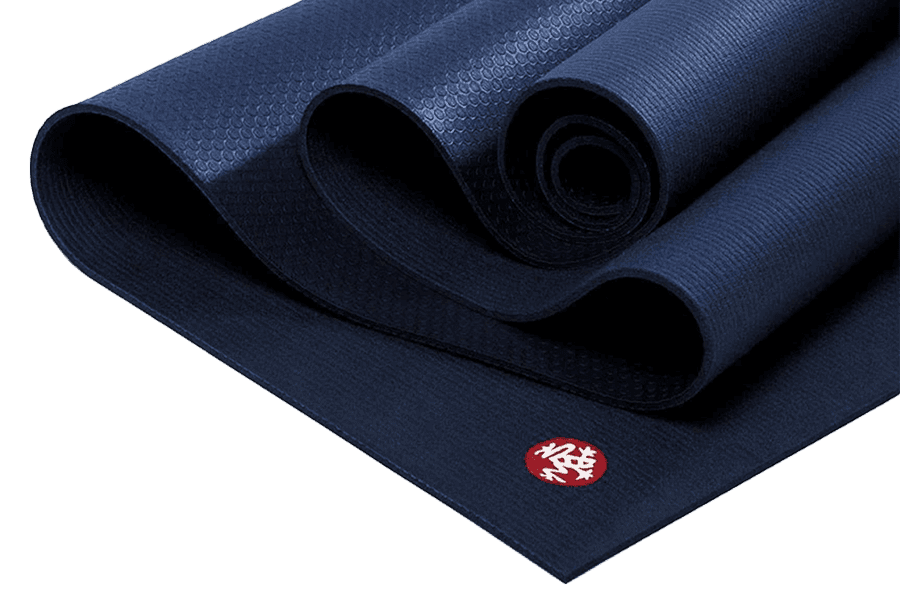
Price
The Long & Wide lists for $144 less.
$288
List price · check price at Amazon
$144
List price · check price at Amazon
Thickness
The Long & Wide is 28% thicker.
6 mm0.24″
4.7 mm0.19″
Weight
The Long & Wide is 15 lbs lighter.
22 lbs10 kg
7 lbs3.2 kg
Size
Same length; the Long & Wide is 22″ wider.
Same on both
- 79 inches long
- Closed-cell PVC, made in Germany
- Fabric-like top surface
- Lifetime guarantee
- OEKO-TEX certified
- Needs a break-in period
- Black or Midnight only
Full specs
Dimensions
Materials & build
Two mats, one name
Manduka puts “Long & Wide” on the end of two different mats, and the name hides how far apart they are. Both run 79 inches. Both are the same closed-cell PVC made in Germany, with the same fabric-like top, the same slick break-in, the same OEKO-TEX certification, and the same lifetime guarantee. Both come in Black or Midnight and nothing else. On paper they look like the same mat in two trims.
Then you get to the numbers that matter. The PRO Long & Wide is 52 inches across and weighs 22 pounds, at $288. The PROlite Long & Wide is 30 inches across and weighs 7 pounds, at $144. That is 22 inches of width and 15 pounds of mat, for exactly double the money. Length is a wash, material is a wash, and the guarantee is a wash. What you are choosing here is a width, and whether the mat is still allowed to leave the house.
What 30 inches fixes, and what 52 inches fixes
A standard yoga mat is 24 inches wide, which is what nearly every studio class in the world is practiced on. If it has ever bothered you, it bothered you in a specific way: a hand landing half off in a wide-legged forward fold, a knee on bare floor in a low lunge, a foot hunting for the edge in warrior two. The PROlite Long & Wide adds 6 inches, and those 6 inches are aimed squarely at that complaint. Most people who felt cramped stop feeling cramped.
The PRO Long & Wide is doing something else. At 52 inches it is slightly more than two standard mats laid side by side with no gap, and it stops being about margin. You can roll from one hip to the other in floor work, sprawl through a long supine twist, take a wide-armed balance without aiming, and move through a whole session without once checking where the edge is. Owners of oversized mats tend to describe it the same way: they had been quietly managing the size of a mat for years without noticing.
That is a real upgrade, and it is also more than a lot of people need. If your practice is mostly vinyasa and standing sequences on a strip, 30 inches will feel generous and 52 will feel like an indulgence you paid $144 extra for.
The 7 pound mat travels. The 22 pound mat does not.
This is the line that decides most of these purchases, so it is worth being blunt about. At 7 pounds the PROlite Long & Wide is heavier than a typical mat but still a mat: you can roll it, sling it, put it in a car, take it to a studio, stand it in a closet. It is a bit of a handful and it will not fit a slim mat bag, but nothing about carrying it requires planning.
At 22 pounds the PRO Long & Wide is a different object. Rolled, it is closer in size and heft to a rolled area rug than to gym gear, and no standard bag or strap will take it. In practice you unroll it once in the spot you have chosen and it stays there, which suits closed-cell PVC perfectly since it lies flat without curling and does not care about being left out. It also means giving up a clear rectangle of about 6 feet 7 inches by 4 feet 4 inches of your home, permanently.
So ask the boring question before the fun one. If the mat has to be anywhere other than where you last put it, even occasionally, the PROlite Long & Wide is the answer and the width discussion is over.
Underfoot: 6 mm against 4.7 mm of the same PVC
Both mats feel like Mandukas. Firm, dense, planted, never squishy. The PRO Long & Wide carries the full 6 mm of the PRO recipe; the PROlite Long & Wide carries 4.7 mm of the same material. On sprung wood or carpet, the gap is small enough that most people would need to switch back and forth to name it. Kneeling on tile or concrete through a long hold, the extra 1.3 mm is genuinely noticeable, and since the PRO is the one that lives on a home floor anyway, it tends to be the one meeting the hard surface.
Neither is a cushioning mat in the way a thick rubber slab is. Manduka builds density, not plush, and OutdoorGearLab scored that construction perfectly for comfort and support precisely because it holds joints up rather than letting them sink. If what you actually want is deep padding for sensitive knees, look at the 8 mm Jade Fusion instead; neither Manduka on this page is built for that.
Grip and sweat: identical, including the annoying part
Same surface, same story. Both ship slick, and both need a few weeks of regular practice before the top comes good. That break-in is the most common complaint about the whole PRO family, and it is real; Manduka has retired its old salt-scrub advice and now says plainly that the slickness resolves with use, which matches what owners report. Once broken in, dry traction is excellent and stays that way for years.
Both are also closed-cell, which means sweat sits on top rather than soaking in. That keeps the mat hygienic and easy to wipe down, and it means heated practice needs a towel on either one, forever. Nothing in this section separates them, so if grip is your main concern, neither of these mats is the reason to spend the extra $144.
Durability and the guarantee: dead even
Same material, same expectations. GearLab’s testers keep turning up instructors’ PRO-family mats that are five to twenty years old and still in service, and both of these carry Manduka’s lifetime guarantee with identical fine print: roughly ten years of regular use counts as a lifetime, performance-affecting wear is covered while cosmetic wear is not, one replacement per purchase, and you need proof of purchase from an authorized seller. Amazon qualifies when the mat is sold and shipped by Amazon itself, which is worth checking on the listing before you buy.
Care on both is a wipe-down. No sunlight rules, no vinegar rituals, no drying schedule. Whatever else separates these two mats, longevity does not.
Colors: the same two, on both
Black or Midnight at last count, on each mat. Manduka gives its oversized cuts the studio-neutral treatment and does not appear interested in changing that. If color is something you actually care about and a standard length would fit you, the regular PROlite runs around 13 colorways and the PRO around 14. Going big means going dark, on both of these.
Price: exactly double, and roughly fair
List prices are $288 for the PRO Long & Wide and $144 for the PROlite Long & Wide. Check current prices on the PRO Long & Wide and the PROlite Long & Wide before deciding; Manduka discounts by colorway and the street price moves around.
The doubling is not a gouge. The PRO Long & Wide is about 1.7 times the surface area of the PROlite version and thicker on top of that, so you are genuinely buying a lot more material. The question is whether you will use it. We think the PROlite Long & Wide is the better value for most buyers, because the width people are usually missing is the first 6 inches, not the next 22, and $144 for a 79 inch mat with a lifetime guarantee is a strong price in its own right.
Bottom line
Get the PROlite Long & Wide unless you have a specific reason not to. It is tall enough for nearly anyone, wider than a standard mat by a useful margin, still light enough to carry, half the price, and covered by the same guarantee as its bigger sibling. For most people shopping this corner of Manduka’s lineup, it is the mat that ends the search.
Get the PRO Long & Wide if you have a dedicated practice space, the floor to give it, and the width is the thing you came for. It is not a marginal upgrade; 52 inches changes what you can do without thinking about the edge of the mat, and since it never commutes, its 22 pounds costs you nothing. If you also want the same footprint in a longer, squarer shape, the PRO Squared at 78″ × 78″ is the next step up, and we compare it against this mat in our PRO Long & Wide vs PRO Squared review.
Frequently Asked Questions
- What's the actual difference between the PRO Long & Wide and the PROlite Long & Wide?
- Width, weight, thickness, and price. The PRO is 52" wide, 22 pounds, 6 mm thick, and $288. The PROlite is 30" wide, 7 pounds, 4.7 mm thick, and $144. Both are 79 inches long, both are closed-cell PVC made in Germany, both carry the lifetime guarantee, and both come in Black or Midnight. The length and the material are a wash, so you are really choosing a width.
- Is 30 inches wide enough, or do I need 52?
- For most practitioners 30 inches is the fix. A standard mat is 24" wide, and the 6 extra inches on the PROlite Long & Wide are enough to keep hands and feet on the mat in wide-legged poses, which is the complaint that sends people shopping in the first place. At 52 inches the PRO is slightly more than two standard mats side by side, and that buys a different thing: room to roll around in floor work, sprawl in hip openers, and never aim your body at a strip. Worth it if you have the space, unnecessary if you just felt a little cramped.
- Can you carry the PRO Long & Wide?
- Not in any pleasant way. It weighs 22 pounds and rolls into a log about the size of a rolled area rug, which no standard mat bag or strap will take. Plan on unrolling it once in a committed spot and leaving it flat, which closed-cell PVC is perfectly happy to do. The PROlite Long & Wide, at 7 pounds, is a normal mat you can sling over a shoulder.
- Is the thickness difference noticeable?
- On a hard floor, yes. The PRO carries 6 mm of dense PVC; the PROlite carries 4.7 mm of the same material. On sprung wood or carpet they feel very close. Kneeling on tile or concrete, the extra 1.3 mm is real. Neither is remotely squishy; firmness is the PRO family's whole character, and if you want plush cushioning, neither of these is the right mat.
- Which is better value?
- The PROlite Long & Wide, for most people. It costs $144 against $288, and the width most practitioners are actually missing is the first 6 inches, not the next 22. The PRO Long & Wide is fairly priced for what it is, since you are buying roughly 1.7 times the material, but it only pays off if you use the width and have somewhere permanent to put it.
- Do they come in the same colors?
- Yes: Black or Midnight at last count for both. Manduka gives its oversized mats the studio-neutral treatment, so neither one gives you much of a vote. If color matters and a standard length works for you, the regular PROlite runs around 13 colorways.
Related comparisons
- Manduka PROlite Long & Wide vs JadeYoga Harmony XW
- Manduka PROlite Long & Wide vs Alo Warrior
- Manduka PROlite Long & Wide vs Lululemon The (Big) Mat 5mm
- Manduka PROlite Long & Wide vs Hugger Mugger Para Rubber 5mm
- Manduka PROlite Long & Wide vs Yoga Design Lab Infinity 5mm
- Manduka PROlite Long & Wide vs b, halfmoon B Mat Strong 6mm
- Manduka PROlite Long & Wide vs Yoloha Unity Pro Cork
- Manduka PROlite Long & Wide vs Liforme Classic
- Manduka PROlite Long & Wide vs Lululemon The Mat 5mm