Manduka eKO vs Jade Voyager: Which One Should You Buy?
One of these is a daily studio mat and the other folds to about the size of a yoga block. They are not really rivals, and the honest version of this page says so early. The question worth answering is whether the Voyager can be your only mat.
As an Amazon Associate, we earn from qualifying purchases made through links on this page. How this works
The quick answer
The eKO is 5 mm of closed-cell natural rubber, and OutdoorGearLab scored it 87 of 100 in its 2026 roundup, second of nineteen mats, with a perfect 10 for dry grip. The Voyager is 1.6 mm and 1.5 pounds, scored 2 of 10 for comfort, and grips almost as well while being uncomfortable to practice on alone.
If you're choosing one mat, buy the eKO. Buy the Voyager as a travel mat or a topper alongside something else.
Get the Manduka eKO if...
- This is your main mat and it mostly stays in one place
- You want a perfect 10 for dry grip in GearLab's testing
- You want a full 71" × 26" surface with real cushioning
- You want a mat that will last years of regular practice
Get the Jade Voyager if...
- You already own a main mat and need something for travel
- You want a mat that folds flat into a carry-on at 1.5 pounds
- You'd rather use your own surface than a studio rental
- You'd rather keep about $64
Side by side
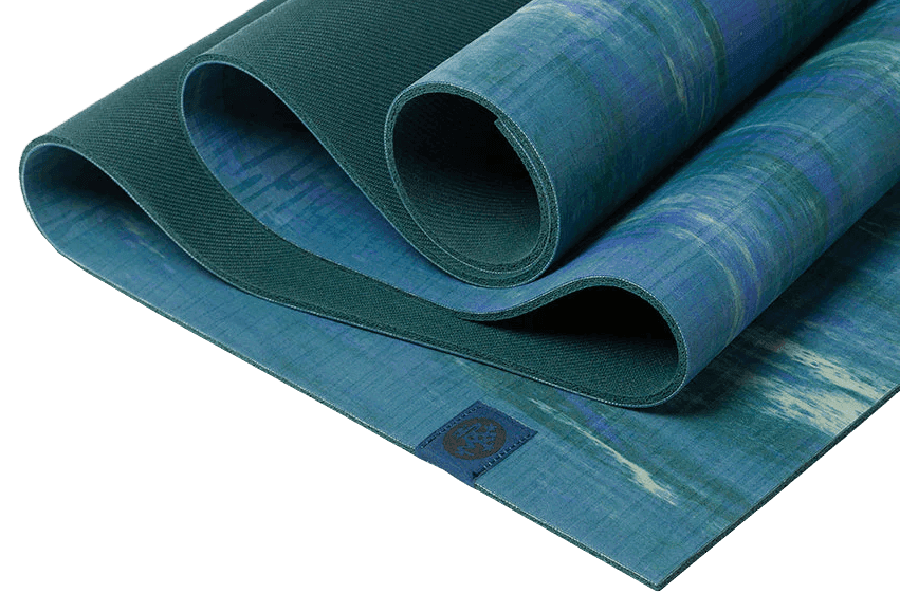
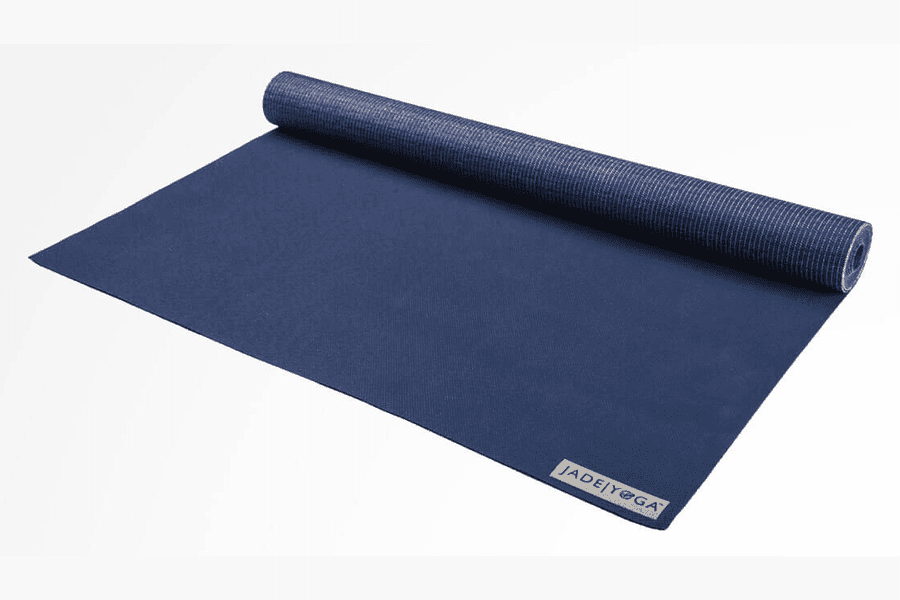
Price
The Voyager lists for about $64 less.
$114
List price · check price at Amazon
$49.95
List price · check price at jadeyoga.com
Thickness
The eKO is 213% thicker.
5 mm0.2″
1.6 mm0.06″
Weight
The Voyager is 5.5 lbs lighter.
7 lbs3.2 kg
1.5 lbs0.68 kg
Size
The eKO is 3″ longer; the eKO is 2″ wider.
Same on both
- Both are natural rubber
- Both grip well from the first class, with no break-in
- Both degrade in sunlight and should be stored indoors
- Neither is safe for a latex allergy
Full specs
Dimensions
Materials & build
Buying
A studio mat and a mat that fits in a backpack
The Manduka eKO is $114 for 5 mm of closed-cell natural rubber, and OutdoorGearLab scored it 87 of 100 in its 2026 roundup, second of nineteen mats behind only the Manduka PRO. The Jade Voyager is $49.95 for 1.6 mm of open-cell rubber that folds to about the size of a yoga block.
These are not really rivals, and the honest version of this page says so early. The question worth answering is whether the Voyager can be your only mat, and for most people the answer is no.
Cushioning: 5 mm against 1.6
GearLab scored the eKO 9 of 10 for comfort and support, praising the spring in its rubber and calling it good on both hard and soft ground. Five millimeters of dense rubber is a normal, comfortable amount of mat for a daily practice.
The Voyager scored 2 of 10, the joint lowest in the lineup, and GearLab described mats at this thickness as better used as a topper over whatever the studio provides than as a mat in their own right. Their listed cons open with “too thin to provide comfort.” On a hard floor, kneeling on a Voyager is kneeling on the floor.
Grip: both are excellent, which is the surprise
The eKO scored 9 of 10 for grip overall, and in GearLab’s separate wet and dry testing it hit a perfect 10 dry, a score only the Prana Verde matched, with 7 wet. No break-in period, no salt scrub, grippy from the first class. GearLab did list “more slippery when wet” among its downsides, which is the closed-cell trade-off: sweat sits on the surface rather than soaking in.
The Voyager scored 8 for grip, 9 dry and 7 wet, and its pros list leads with excellent dry and wet hand grip. Jade’s open-cell rubber absorbs moisture as you go, so it matches the eKO’s wet score exactly, which is remarkable for a mat this thin and this cheap.
How each one behaves on the floor
The eKO weighs 7 pounds and stays exactly where you put it. GearLab called it a stable foundation and noted the textured rails along the edges add grip where your hands land in a wide stance.
The Voyager is 1.5 pounds, and GearLab flagged that it shifts and wrinkles during practice. On carpet it behaves. On a polished floor it slides, and the creases from folding do not lie flat immediately. That is the cost of packing it.
Size
The eKO is 71″ × 26″, three inches longer and two wider than the Voyager’s 68″ × 24″. Two inches of width is more noticeable than it sounds in any wide-legged pose.
Manduka also sells a 79″ eKO Long for taller practitioners. Jade sells the Voyager in one size only, and to its credit that size is a full 68 by 24 rather than the shrunken footprint some travel mats use.
Portability: the whole point of the Voyager
The Voyager folds flat and weighs less than two pounds. GearLab weighed theirs at 1.8, the lightest mat in the roundup. It goes into a carry-on or a daypack without a strap, a sling, or a decision.
The eKO is a seven pound roll, and GearLab listed “heavier” as its first con. It carries fine to a studio a few blocks away and it is not something you take on a plane.
Durability and care
Both are natural rubber, so both break down in sunlight and both should be stored indoors and rolled. The eKO’s closed-cell surface wipes clean in seconds, and GearLab scored it 8 of 10 for care while noting it creases if stored badly.
The Voyager scored 8 for care as well, mostly because there is so little of it to dry, but GearLab listed “not very durable” and “creases easily” among its cons. Folding a rubber mat over and over eventually leaves permanent lines. Jade covers it for one year, excluding sun damage and harsh cleaners; Manduka gives the eKO a 30 day return window and nothing further, since the lifetime guarantee applies to the PRO line only.
Materials
The eKO is natural tree rubber, non-Amazon harvested, made in Taiwan. GearLab scored its materials 8 of 10, behind only the PVC PRO. Manduka does not put a certification on it.
The Voyager is sustainably farmed natural rubber made in the USA, and Jade plants a tree for every mat sold. GearLab scored its materials 4 of 10, which reads harsh until you remember they weight longevity heavily and this mat is not built to last. Neither is safe for a latex allergy.
Price and where to buy
$114 against $49.95. Manduka discounts eKO colorways on its own site fairly often, so it is worth comparing that against the current Manduka eKO price at Amazon.
The Voyager sells through jadeyoga.com in five colorways rather than through Amazon, and it holds its list price.
Bottom line
Buy the eKO if you are choosing one mat. It is the second-highest scoring mat GearLab tested, its dry grip a perfect 10, and 5 mm of rubber that will hold up for years. Seven pounds is the price of that.
Buy the Voyager as a travel mat or a topper, not as your main surface. It grips like a Jade and weighs nothing, and it is genuinely uncomfortable on a hard floor. If you want a packable mat with some cushion left in it, the eKO Superlite against the Voyager compares the two obvious travel options directly.
Manduka eKO
List price $114
Jade Voyager
List price $49.95
Frequently Asked Questions
- How good is the Manduka eKO's grip?
- Excellent dry. GearLab scored it 9 of 10 for grip overall and a perfect 10 for dry traction in its separate wet and dry testing, a score only the Prana Verde matched, with 7 wet. There is no break-in period. The one caveat GearLab listed was more slippery when wet, which is the closed-cell trade-off: sweat sits on the surface rather than soaking in.
- Can the Jade Voyager work as an everyday mat?
- For most people, no. GearLab scored it 2 of 10 for comfort and support, the joint lowest of nineteen mats, and its cons list opens with too thin to provide comfort. Their reviewers described mats this thin as working better as a topper over a studio mat. It grips beautifully, at 9 dry and 7 wet, but there is nothing between you and the floor.
- Which handles sweat better?
- They are level, which is a surprise given the price. Jade's open-cell rubber absorbs moisture as you practice and GearLab rated it 7 wet, the same as the eKO. The difference is what happens next: the eKO wipes clean in seconds, while the Voyager needs to dry out. Neither is a substitute for a towel in a genuinely hot room.
- How much does each one weigh?
- Manduka lists the eKO at 7 pounds and GearLab weighed theirs at 6.3, listing heavier as its first con. The Voyager is 1.5 pounds by Jade's figure and 1.8 by GearLab's measurement, the lightest mat in the roundup. The eKO carries fine to a nearby studio; the Voyager goes in a daypack without a thought.
- How are they covered?
- Jade covers the Voyager for one year, excluding sun damage and harsh cleaners. Manduka gives the eKO a 30 day return window and nothing further, since its lifetime guarantee applies to the PRO line rather than everything the brand sells. In practice, the eKO outlasts the Voyager by years.
- Is there a better travel option?
- The Manduka eKO Superlite is the direct rival at a similar weight and thickness, and the Jade Travel at 3.2 mm is the option if you want a packable mat with some cushion left in it. If you plan to practice daily on whatever you pack, the Travel is the more sensible buy than either paper-thin mat.
Related comparisons
- Manduka eKO Superlite vs JadeYoga Voyager
- Manduka eKO vs Lululemon The (Big) Mat 5mm
- Lululemon The Mat 5mm vs Manduka eKO
- Manduka eKO Superlite Long vs JadeYoga Voyager
- JadeYoga Harmony 74" vs Manduka eKO
- Manduka eKO vs Suga SugaMat
- JadeYoga Harmony 68" vs Manduka eKO
- Manduka eKO vs Yoga Design Lab Combo 3.5mm
- Manduka eKO vs b, halfmoon B Mat Everyday 4mm