Manduka eKO Lite vs Gaiam Essentials 6mm: Which One Should You Buy?
The Gaiam Essentials is one of the most-bought first mats in the country, soft PVC with a carry sling for about $22 and a lifetime guarantee attached. The eKO Lite is $96 of thinner, firmer natural rubber. The question is whether you have run into the cheap mat's limits yet.
As an Amazon Associate, we earn from qualifying purchases made through links on this page. How this works
The quick answer
The eKO Lite is 71 by 24 inches, 4 mm of natural rubber, 5 pounds, made in Taiwan, in eight colorways. The Essentials is 72 by 24, 6 mm of soft PVC, 3.5 pounds, holding 4.6 stars across roughly 14,965 Amazon ratings, with a sling in the box. GearLab has not tested either, but it measured Gaiam's closely related 6 mm Premium at 6 dry and 4 wet, and the 5 mm eKO at 10 dry and 7 wet.
Get the Essentials if you are new, practice in a cool room, and want to spend as little as possible finding out whether this sticks. Get the eKO Lite if your hands slide or the cheap mat has already gone flat, which is how these decisions usually arrive.
Get the Manduka eKO Lite if...
- Your hands slide once the room warms up
- You want a firm surface for balance work
- You want years of use rather than a season or two
- You want natural rubber instead of PVC
Get the Gaiam Essentials if...
- You are new and $96 is too much to risk
- You want softer cushioning under knees and wrists
- You want a carry sling included
- You'd rather keep about $74
Side by side
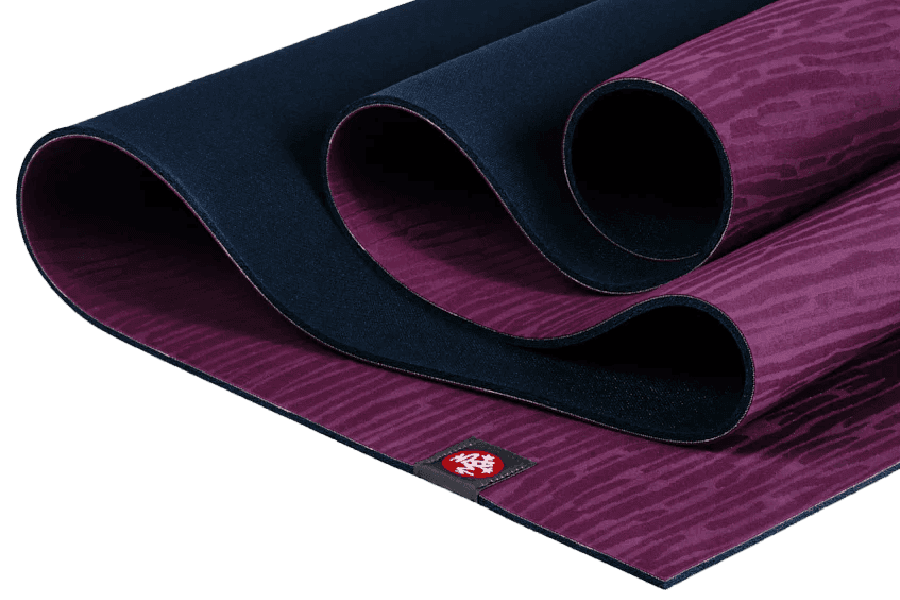
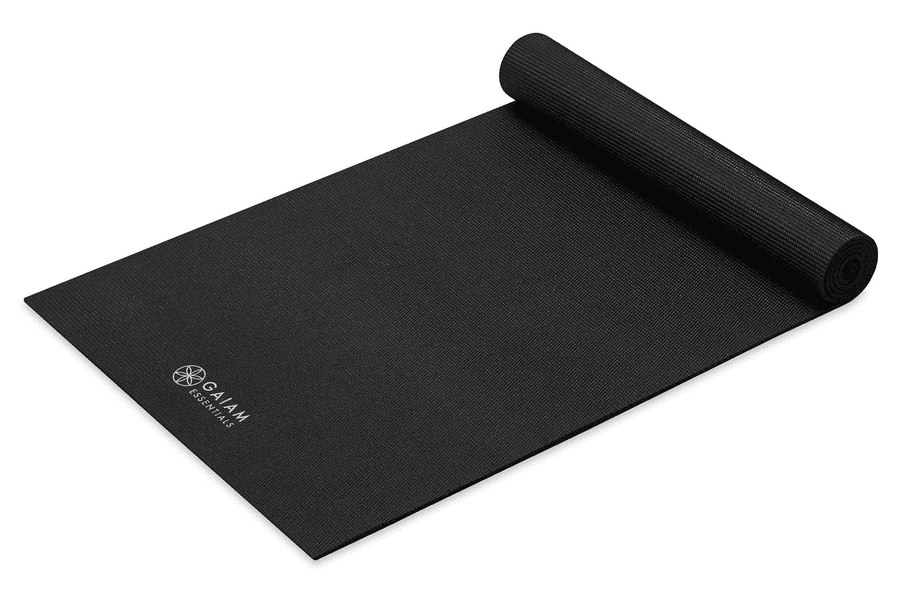
Price
The Gaiam Essentials lists for about $74 less.
$96
List price · check price at Amazon
$22.13
List price · check price at Amazon
Thickness
The Gaiam Essentials is 50% thicker.
4 mm0.16″
6 mm0.24″
Weight
The Gaiam Essentials is 1.5 lbs lighter.
5 lbs2.2 kg
3.5 lbs1.59 kg
Size
The Gaiam Essentials is 1″ longer; same width.
Same on both
- Around 71 to 72 inches long and 24 wide
- Usable on both faces
- Closed surfaces, so sweat sits on top
- Both suffer if left in the sun
Full specs
Dimensions
Materials & build
Buying
A first mat and the mat people buy next
The Gaiam Essentials is one of the most-bought first mats in the country: 6 mm of soft PVC with a carry sling for about $22.13, holding 4.6 stars across roughly 14,965 Amazon ratings.
The eKO Lite is what a lot of those buyers move to: thinner, firmer, natural rubber, $96. This page is mostly about whether you have run into the cheap mat’s limits yet, because if you have not, it is a perfectly good mat.
Grip is the reason people upgrade
Rubber holds a dry palm on its own. GearLab measured the 5 mm eKO sharing this compound at 10 out of 10 for dry grip, the best of its 2026 field of 19, and 7 wet. The eKO Lite is that surface in a thinner cut.
The Essentials has not been tested, but GearLab measured Gaiam’s closely related 6 mm Premium at 6 dry and 4 wet. Its listing describes the texture as suitable for heated practice; treat that as marketing rather than a result.
Soft foam moves, dense rubber does not
Six millimeters of soft PVC compresses unevenly under one foot. In tree pose and warrior three your ankle ends up correcting for the surface as well as holding the shape, which is work the mat should not be creating.
GearLab’s note on Gaiam’s comparable foam is that it holds a handprint for a moment after you lift your hand, and it rated that mat 6.5 out of 10 for comfort and support. The eKO Lite’s 4 mm does not deflect at all.
The cheap mat is the softer one
Six millimeters of foam is thicker than most studio mats use, and it is kind to knees and wrists in floor work. That is exactly why mats like this fill loaner piles and why beginners like them.
The eKO Lite is the firmer surface, which is better standing and less forgiving kneeling. A folded towel under the knee closes most of that gap for nothing, but it is worth knowing you are trading comfort for stability rather than getting both.
Years against a season or two
Soft PVC foam compresses and takes a permanent set, so the Essentials you like in month one is flatter by month twenty. That is normal for a $22 mat rather than a defect, and it is why studios replace these regularly.
Rubber thins slowly and stays usable while it does. The eKO Lite should give you several years, which changes the arithmetic: one $96 mat over five years against three or four Essentials in the same span.
The longer promise sits on the cheaper mat
Gaiam covers the Essentials for life, which is genuinely unusual at $22, and like every guarantee it addresses manufacturing defects rather than foam softening from normal use.
Manduka gives the eKO Lite a 30 day return window and nothing after it, because the lifetime guarantee applies to the PRO and PROlite lines only. Neither promise covers how these mats actually end.
Size and weight
The Essentials is 72″ × 24″ and the eKO Lite is 71″ × 24″, so the cheap mat is an inch longer. Same width on both, and 24 inches is narrow by premium standards.
The Essentials is lighter at 3.5 pounds against 5, and it includes a cinch sling the Manduka does not. If you want a longer eKO Lite, the 79 inch version is $104.
Both of them smell, differently
Gaiam asks buyers to air its mats out for two to three days before the first session and publishes a guide on removing the odor, which tells you how often people ask about it.
The eKO Lite’s rubber smell is stronger at first and takes weeks rather than days to settle. It is the most common complaint about the eKO line. Both fade, and neither is a defect. Note the rubber also rules the Manduka out for a latex allergy, where the PVC mat is fine.
Price, colors and where to buy
The Essentials is an Amazon staple in about seven plain colors and frequently sells below list, so check the current number before you order. One thing to confirm: Gaiam also sells a 68 inch Essentials on its own site without the sling, so the length depends on the listing.
The eKO Lite comes in eight colorways at $96 and discounts by colorway. If you want rubber for less, Jade’s Level One is $66.50, though it is 68 inches and brand-site only.
Bottom line
Get the Essentials if you are new, practice in a cool room, and want to spend as little as possible finding out whether this sticks. It is thicker, longer, lighter, cheaper and comes with a sling, and 15,000 owners rating it 4.6 is not nothing.
Get the eKO Lite if your hands slide or the cheap mat has already gone flat. Rubber fixes grip and lasts years, and those are the two complaints that send people back to this page a second time.
Gaiam Essentials 6mm
List price $22.13
Frequently Asked Questions
- Is the eKO Lite four times better?
- It is better at the things that decide whether you enjoy a class. Rubber grips where foam texture does not, and it stays usable for years where soft PVC flattens. It is not thicker, not lighter, and not cheaper. If your current complaint is that your knees hurt, the Gaiam is the better answer and it costs $74 less.
- How does the Gaiam feel underfoot?
- Soft, and softer than most studio mats use. Six millimeters of PVC foam is kind to knees and wrists, which is why mats like this fill loaner piles. The cost is steadiness: GearLab found the same foam in Gaiam's Premium unstable in balance poses, rating comfort and support 6.5 out of 10 and noting it holds a handprint for a moment.
- Does the Gaiam smell?
- Often, out of the packaging. Gaiam asks buyers to air its mats out for two to three days before the first session and publishes a guide on removing the odor, which tells you how often people ask. The eKO Lite has its own rubber smell that is stronger at first and takes weeks rather than days to settle.
- What about the lifetime guarantee?
- Gaiam covers the Essentials for life, which is genuinely unusual at $22, and like every guarantee it addresses manufacturing defects rather than foam softening from normal use. The eKO Lite gets a 30 day return window and nothing after it, since Manduka's lifetime guarantee covers the PRO and PROlite lines only.
- Which one is better for hot yoga?
- The eKO Lite, clearly, though neither is built for it. Its rubber is closed-cell so sweat still pools, but the tack holds far longer than a PVC texture does. If heated classes are the plan, budget for a polyurethane-topped mat instead; nothing on this page will keep your hands where you put them at 40 degrees.
- Which one is more comfortable?
- The Gaiam, at 6 mm of soft foam against 4 mm of dense rubber. It is the better mat to kneel on and the worse one to balance on, which is the standard trade at this end of the market. Folding a towel under the knee closes most of the gap on the eKO Lite.
Related comparisons
- YogaAccessories Extra Thick Deluxe 1/4" vs Gaiam Essentials 6mm
- Gruper TPE 6mm vs Gaiam Essentials 6mm
- JadeYoga Harmony 68" vs Manduka eKO Lite
- Manduka eKO Lite vs Suga SugaMat
- Amazon Basics 1/4 Inch Thick TPE vs Gaiam Essentials 6mm
- Manduka eKO Lite vs Lululemon The Mat 3mm
- Manduka eKO Lite vs JadeYoga Harmony 2.0 68"
- JadeYoga Harmony 74" vs Manduka eKO Lite
- Manduka eKO Lite vs Yoga Design Lab Combo 3.5mm