Jade Harmony 74" vs IUGA Eco Friendly PU: Which One Should You Buy?
The IUGA is the mat OutdoorGearLab gave its Best Buy award to and called the best value upgrade in the category, at $66.99. The Harmony 74 is the long version of a mat that has been the grip benchmark for two decades, at $109.95. The gap between them is $43, three pounds of carrying weight, and two very different surfaces.
As an Amazon Associate, we earn from qualifying purchases made through links on this page. How this works
The quick answer
The IUGA is the easier mat to recommend to most people. It weighs 2.1 pounds, which is less than half the Harmony, it is 26 inches wide against 24, its polyurethane top absorbs sweat so grip improves as you heat up, and it costs $43 less. GearLab scored it 75 out of 100 and 8 out of 10 for dry grip, behind the top rubber mats but not by much.
The Harmony earns its money on durability and on dry traction. It is USA-made natural rubber that wears in rather than out, it is six inches longer than a standard mat, and it is the tackier of the two on a dry floor. The IUGA's absorbent top is the part that wears; owners report it going shiny and losing grip with heavy sweaty use, and there is no warranty behind it.
Get the Jade Harmony 74" if...
- You want a mat that lasts years rather than a couple of seasons
- You are tall and 74 inches is the point
- You want the tackiest dry grip you can buy
- You want a warranty, even a one-year one
Get the IUGA if...
- You carry your mat and 2.1 pounds changes your commute
- You want 26 inches of width
- You sweat and want traction that improves when damp
- You'd rather keep the $43
Side by side
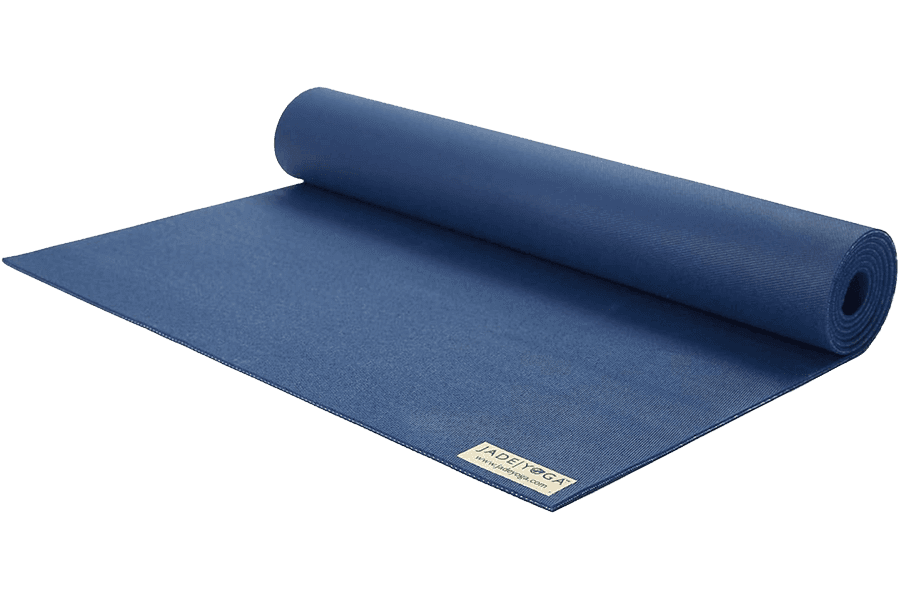
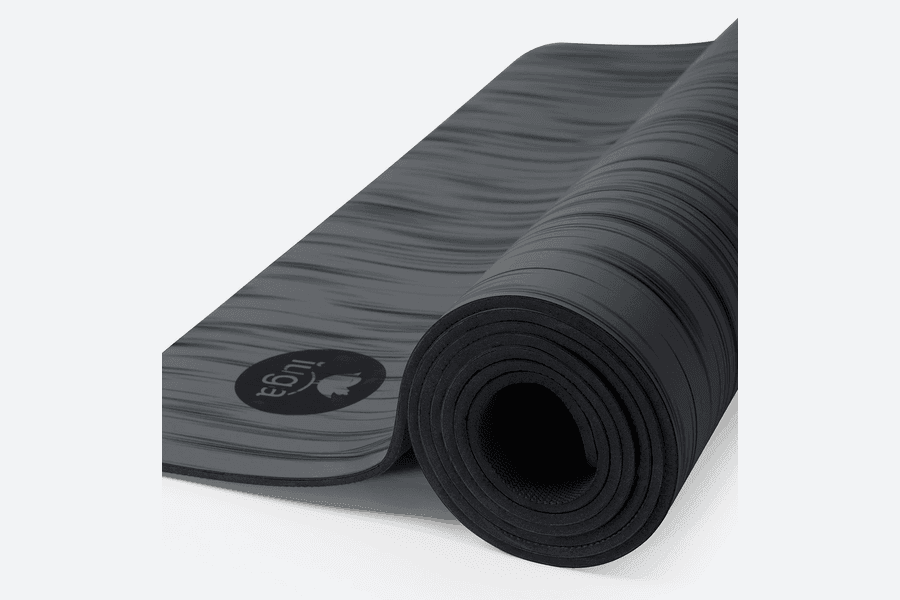
Price
The IUGA lists for about $43 less.
$109.95
List price · check price at Amazon
$66.99
List price · check price at Amazon
Thickness
The IUGA is 4% thicker.
4.8 mm0.19″
5 mm0.2″
Weight
The IUGA is 3.2 lbs lighter.
5.3 lbs2.4 kg
2.1 lbs0.95 kg
Size
The Harmony 74" is 2″ longer; the IUGA is 2″ wider.
Same on both
- Grip from the first class with no break-in
- Natural rubber on the underside
- Around 5 mm of material underfoot
- Need to be kept out of direct sun
Full specs
Dimensions
Materials & build
Buying
The benchmark against the value pick
The Harmony has been the mat people name when they talk about grip for about twenty years, and the 74″ version is the one for taller bodies. It is natural rubber, made in the USA, $109.95.
The IUGA is the mat OutdoorGearLab gave its Best Buy award to, calling it the best value upgrade in the category. It is a polyurethane top over a natural rubber base, 26″ wide, and it weighs 2.1 pounds, which for a full-size 5 mm mat is close to unheard of. It costs $66.99.
Three pounds is the headline
GearLab weighed an IUGA at 2.1 pounds, one of the lightest results in a 19-mat test that included dedicated travel mats. The Harmony 74 is 5.3. That gap changes what the mat is: one you sling over a shoulder without thinking, and one you plan a bag around.
If you drive to a studio and carry a mat thirty feet, none of this matters. If you commute with it, it is the most useful thing on this page and it is worth weighing against everything else the Harmony does better.
Grip: both good, different mechanisms
The Harmony is open-cell rubber, so it pulls moisture in and grips harder as you warm up. It is the tackier surface on a dry floor and it holds from the first unroll with no ceremony.
The IUGA’s polyurethane top absorbs sweat too, and GearLab scored it 8 out of 10 dry and 7 wet. That is genuinely close to mats costing twice as much. In a normal class you would struggle to tell them apart; in a hot room both work, and the difference is what happens to the mat afterwards rather than what happens to your hands during.
Length against width
The Harmony 74 is 74″ × 24″ and the IUGA is 72″ × 26″. So the Jade gives you two extra inches of length and the IUGA gives you two extra inches of width.
Width tends to be the more useful of the two unless you are properly tall. Twenty-four inches puts your hand on the floor in a wide stance more often than 26 does. If length is what you need and you also want width, Jade’s Harmony XW is 80″ × 28″, and IUGA sells nothing bigger than this one.
This is where the money goes
The Harmony wears slowly. Rubber softens over years and sheds a little with heavy sweaty use, and the fastest way to ruin it is sunlight, which is why Jade’s one-year warranty excludes sun damage and harsh cleaners. Kept sensibly, it is a mat you own for years.
The IUGA’s weak point is its top layer. Absorbent polyurethane is what makes the grip work and it is also the part that degrades: owners report the surface going shiny and losing traction after a year or two of heavy sweaty use. IUGA offers a 45-day return window rather than a warranty, so there is nothing behind it when that happens. GearLab scored its materials 7 out of 10, which is fair for what it is.
Comfort underfoot
The IUGA is 5 mm and the Harmony 4.8, and GearLab rated the IUGA 8 out of 10 for comfort and support, ahead of the Harmony family. Neither is a plush mat, but the IUGA is the more forgiving of the two for kneeling.
The Harmony feels more planted. Dense rubber gives you a very clear read on the floor, which some people want and others find hard on the joints. On tile, both eventually want a folded blanket for long kneeling sequences.
Which Harmony the reviews are talking about
Worth knowing before you read anything else about this mat: Jade sells both the original Harmony and a newer Harmony 2.0, and they are different products. The 2.0 is made in Spain, carries FSC and OEKO-TEX certifications, and is the version that took OutdoorGearLab’s recent award as an eco-friendly dry grip powerhouse.
This page covers the original Harmony in its 74″ cut, still made in the USA at $109.95. Reviews and scores written about the 2.0 do not automatically describe it. Check which version a review tested before you let it decide anything.
Price and value
$109.95 against $66.99, so the IUGA saves you $43. Check the live prices on the Harmony 74 and the IUGA; the IUGA in particular is frequently below list on Amazon.
Over a five-year window the Harmony is probably the cheaper mat, because the IUGA’s surface will likely need replacing inside that span if you sweat. Over two years, or if you are not sure how long you will keep practising, the IUGA is a lot of mat for the money and the award is deserved.
Bottom line
Get the IUGA if you carry your mat, if you want 26 inches of width, or if $67 is the number that makes this purchase happen. It grips well, it is comfortable, it weighs almost nothing, and independent testing rates it above mats at twice the price. Plan on replacing it eventually rather than keeping it.
Get the Harmony 74 if you want a mat that lasts, if you are tall, or if you want the tackiest dry surface available. It is heavier and costs more, and in exchange you get USA-made rubber, a real reputation behind the grip, and a mat that will still be doing its job when the IUGA has gone shiny.
Jade Harmony 74"
List price $109.95
Frequently Asked Questions
- Is the IUGA actually as good as mats costing twice as much?
- For grip and comfort, close to it. OutdoorGearLab gave it the Best Buy award, scored it 75 out of 100, and rated it 8 for dry grip, 7 for wet and 8 for comfort, which puts it in the same conversation as mats at $130. Where it falls behind is longevity. The polyurethane top is the part that wears, and IUGA offers 45-day returns rather than a warranty, so treat it as a very good mat for a couple of years rather than a mat for a decade.
- Which is better for hot yoga?
- The IUGA, narrowly. Its polyurethane top soaks up sweat, so traction holds or improves as your palms get damp, and GearLab rated its wet grip 7 out of 10. The Harmony is open-cell rubber and also handles sweat well by absorbing it. The practical difference is cleanup and wear: the IUGA's top layer degrades faster under constant sweat, while the Harmony's rubber holds up longer but needs cleaning more often. Both beat any closed-cell PVC mat in a heated room.
- How much lighter is the IUGA?
- Dramatically. It is about 2.1 pounds, confirmed on GearLab's own scale, against roughly 5.3 for the Harmony 74. That is the difference between a mat you barely notice on a bike or a bus and one you plan your bag around. Very few full-size 5 mm mats weigh close to two pounds, and it is the IUGA's most distinctive feature.
- Is the Jade Harmony 74" the same mat as the Harmony 2.0?
- No. The 2.0 is a different, newer mat made in Spain with FSC and OEKO-TEX certifications and its own OutdoorGearLab award. The mat here is the original Harmony, made in the USA, in the 74-inch cut. Any review you read should be checked for which version it tested, because the two differ in origin, certifications and price.
- Does the IUGA smell when you unbox it?
- Some owners report a chemical smell for the first week or two that airs out. The Harmony has a distinct natural rubber smell that also fades over a few weeks. Neither is unusual for its material. Unroll whichever you buy flat in a ventilated room for a few days before your first class and both settle down.
- Which is safer with a latex allergy?
- Neither, strictly. The Harmony is natural rubber, which contains latex, and Jade describes its mats as 99% latex free rather than latex free. The IUGA has a natural rubber base under its polyurethane top, so it also contains latex, even though your hands are mostly touching the PU. If you have a genuine latex allergy, look at a PVC or TPE mat instead of either of these.
Related comparisons
- Manduka PROlite vs JadeYoga Harmony 74"
- Manduka Begin vs IUGA Eco Friendly Non Slip PU
- JadeYoga Harmony 74" vs Lululemon The Mat 5mm
- Manduka X vs IUGA Eco Friendly Non Slip PU
- JadeYoga Harmony 74" vs Suga SugaMat
- JadeYoga Harmony 74" vs Manduka eKO Lite Long
- Gaiam Performance Dry-Grip 5mm vs IUGA Eco Friendly Non Slip PU
- Manduka PROlite Long vs JadeYoga Harmony 74"
- JadeYoga Harmony 74" vs Manduka eKO