Jade Harmony 74" vs Gaiam Performance Dry-Grip: Which One Should You Buy?
One of these is named after the thing it does worst. The Gaiam Performance Dry-Grip is a $69.98 PVC mat with a moisture-wicking topcoat, and OutdoorGearLab scored it 3.5 out of 10 for wet grip, second-lowest in a 19-mat test. The Jade Harmony 74 is open-cell natural rubber that gets better as you get damp. The $40 between them buys traction you can rely on.
As an Amazon Associate, we earn from qualifying purchases made through links on this page. How this works
The quick answer
If you sweat at all, the Harmony is the mat and the name on the Gaiam should not persuade you otherwise. Open-cell rubber absorbs moisture rather than shedding it, which is why Jade mats have held their reputation for twenty years, and the 74-inch cut covers taller bodies. It is a pound heavier, it contains latex, and it needs cleaning more often.
The Dry-Grip is a decent mat for a cool room. It is comfortable at 5 mm, GearLab scored it 8 out of 10 for comfort and support, it grips from the first unroll, it is latex free, and Gaiam's lifetime guarantee costs nothing extra. Buy it knowing its ceiling, which arrives about the time your palms do.
Get the Jade Harmony 74" if...
- You sweat and grip is what keeps failing you
- You are tall enough that 68 inches runs out
- You want natural rubber made in the USA
- You want a mat that wears in rather than wearing through
Get the Gaiam Dry-Grip if...
- You practice in a cool room and rarely sweat
- You want 5 mm of softer cushion for your knees
- A latex allergy rules natural rubber out
- You'd rather keep the $40 and have a lifetime guarantee
Side by side
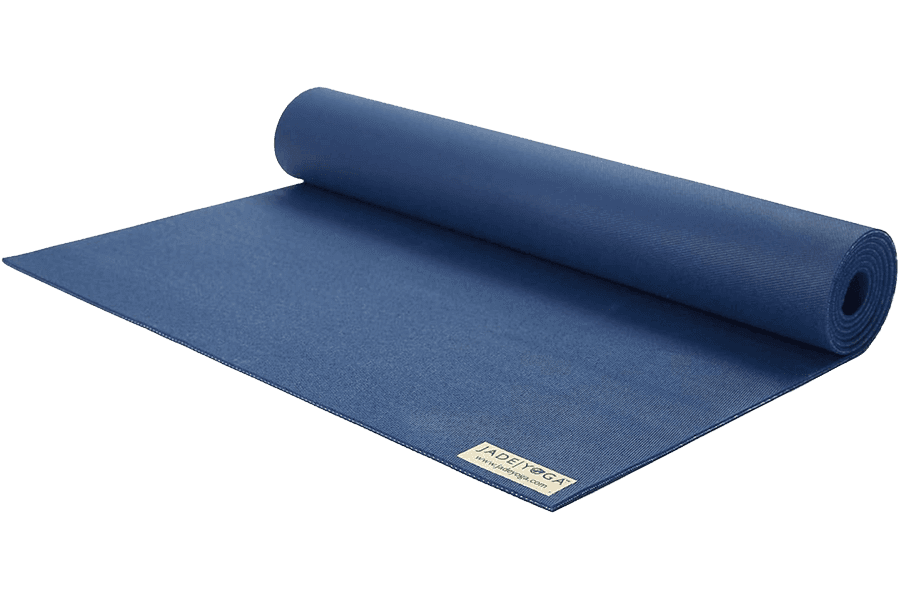
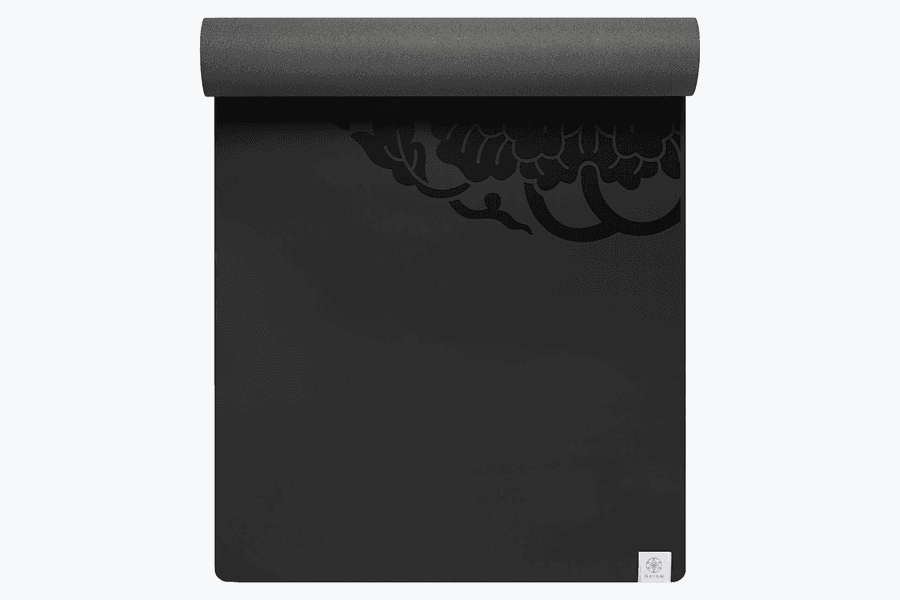
Price
The Dry-Grip lists for about $40 less.
$109.95
List price · check price at Amazon
$69.98
List price · check price at Amazon
Thickness
The Dry-Grip is 4% thicker.
4.8 mm0.19″
5 mm0.2″
Weight
The Dry-Grip is 1 lbs lighter.
5.3 lbs2.4 kg
4.25 lbs1.9 kg
Size
The Harmony 74" is 6″ longer; same width.
Same on both
- Around 5 mm underfoot
- Grip from the first unroll with no break-in
- Both roll rather than fold
- Both are sold in a small range of colors
Full specs
Dimensions
Materials & build
Buying
One of these is named after the thing it does worst
The Gaiam Performance Dry-Grip is 5 mm of PVC with a moisture-wicking topcoat, 68″ × 24″, at $69.98, with a lifetime guarantee. OutdoorGearLab scored it 3.5 out of 10 for wet grip, second-lowest among the nineteen mats it tested.
The Harmony 74 is 4.8 mm of open-cell natural rubber made in the USA, at $109.95. Its whole reputation rests on getting better as you get damp. That is the comparison in two sentences, and the $40 between them is buying exactly one thing.
Absorbing against coating
Jade’s rubber is open-cell, so moisture soaks into the material rather than sitting on the surface. A damp palm sinks in slightly instead of skating, which is the mechanism behind twenty years of reputation, and Wirecutter has credited the same absorption for the Harmony’s traction in sweaty sessions.
The Gaiam’s topcoat wicks a little moisture and you notice it working at the start of a warm class. Once you are properly sweating, it behaves like the topcoated PVC mat it is. GearLab scored it 6.5 dry and 3.5 wet, which is a fair account: solid in a cool room, unreliable when it matters most.
The cheaper mat is the softer one
The Dry-Grip is 5 mm of PVC with more give than the Harmony’s 4.8 mm of dense rubber, and GearLab scored it 8 out of 10 for comfort and support. On tile, kneeling sequences are genuinely easier on it.
The Harmony is firmer and feels more planted in standing work, which is the other side of the same property. Neither is a plush mat, and if sore knees are the problem you are solving, a 6 mm mat beats both of them.
Six inches of length, same width
Width is a draw at 24 inches each. Length is where they part: 74″ against 68″. Sixty-eight inches is short for anyone near six feet, since a full-length pose leaves either your head or your heels on the floor.
Gaiam’s answer is the Dry-Grip Long & Wide at 78″ × 26″, which fixes both dimensions for a lot less than the Jade costs. Jade’s bigger options are the Harmony XW at 80″ × 28″ and nothing in between.
A material against a coating
This explains most of what follows. The Harmony’s grip is the rubber itself, all the way through, so there is nothing to wear off. It is natural tree rubber made in the USA, and Jade plants a tree for every mat sold.
The Gaiam’s grip lives on the surface. Coatings wear, and GearLab scored its materials 4 out of 10, among the lowest in its test. When the topcoat goes smooth, what is underneath is ordinary PVC foam. Gaiam’s lifetime guarantee covers manufacturing defects rather than that, which is the failure you should actually plan for.
The one place the Gaiam wins outright
The Dry-Grip is PVC and latex free. The Harmony is natural tree rubber, and Jade describes its mats as 99% latex free rather than latex free, which is a meaningful distinction if you have a genuine allergy.
That matters more than it sounds, because nearly every mat with serious wet grip is either rubber or sits on a rubber base. If latex is your constraint, you are accepting some loss of traction, and the Dry-Grip is one of the better PVC options at limiting the damage.
Care, weight and sun
Gaiam lists the Dry-Grip at 4.25 pounds, although GearLab weighed a sample at 5.4, which is worth knowing if you are buying on the spec sheet. The Harmony 74 is about 5.3. Both are ordinary studio carries.
Cleaning favours the Gaiam, which wipes down and dries fast because nothing soaks in; GearLab scored its care and cleaning 7 out of 10. The Harmony absorbs, so regular cleaning with mild soap is not optional if you practice often, and sunlight is what really destroys it. Jade’s warranty excludes both sun damage and harsh cleaners.
Which Harmony the reviews cover
Jade sells two different mats called Harmony. The 2.0 is newer, made in Spain, and carries FSC and OEKO-TEX certifications plus a recent OutdoorGearLab award. The original, covered here in its 74″ cut, is still made in the USA at $109.95.
It is worth checking before you trust any review, because the two differ in origin, certifications and price. A score for one is not a score for the other.
Price and value
$109.95 against $69.98. Check the live numbers on the Harmony 74 and the Dry-Grip; Gaiam prices each of its three colors independently.
If you never sweat, the $40 is buying you very little and the Gaiam is a comfortable, well-covered mat. If you do sweat, it is buying the only thing that matters, and no lifetime guarantee compensates for sliding out of a pose.
Bottom line
Get the Harmony 74 if you sweat, if you are tall, or if grip is the thing that keeps letting you down. It is USA-made rubber with a genuine track record, and it will still be gripping in year five if you keep it out of the sun.
Get the Dry-Grip if your room is cool, if your knees want the softer surface, or if you need a latex-free mat under $70 with a lifetime guarantee behind it. Just buy it with clear eyes about what the name promises and what the testing found.
Jade Harmony 74"
List price $109.95
Frequently Asked Questions
- Does the Gaiam Dry-Grip work when you sweat?
- Less well than the name implies. OutdoorGearLab scored it 6.5 out of 10 for dry grip and 3.5 for wet, the second-lowest wet score in a 19-mat test. The topcoat wicks a little moisture away, which helps at the start of a warm class, but it is a topcoated PVC mat and behaves like one once you are properly sweating. In a heated room, plan on a towel.
- Why does the Jade grip better when it is wet?
- Because it is open-cell. The rubber absorbs moisture rather than letting it sit on the surface, so a damp palm sinks in slightly instead of skating. That is the mechanism behind the Harmony's reputation, and Wirecutter has credited the same absorption for its traction in sweaty sessions. The cost is that the moisture is now inside your mat, so it wants cleaning more often than a sealed mat does.
- Which is more comfortable?
- The Gaiam, slightly. It is 5 mm of PVC with more give than the Harmony's 4.8 mm of dense rubber, and GearLab scored it 8 out of 10 for comfort and support. On tile, kneeling sequences are easier on it. The Harmony is firmer and feels more planted in standing poses, which is the flip side of the same property.
- Is the Jade Harmony 74" the same as the Harmony 2.0?
- No. The Harmony 2.0 is a different, newer mat made in Spain that carries FSC and OEKO-TEX certifications and a recent OutdoorGearLab award. This page covers the original Harmony in its 74-inch length, still made in the USA. The two differ in origin, certifications and price, so check which one a review tested.
- Which lasts longer?
- The Harmony, if you keep it out of the sun. Natural rubber wears slowly and Jade covers it for a year, excluding sun damage and harsh cleaners, which tells you what actually kills these mats. The Dry-Grip's weak point is its topcoat: GearLab scored its materials 4 out of 10, among the lowest in its test, and when a coating wears smooth the mat underneath is ordinary PVC. Gaiam's lifetime guarantee covers defects rather than that.
- Is there a latex-free mat with real wet grip?
- Not many, because most grippy surfaces are natural rubber or sit on a rubber base. If latex is the constraint, a polyurethane-topped mat gets you closer than PVC does, though you should read the construction because nearly all of them have rubber underneath. Among the mats we cover, the honest answer is that you give up some wet traction to stay latex free, and the Dry-Grip is one of the better PVC options at doing so.
Related comparisons
- Manduka PROlite vs JadeYoga Harmony 74"
- Manduka X vs Gaiam Performance Dry-Grip 5mm
- JadeYoga Harmony 74" vs Lululemon The Mat 5mm
- JadeYoga Level One vs Gaiam Performance Dry-Grip 5mm
- JadeYoga Harmony 74" vs Suga SugaMat
- JadeYoga Harmony 74" vs Manduka eKO Lite Long
- Gaiam Performance Dry-Grip 5mm vs IUGA Eco Friendly Non Slip PU
- Manduka PROlite Long vs JadeYoga Harmony 74"
- JadeYoga Harmony 74" vs Manduka eKO