Gaiam Premium 6mm vs Manduka PRO Travel: Which One Should You Buy?
One of these is the mat most people buy first, at about $30 for 6 mm of soft PVC foam. The other is $74 for 2 mm of dense German PVC that folds into a suitcase. They weigh nearly the same, they are both PVC, and they are built for completely different reasons.
As an Amazon Associate, we earn from qualifying purchases made through links on this page. How this works
The quick answer
The Gaiam is three times thicker and less than half the price, and GearLab gave it a Best Buy award as the best first yoga mat. It also scored 6 out of 10 for dry grip and 4 wet, and its soft foam compresses under a knee and dents permanently within a year or two of regular use. The PRO Travel is firm 2 mm PVC that folds flat, needs a few weeks of breaking in, and carries a lifetime guarantee that means something.
If you need one cheap mat for home, buy the Gaiam. If you need a mat that packs, or a second mat that will still be here in ten years, buy the PRO Travel.
Get the Gaiam Premium if...
- You want to spend as little as possible on a first mat
- You practice at home on a hard floor and want padding
- You want a mat you won't worry about replacing
- You'd rather have four color combos than three
Get the PRO Travel if...
- You need a mat that folds flat into luggage
- You want a firm, stable surface for standing balances
- You want a mat that lasts a decade rather than a year
- You already own a mat and want one for the road
Side by side
Price
The Gaiam Premium lists for about $44 less.
$29.98
List price · check price at Amazon
$74
List price · check price at Amazon
Thickness
The Gaiam Premium is 200% thicker.
6 mm0.24″
2 mm0.08″
Weight
The PRO Travel is 0.4 lbs lighter.
3.3 lbs1.5 kg
2.9 lbs1.3 kg
Size
The PRO Travel is 3″ longer; same width.
Same on both
- PVC construction, latex-free
- 24 inches wide
- Backed by a lifetime guarantee
- Light enough to carry easily
- Wipe clean, never machine wash
Full specs
Dimensions
Materials & build
Buying
- Long79" × 24"
A $30 starter mat against a $74 travel mat
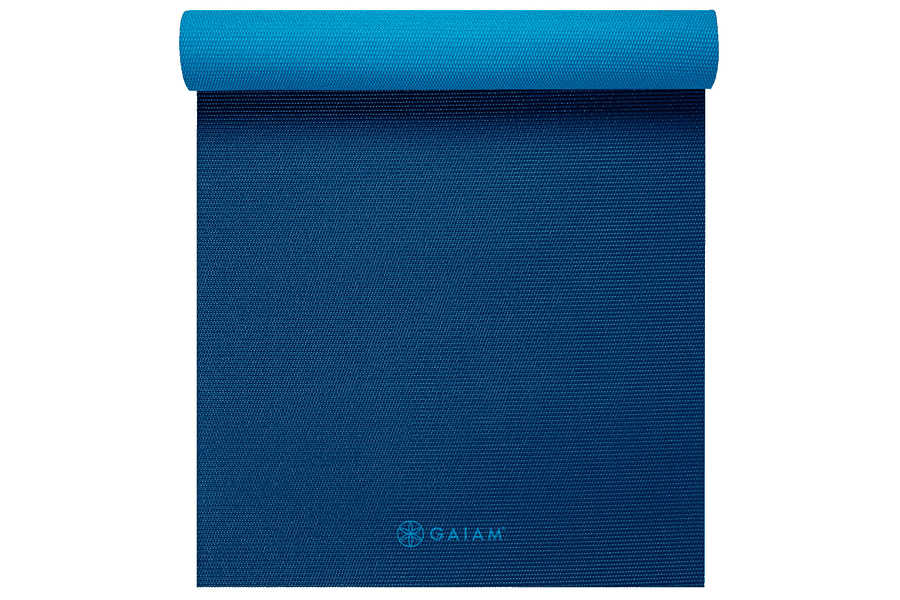
The Gaiam Premium 6mm is the mat most people meet first: soft PVC foam, 6 mm thick, 68″ × 24″, sold in every sporting goods aisle for about $29.98. GearLab gave it a Best Buy award as the best first yoga mat.
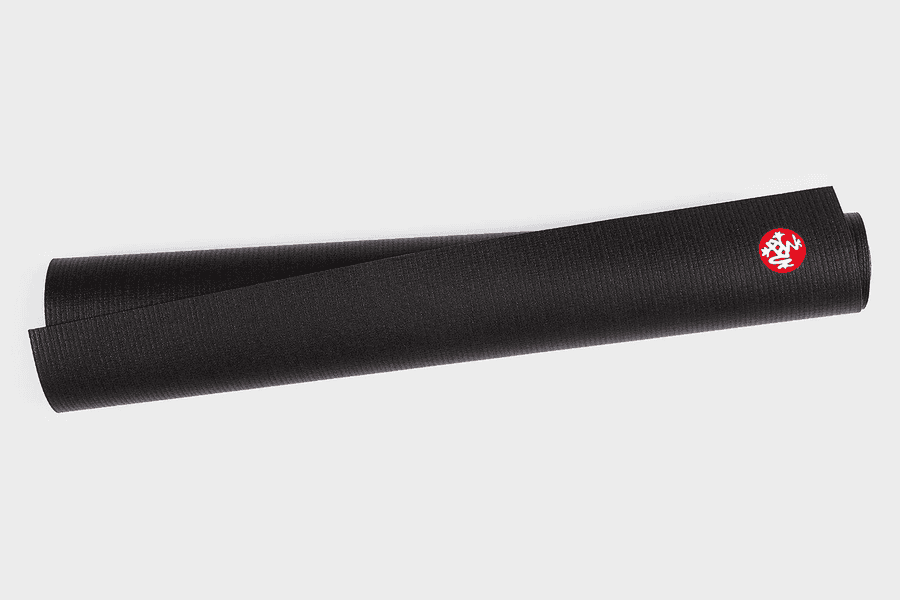
The Manduka PRO Travel costs $74 and goes the other way: 2 mm of dense German PVC that folds flat for luggage, with the surface and the guarantee of the full-size PRO. Both mats are PVC, both are light, and they are built for completely different reasons.
Six millimeters of foam is not six millimeters of PRO
The Gaiam is three times thicker and it feels it. GearLab still only scored its comfort and support 6.5 out of 10, because soft foam compresses under a knee until you reach the floor anyway, and it shifts when you push into it. It is comfortable to lie on and less reassuring in a lunge.
The PRO Travel is 2 mm of high-density PVC, which Manduka fairly describes as light joint protection. Nothing compresses, so what you feel is the floor with a firm grip layer on it. That is worse for knees than the Gaiam and better for standing balances, where the Gaiam’s squish is a liability.
Grip: neither is good, in different ways
GearLab rated the Gaiam 6 out of 10 dry and 4 wet, near the bottom of a 19-mat field. The sticky textured finish works when everything is dry and gives up quickly once hands get damp, which is the usual compromise at this price.
The PRO Travel starts worse and ends better. The PRO surface ships slick and needs a few weeks of regular practice before it grips; Manduka retired its salt-scrub advice and now says the slickness resolves with use. Once broken in it is a genuinely secure dry surface. Wet is a loss for both, since closed-cell PVC absorbs nothing and sweat pools on top.
Close on weight, nothing alike in a bag
GearLab’s scale put the Gaiam at 3.3 pounds against 2.9 for the Manduka, which is much closer than the prices suggest. Weight is not the difference here; bulk is. Six millimeters of foam rolls into a fat cylinder that goes over your shoulder and nowhere near a suitcase.
The PRO Travel folds flat instead of rolling, so it lies against the back of a carry-on or the bottom of a tote and takes up no shape of its own. The fold lines are obvious on a new one and disappear after a week or two of practice. If you are choosing a mat to fly with, that is the whole argument.
Two lifetime guarantees that mean different things
Both mats carry a lifetime guarantee on paper, and they are not comparable in practice. Gaiam’s soft foam is a consumable: owners report flaking at the hands and feet and permanent dents under the knees inside a year or two of regular use, and most people replace rather than claim on a $30 mat.
Manduka’s PRO series guarantee reads in the fine print as roughly ten years of regular use, one replacement, and proof of purchase from an authorized seller, which on Amazon means sold and shipped by Amazon itself. It is the same coverage the full-size PRO gets, and no other travel mat we cover has anything like it. One mat at $74 that lasts a decade costs less than replacing a $30 mat every couple of years.
Both narrow, one shorter
Both are 24 inches wide, which is the old standard and tight in a wide stance. The Gaiam is 68 inches long against the PRO Travel’s 71, so the travel mat is the roomier of the two, which is not how this usually goes.
Neither line offers much beyond that. Manduka sells a 79″ PRO Travel Long for $84; Gaiam sells the Premium in one size and four reversible color combos at last count. Anyone over about five foot ten will find the Gaiam short.
Cleaning and smell
GearLab scored the Gaiam 8 out of 10 for care and cleaning, and it is genuinely easy to wipe down, though new mats have a plastic smell that takes a week or two to fade. The foam surface holds dirt in its texture more than a smooth mat does.
The PRO Travel is closed-cell and smooth, so nothing soaks in and a damp cloth handles it in seconds. That is worth something if the mat is going on hotel carpet and studio floors rather than the same corner of the same room.
Price and where to buy
$29.98 against $74, about $44 apart. Both sell widely on Amazon: check the Gaiam at Amazon and the PRO Travel at Amazon, where colorways run below list on both. The Gaiam turns up discounted in stores constantly; the Manduka moves less.
If $30 is the budget and you need one mat for home, the Gaiam is a reasonable buy and GearLab’s award says so. If you can stretch, there are better full-size mats not far above it; our Gaiam vs IUGA page covers the usual upgrade.
Bottom line
Buy the Gaiam Premium if you are starting out, practicing at home on a hard floor, and want to spend as little as possible. It is thick, it is everywhere, and it will not last long, which is a fair trade at $30.
Buy the PRO Travel if the mat needs to fold into a bag, or if you already own a mat and want a second one that will still be around in ten years. It is thin, it needs breaking in, and it is the more serious piece of equipment of the two.
Gaiam Premium 6mm
List price $29.98
Frequently Asked Questions
- Is 6 mm of Gaiam foam more comfortable than 2 mm of Manduka PVC?
- For kneeling, yes, though less than the numbers suggest. Soft foam compresses under a knee until you reach the floor anyway, which is why GearLab scored the Gaiam's comfort and support only 6.5 out of 10. The PRO Travel does not compress at all, so it feels like a firm floor with a grip layer, which is worse under knees and better under standing balances.
- Both claim a lifetime guarantee. Are they the same?
- Not in practice. Manduka's PRO series guarantee reads as roughly ten years of regular use, one replacement, and proof of purchase from an authorized seller, which on Amazon means sold and shipped by Amazon. Gaiam's soft foam is effectively a consumable: owners report flaking and permanent dents inside a year or two, and most people replace a $30 mat rather than pursue a claim.
- Which one is better for travel?
- The PRO Travel, and it is not close. The two weigh nearly the same, 3.3 pounds against 2.9, but bulk is the difference. Six millimeters of foam rolls into a fat cylinder; the Manduka folds flat and lies against the back of a carry-on. Fold creases show for the first few sessions and settle with use.
- How is the grip on each?
- Neither is a strong point. GearLab rated the Gaiam 6 out of 10 dry and 4 wet, near the bottom of a 19-mat field, with a sticky finish that gives up once hands are damp. The PRO Travel starts worse, since the PRO surface ships slick and needs a few weeks of practice, and ends better as a dry surface. Both are closed-cell, so sweat pools on top of either one.
- Which is bigger?
- The PRO Travel, which surprises people. Both are 24 inches wide, and the Gaiam is 68 inches long against 71 for the Manduka. Anyone over about five foot ten will find the Gaiam short. Manduka sells a 79 inch PRO Travel Long at $84; Gaiam sells the Premium in one size.
- Is the Gaiam Premium a good first mat?
- Yes, with limits. GearLab's Best Buy award says as much, and $30 for 6 mm of cushioning is a reasonable way to find out whether you will stick with a practice. Expect a plastic smell for the first week or two, expect the surface to slip once you sweat, and expect to replace it rather than repair it.
Related comparisons
- Gaiam Premium 6mm vs Gruper TPE 6mm
- Amazon Basics 1/4 Inch Thick TPE vs Gaiam Premium 6mm
- Gaiam Premium 6mm vs YogaAccessories Extra Thick Deluxe 1/4"
- JadeYoga Travel 68" vs Manduka PRO Travel
- JadeYoga Level One vs Manduka PRO Travel
- JadeYoga Voyager vs Manduka PRO Travel
- IUGA Eco Friendly Non Slip PU vs Manduka PRO Travel
- Hugger Mugger Earth Elements 5mm vs Manduka PRO Travel
- Gaiam Performance Dry-Grip 5mm vs Manduka PRO Travel