Manduka PRO Squared vs Jade Harmony: Which One Should You Buy?
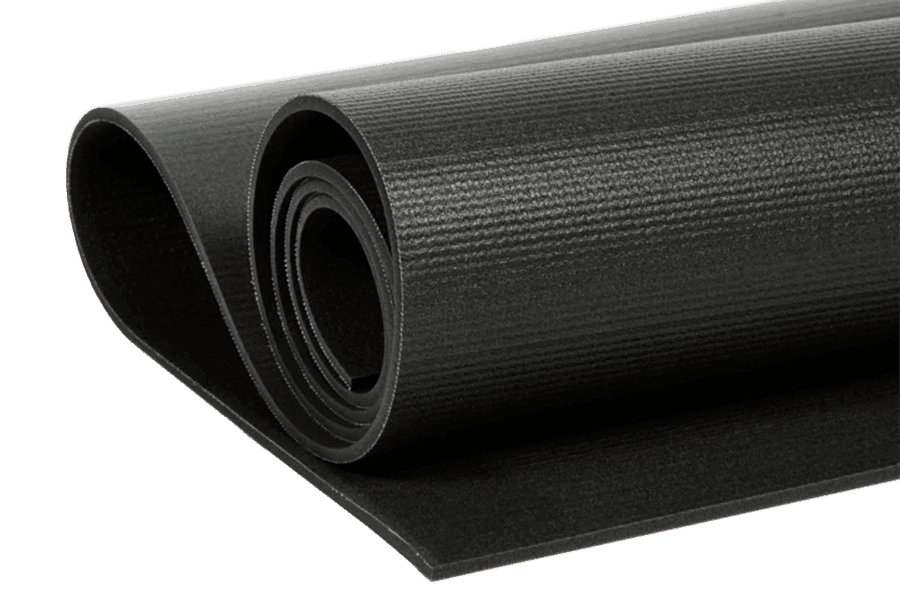
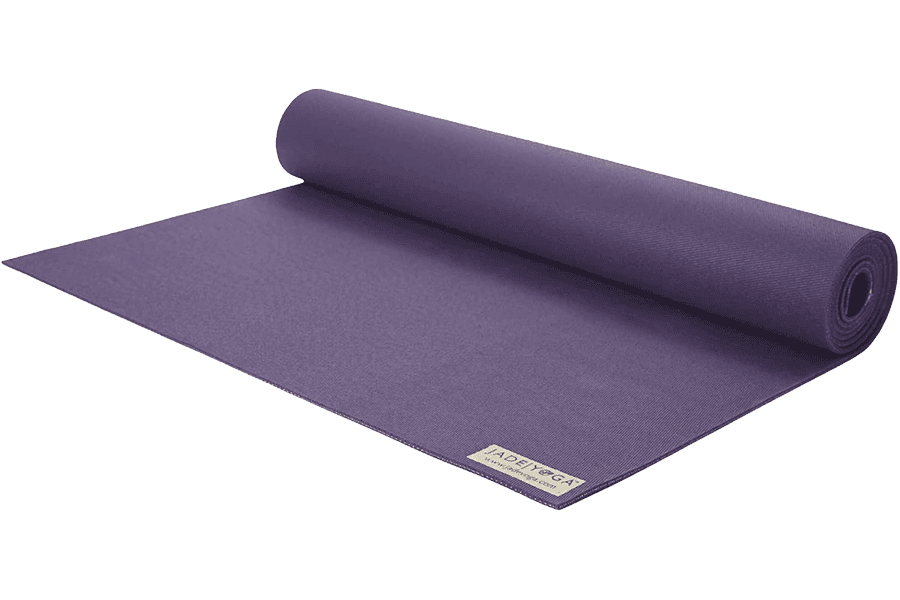
The Jade Harmony is the mat you have seen in studios for twenty years: 68 inches of tacky natural rubber, 4.8 pounds, $99.95, ready to grip the day it arrives. The Manduka PRO Squared is a 78 inch square of dense German PVC that weighs 26 pounds, costs $350, and stays wherever you unroll it. These two do not compete on any spec sheet. What you are really deciding is whether you are buying a mat or building a practice space.
As an Amazon Associate, we earn from qualifying purchases made through links on this page. How this works
The quick answer
The Harmony grips from the first practice, goes anywhere at 4.8 pounds, comes in a dozen colorways, and costs $99.95. In exchange, natural rubber wears out in years rather than decades, it cannot sit in the sun, and 68 inches runs short for anyone much past five foot eight. The Squared gives you 6,084 square inches of firm PVC with no front and no back, room for two people, and a lifetime guarantee, and it asks for $350, a dedicated room, and a few weeks of break-in before the surface grips properly.
Most people should buy the Harmony, because most people need a mat, not a floor. Buy the Squared only if you practice at home, you can give a room to it, and the idea of never running out of mat is the specific thing that brought you here.
Get the PRO Squared if...
- You practice at home and can clear a 6.5 foot square permanently
- Two of you practice at once, or you want to face any direction
- You want one purchase that lasts a decade, guarantee included
- A latex allergy rules out natural rubber
Get the Harmony if...
- Your mat goes to class, so 4.8 pounds is the number that matters
- You want grip on day one, with nothing to break in
- You are about five foot eight or under, so 68 inches fits you
- You'd rather keep about $250
Side by side
Price
The Harmony lists for about $250 less.
$350
List price · check price at Amazon
$99.95
List price · check price at Amazon
Thickness
The Squared is 25% thicker.
6 mm0.24″
4.8 mm0.19″
Weight
The Harmony is 21.2 lbs lighter.
26 lbs11.8 kg
4.8 lbs2.2 kg
Size
The Squared is 10″ longer; the Squared is 54″ wider.
Same on both
- Stable enough for balance work
- Specialist yoga brands, not house brands
- Lie flat without curling
Full specs
Dimensions
Materials & build
Buying
- Short68" × 26"
- Standard71" × 26"
- Long85" × 26"
- Long & Wide79" × 52"
- Long74" × 24"
- Harmony XW80" × 28"
A mat, or the floor under it
The Jade Harmony has been the default serious yoga mat for twenty years: 68″ × 24″ of tacky natural rubber, 4.8 pounds, about $100, grippy the moment it comes out of the box. The Manduka PRO Squared is a 78 inch square of the same dense PVC as the famous PRO, 26 pounds of it, at $350. It does not compete with the Harmony so much as sit in an entirely different category.
So treat this less as a product comparison and more as a fork in the road. If you are shopping for a mat, the Harmony is one of the best ever made and the Squared is a wild overreach. If you are shopping for a home practice space, the Harmony cannot become one no matter how much you like it. Most of what follows is working out which shopper you are.
68 inches against 78 in every direction
The Harmony is the smallest mat Jade sells: 1,632 square inches, and its 68 inch length fits practitioners up to roughly five foot eight before heads and heels start finding bare floor in savasana. Taller people are better served by the 74″ Harmony at $109.95 or the 80″ × 28″ Harmony XW at $149.95 before they are served by anything on the Manduka side of this page.
The Squared is 6,084 square inches, nearly four times as much, and the shape matters as much as the number. A square has no front. Sun salutations can face any wall, floor sequences roll from edge to edge without leaving the surface, and two adults can practice side by side with more room each than a standard mat would give them. No rectangular mat, Jade’s or anyone’s, does any of that.
Portability: 4.8 pounds against 26
The Harmony goes wherever you do. At 4.8 pounds it rolls tight, fits every mat bag and studio cubby ever made, and rides a shoulder to class without complaint. For anyone whose practice happens in more than one place, this line alone decides the comparison.
The Squared weighs 26 pounds, and rolled up it is a two-arm object with no bag that fits it. The honest description is that it gets unrolled once, in a room you have already chosen, and becomes part of that room. Manduka clearly built it on that assumption, and the dense closed-cell PVC cooperates by lying dead flat with no curl to fight.
Grip: rubber now, PVC eventually
The Harmony’s open-cell rubber is tacky from the first practice, holds with damp hands, and pulls light sweat into the surface rather than letting it sit. It is the reason the mat became a studio fixture, and nothing about it requires patience.
The Squared arrives slick, like every mat in the PRO family, and that break-in remains the most common complaint owners have about the whole line. It takes a few weeks of regular practice before the fabric-like top comes good; Manduka has retired its old salt-scrub advice and now says the slickness simply resolves with use, which matches what owners report. Broken in, its dry grip is excellent and stays that way for years, but the closed-cell surface absorbs nothing, so sweat pools on top and heated sessions call for a towel permanently.
Rubber’s grip has small print of its own: the tack can catch a foot mid-transition, the surface collects lint, and truly dripping palms overwhelm it eventually. It still wins this section comfortably.
Cushioning: two firm mats, one firmer
Neither of these is a plush mat. The Harmony’s 3/16″ of natural rubber, about 4.8 mm, has a springy, warm feel with a little give on first contact. The Squared’s 6 mm of PVC is dense enough that it barely dents, protecting knees and hips by holding them up rather than letting them sink; OutdoorGearLab has scored that PRO construction perfectly for comfort and support.
On a wood floor the difference is minor. On tile or concrete, long kneeling holds favor the Manduka’s density. And if deep cushioning is what you actually want, neither is the answer: the 8 mm Jade Fusion is the mat built for that job.
Durability and care: decades against years
The Squared should be the last purchase of its kind you make. GearLab’s testers keep finding instructors’ PRO-family mats five to twenty years old and still in service, and Manduka’s lifetime guarantee makes the expectation contractual: roughly ten years of regular use counts as a lifetime in the fine print, one replacement per purchase, proof of purchase from an authorized seller required, and Amazon qualifies when the mat is sold and shipped by Amazon itself. Care is an occasional wipe-down, and sunlight does not trouble it.
The Harmony is a plant product with a plant product’s life. Hard daily practice softens and sheds the surface, sweat accelerates it, and sun exposure hardens the rubber outright, which is why Jade’s 1 year warranty excludes sun damage and harsh cleaners. Clean it with a damp cloth or diluted vinegar, never alcohol. Owners who practice hard replace theirs every few years; gentler owners report much longer. At about $100 that cycle is reasonable. It is just a different proposition from the Manduka.
Materials, trees, and the latex caveat
On sourcing, Jade wins without much argument: rubber tapped from trees, manufactured in the USA, no PVC anywhere in the product, and a tree planted for every mat sold, past two million by the company’s count. The Squared is 26 pounds of PVC with no practical recycling path. Manduka’s counterargument is longevity, one mat for decades instead of a rotation of rubber mats, plus OEKO-TEX Standard 100 certification on the manufacturing. Both arguments are real; how they weigh depends on whether sourcing or total waste is the thing you care about.
The health note cuts the other way. Jade mats are 99% latex free, which is not latex free, and Jade does not recommend them for latex allergies. If that applies to anyone in your household, the PVC Manduka is the only option on this page.
Colors, price, and what the gap buys
List prices are $350 for the Squared and $99.95 for the Harmony, a gap of about $250. Check the current price on the PRO Squared and the Jade Harmony before deciding; the Harmony’s dozen colorways at last count see discounts far more often than the Squared’s two, Black and Black Sage.
What the $250 buys is area and lifespan, not a better version of what the Harmony does. The Harmony will still be the grippier mat, the greener material, and the only one of the two you can take anywhere. If you find yourself hesitating over the gap, that hesitation is usually the answer: people who need the Squared tend to know it before they see the price.
Bottom line
Buy the Harmony if you are shopping for a yoga mat. It grips on day one, weighs a fifth as much, costs a quarter as much, and has earned its two decades as the studio default. Fit matters, though: at 68 inches it suits practitioners up to about five foot eight, and taller buyers should step up a Jade size rather than across to the Manduka.
Buy the PRO Squared if you are building a home practice space and want the surface to be permanent, shared, and directionless. Give it a mostly dry practice, a few weeks of patience while it breaks in, and a room it can keep. If you want something between these extremes, the PRO Long & Wide vs Harmony comparison covers Manduka’s rollable oversized option against this same Jade.
Jade Harmony
List price $99.95
Frequently Asked Questions
- Is the PRO Squared just a bigger Manduka PRO?
- Materially, yes. It is the same 6 mm dense PVC, the same fabric-like top, the same German factory, and the same lifetime guarantee as the standard PRO. What changes is the shape: 78 inches in both directions instead of a 71" × 26" strip, which removes any sense of front and back and pushes the weight to 26 pounds. It practices like a PRO and moves like furniture.
- How tall can you be for the Jade Harmony?
- About five foot eight before your head or heels start finding bare floor in savasana. If you like the Harmony but need more length, Jade sells the same mat at 74 inches for $109.95 and an 80" × 28" Harmony XW for $149.95, and either is a better answer to a height problem than a $350 square.
- How much room does the PRO Squared actually need?
- A clear square roughly six and a half feet on each side, plus somewhere to walk around it. That is a meaningful share of most bedrooms and home offices. It is worth marking the footprint out on your floor before ordering, because the size in person surprises people who bought it from a photo.
- Which mat grips better?
- The Harmony, immediately. Open-cell natural rubber is tacky on contact and drinks light sweat into the surface. The Squared ships slick like every mat in the PRO family, needs a few weeks of regular practice to break in, and even then its closed-cell surface absorbs nothing, so heated or sweaty sessions mean a towel for as long as you own it. Manduka has retired its old salt-scrub advice and now says the new-mat slickness resolves with use, which matches owner reports.
- How long will each of these mats last?
- On very different clocks. GearLab's testers keep finding instructors' PRO-family mats five to twenty years old and still in service, and Manduka's lifetime guarantee backs that up: roughly ten years of regular use, one replacement, proof of purchase from an authorized seller required. The Harmony is natural rubber, which softens and sheds under hard use and hardens in sunlight; Jade covers it for 1 year and excludes sun damage and harsh cleaners. Owners who practice hard tend to replace a Harmony every few years.
- Is this the same mat as the Jade Harmony 2.0?
- No, and mixing them up is easy. The mat covered here is the original Harmony, made in the USA. The Harmony 2.0 is a separate product made in Spain, costs about $10 more per length, and is the version that carries the newer certifications and the recent OutdoorGearLab award. Check which one a review or price refers to before buying.
Related comparisons
- JadeYoga Harmony 68" vs Suga SugaMat
- JadeYoga Harmony 68" vs Manduka eKO Lite
- Manduka PROlite vs JadeYoga Harmony 68"
- JadeYoga Harmony 68" vs Manduka GRP Adapt 1.0
- JadeYoga Harmony 68" vs Manduka eKO Lite Long
- JadeYoga Harmony 68" vs Lululemon The Mat 5mm
- Manduka PROlite Long vs JadeYoga Harmony 68"
- JadeYoga Harmony 68" vs 42 Birds The Robin
- JadeYoga Harmony 68" vs Gaiam Performance Dry-Grip Long & Wide