Lululemon The Mat vs Gaiam Classic Print: Which One Should You Buy?
Lululemon's The Mat costs $118 and Gaiam's Classic Print costs $24.98, and the honest gap between them is smaller in some places and larger in others than the price suggests. The Mat is polyurethane over natural rubber, 5 mm thick, 26 inches wide, and OutdoorGearLab scored it 81 of 100 with a perfect 10 for comfort. The Classic Print is 4 mm of printed sticky PVC that weighs 2.1 pounds and has been the default first mat for two decades.
As an Amazon Associate, we earn from qualifying purchases made through links on this page. How this works
The quick answer
The Mat wins on the things you feel every session: two more inches of width, a denser and more supportive 5 mm platform, and a polyurethane top that absorbs sweat rather than letting it sit. GearLab named it best for mixed fitness routines and gave it the highest comfort score in the test. It also stains, needs proper cleaning, contains latex, and weighs 5.2 pounds.
Get the Classic Print if you want a light, cheap, cheerful mat for gentle practice and you do not want to think about care. Get The Mat if you practice hard enough to sweat, want the extra width, and will look after it.
Get Lululemon The Mat if...
- You want 26″ of width rather than 24″
- You sweat, and want a top layer that absorbs rather than pools
- You want dense 5 mm support that will not pack flat in a year
- You use the same mat for yoga, pilates, and floor workouts
Get the Gaiam Classic Print if...
- You want a working mat for $24.98
- You carry your mat and 2.1 pounds beats 5.2
- You have a latex allergy; The Mat contains rubber
- You want to wipe it down and never think about care again
Side by side
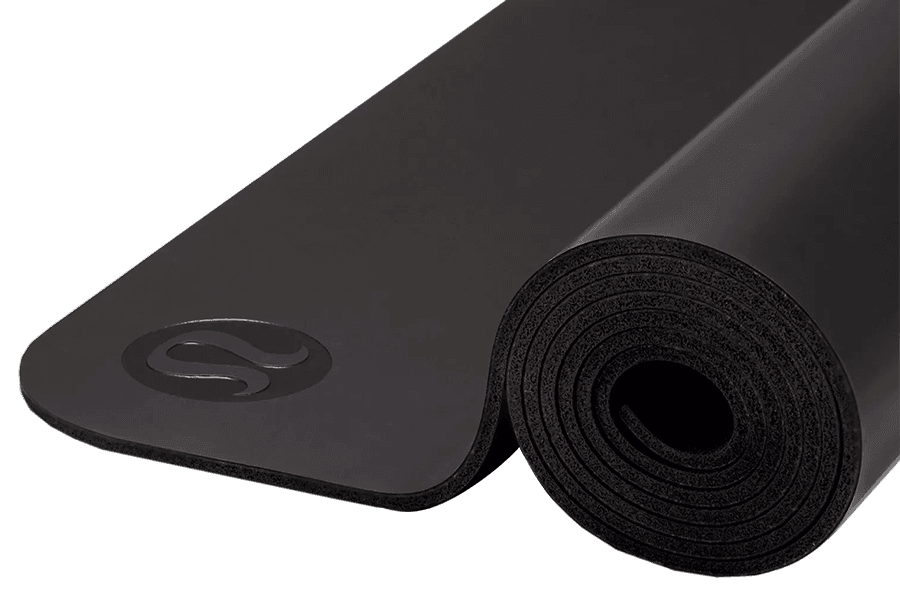
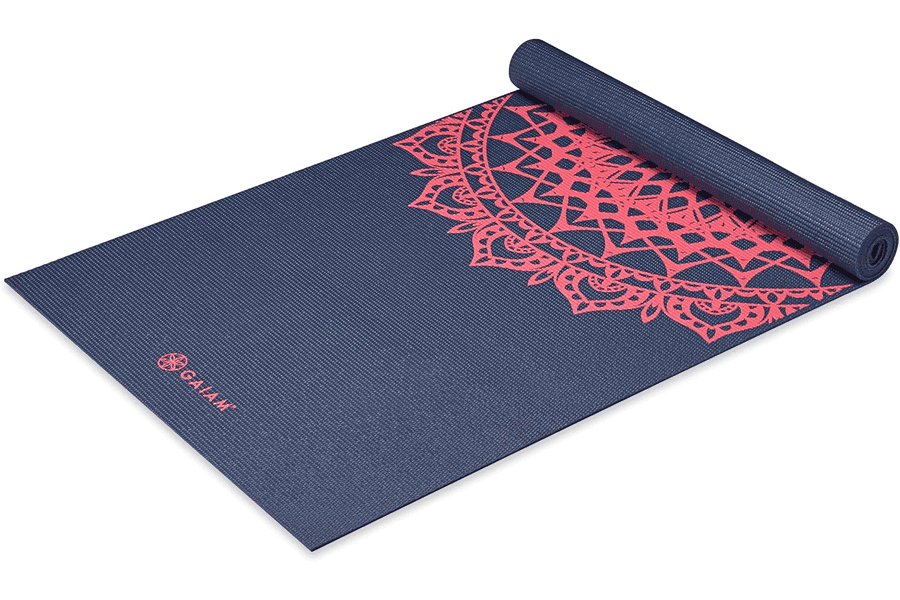
Price
The Classic Print lists for about $93 less.
$118
List price · check price at lululemon.com
$24.98
List price · check price at Amazon
Thickness
The Mat is 25% thicker.
5 mm0.2″
4 mm0.16″
Weight
The Classic Print is 3.1 lbs lighter.
5.2 lbs2.4 kg
2.1 lbs0.95 kg
Size
The Mat is 3″ longer; the Mat is 2″ wider.
Same on both
- Both grip well with dry hands and no break-in period
- Both lie flat on the floor rather than curling at the corners
- Neither is machine washable
- Both come in a choice of colors or prints
Full specs
Dimensions
Materials & build
Buying
The $118 mat and the $24.98 one
Lululemon’s The Mat is polyurethane bonded to a natural rubber base, 5 mm thick and 26 inches wide. OutdoorGearLab scored it 81 out of 100 in a 19 mat test, gave it a perfect 10 for comfort and support, and named it the best mat for mixed fitness routines.
The Gaiam Classic Print is 4 mm of printed sticky PVC that weighs 2.1 pounds and has been the default first yoga mat for about twenty years. It was not in that test, and at $24.98 it is not really trying to be in that conversation.
What follows is where the money actually goes, and the two places the cheap mat genuinely wins.
Two inches of width you will feel immediately
The Mat is 26″ wide against the Gaiam’s 24″. Standard mats have been 24 inches for so long that most people assume that is the correct number, and then they practice on a 26 inch mat and find their hands are no longer hanging over the edge in a wide down dog or a low lunge.
It is also 71 inches long against 68, so the total surface is meaningfully larger. If you are broad-shouldered or tall, this is probably the single most useful thing on this page.
Comfort is where GearLab scored it a perfect 10
The Mat took the top comfort and support score in GearLab’s test, 10 out of 10, which it shares only with the Manduka PRO. The reason is density rather than depth: 5 mm of rubber with a soft top layer feels cushioned under a knee while staying stable under a standing foot, which soft foam cannot do.
The Gaiam is a millimeter thinner and made of much lighter foam. New out of the wrapper it feels reasonable. After a year the spots where your hands and heels land are visibly thinner, and on tile or concrete you feel it.
Grip: better, but not as good as the reputation
The Mat’s polyurethane top absorbs moisture rather than letting it bead, and it is genuinely good with dry and lightly damp hands. GearLab’s testers liked the surface for flows and listed absorbs sweat among its pros.
They also rated its wet grip 4.5 out of 10, below several cheaper mats in the same lineup, and put may lose grip with use in its cons. That is worth knowing before you buy it for a hot class on the strength of studio-floor reputation. The Gaiam is worse, and clearly so: sticky PVC turns slick the moment a film of sweat sits on it.
For a normal unheated class, both grip well enough. For a heated one, The Mat with a towel, or a mat actually built for sweat.
The Mat stains and needs looking after
GearLab listed stains easily and needs deep cleans among The Mat’s cons, and that is the price of an absorbent top layer. Sweat and body oils go into the surface, and after a year of hard practice the mat looks used. Wipe it after sweaty sessions, let it dry fully before rolling it, and keep it out of direct sun.
The Gaiam’s sealed PVC does not care about any of this. Wipe it, roll it, leave it in a car, forget about it. That is a real advantage and it is one of only two the cheap mat has.
The Mat contains rubber, and that rules it out for some people
The Mat is built on a natural rubber base, and GearLab lists latex content explicitly among its cons. If you have a genuine latex allergy it is not an option, no matter how good the surface is.
The Gaiam Classic Print is latex-free PVC. If that is your situation, this comparison is already settled, and the useful follow-up question is which PVC mat to buy rather than whether to spend more. The Manduka PROlite is the obvious upgrade path that stays rubber-free.
Weight and the walk to class
5.2 pounds against 2.1. GearLab measured The Mat at 5.9, which put it mid-pack, and the Gaiam is one of the lightest full-size mats you can buy.
Neither is a travel mat. If you fly with a mat, both are the wrong answer and something that folds is the right one. For a walk to a studio, The Mat is manageable and the Gaiam is barely noticeable.
Where to buy, and what coverage you get
The Mat sells through shop.lululemon.com and Lululemon stores. It is not sold on Amazon, and listings claiming otherwise are worth avoiding. Coverage is Lululemon’s Quality Promise, which carries no set term and is handled case by case, so keep the receipt.
The Gaiam is on Amazon and gaiam.com, frequently discounted below its $24.98 list price, and covered by a lifetime guarantee that in practice does not cover the way the mat actually wears out.
Bottom line
Buy the Gaiam Classic Print if you are starting out, practicing gently, carrying the mat daily, allergic to latex, or simply not ready to spend $118 on something you use twice a month. It is a fine mat for what it is and it will tell you whether you want a better one.
Buy The Mat if you practice regularly, want the extra width, and will look after an absorbent surface. It is the more comfortable and more capable mat by a wide margin, and the two things to go in knowing are that it stains and that its wet grip is good rather than exceptional. If sweat is your main problem, look at mats built specifically for it instead.
Lululemon The Mat 5mm
List price $118
Gaiam Classic Print 4mm
List price $24.98
Frequently Asked Questions
- Is Lululemon's The Mat worth $93 more than a Gaiam?
- If you practice a few times a week, we think so, and mostly for two reasons that have nothing to do with the logo: the 26 inch width, which stops your hands hanging off the edge in a wide down dog, and a 5 mm platform dense enough that it does not compress into nothing after a year. OutdoorGearLab scored The Mat 81 out of 100 with a perfect 10 for comfort and support. If you practice occasionally on carpet, the Gaiam is enough.
- Which one grips better when I sweat?
- The Mat, but by less than its reputation suggests. Its polyurethane top absorbs moisture rather than letting it bead, and GearLab's testers liked its surface for flows. They also rated its wet grip 4.5 out of 10, below several cheaper mats in the same test. The Gaiam's sticky PVC turns slick as soon as your palms are damp. Neither is a hot yoga mat, and heavy sweaters will want a towel on either.
- Does The Mat stain?
- Yes, and GearLab listed staining and the need for deep cleans among its cons. The absorbent top layer takes on sweat and body oils, and after a year of hard use it will look used. Wipe it after sweaty sessions, let it dry fully before rolling, and keep it out of the sun. The Gaiam's sealed PVC surface shrugs off all of this, which is the one clear win for the cheap mat.
- Which is safe with a latex allergy?
- The Gaiam. The Mat is built on a natural rubber base and GearLab explicitly lists latex content among its cons, so it is not safe with a genuine allergy. The Classic Print is latex-free PVC. If that describes you, this comparison is already over.
- How different do they feel underfoot?
- More different than one millimeter suggests. The Mat is 5 mm of dense rubber with a soft top, so it feels cushioned but does not sink under a hand. The Classic Print is 4 mm of light foam, which reads thinner and packs down over months of use. Standing balances are steadier on The Mat; the Gaiam is the one you notice on hard floors after a year.
- Where do I buy each one?
- The Mat sells through shop.lululemon.com and Lululemon stores; it is not on Amazon, and listings claiming otherwise are worth avoiding. The Classic Print is on Amazon and gaiam.com. Lululemon's coverage is its Quality Promise, which has no set term and is applied case by case, so keep your receipt.
- Will the Gaiam be enough if I get serious?
- For a while, then no. The Classic Print's foam compresses under the points you load most, and 24 inches starts to feel narrow once your practice includes wide stances and arm balances. It is a good first mat and a poor fifth-year mat. That is not a criticism at $24.98; it is what the mat is for.
Related comparisons
- JadeYoga Harmony 74" vs Lululemon The Mat 5mm
- Manduka PROlite Long vs Lululemon The Mat 5mm
- Lululemon The Mat 5mm vs JadeYoga Harmony 2.0 68"
- Manduka PROlite vs Lululemon The Mat 5mm
- Lululemon The Mat 5mm vs Manduka GRP Adapt 2.0
- Lululemon The Mat 5mm vs Manduka eKO
- Lululemon The Mat 5mm vs b, halfmoon B Mat Everyday 4mm
- Lululemon The Mat 5mm vs Manduka PRO Lite Terra 4.7mm
- Lululemon The Mat 5mm vs Yoga Design Lab Combo 3.5mm