Lululemon The Mat 5mm vs Amazon Basics 1 Inch Extra Thick: Which One Should You Buy?
Amazon Basics sells a lot of these. The 1 Inch Extra Thick has north of 70,000 ratings averaging 4.6 stars, which makes it one of the most-owned exercise mats in the country. The Mat is Lululemon's $118 polyurethane-topped rubber mat, fourth of 19 in GearLab's 2026 test. Comparing them is really about deciding what your session looks like.
As an Amazon Associate, we earn from qualifying purchases made through links on this page. How this works
The quick answer
The Mat scored 81 out of 100 with GearLab, took a perfect 10 for comfort and support, and won the award for mixed fitness routines. Its polyurethane surface absorbs sweat rather than letting it pool, and it flips over to a natural rubber side for dry work. The Amazon Basics is 25.4 mm of NBR foam with a carry strap, about $38, and it is enormously popular for a reason: it is comfortable and cheap.
If you practice yoga in the usual sense, get The Mat. An inch of soft foam makes every standing pose harder without making you better at any of them. If you stretch, do mat Pilates, follow along with floor workouts, or have knees that object to a hard floor, the Amazon Basics is the better tool at a third of the price.
Get Lululemon The Mat if...
- You do standing poses, balances and vinyasa
- Your hands slide once you start sweating
- You want a surface that stays put under your foot
- You want 26 inches of width and a reversible rubber side
Get the Amazon Basics 1 Inch if...
- Your knees, hips or spine need real padding
- Your session is mostly stretching, Pilates or floor work
- You want 74 inches of length and a strap included
- You'd rather keep about $80
Side by side
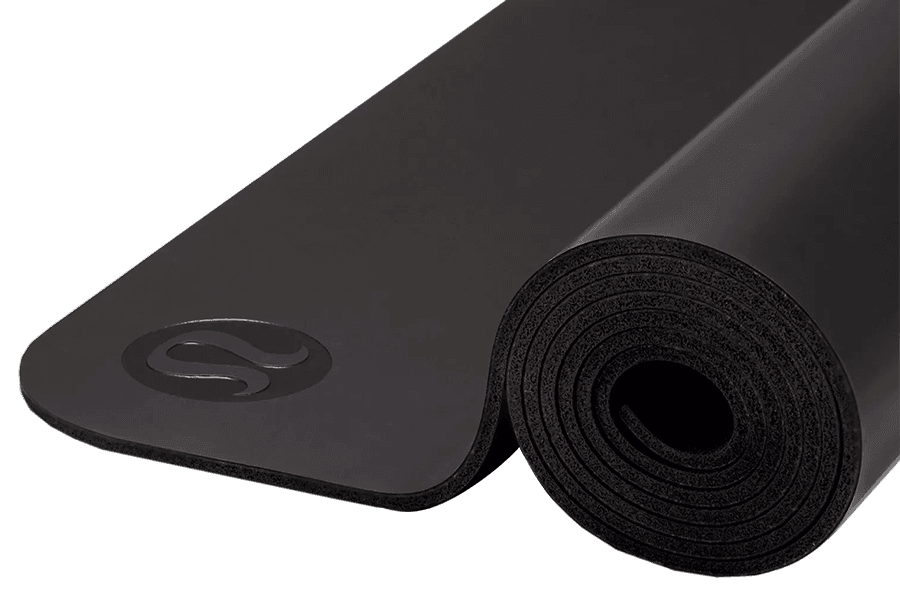
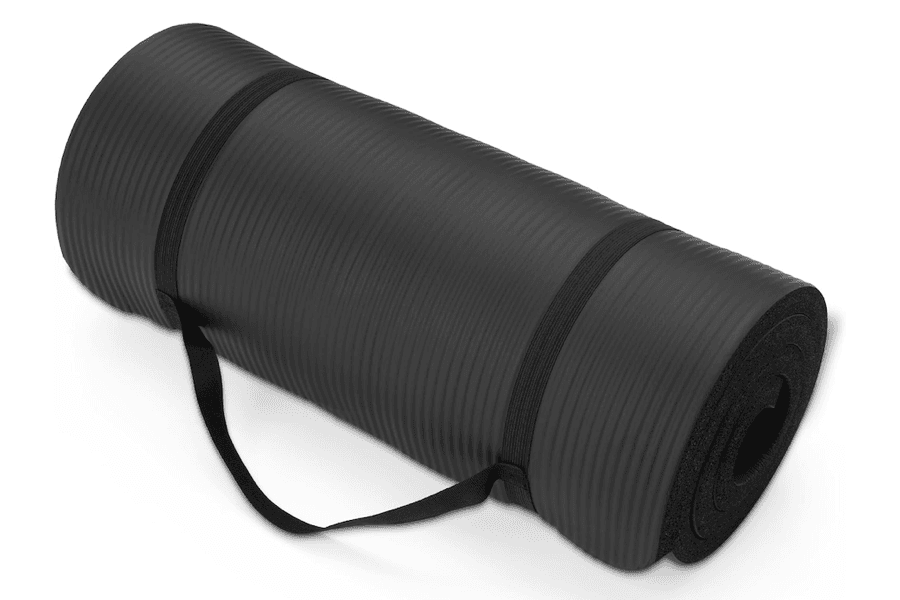
Price
The Amazon Basics lists for about $80 less.
$118
List price · check price at lululemon.com
$38.40
List price · check price at Amazon
Thickness
The Amazon Basics is 408% thicker.
5 mm0.2″
25.4 mm1″
Weight
The Amazon Basics is 0.6 lbs lighter.
5.2 lbs2.4 kg
4.6 lbs2.1 kg
Size
The Amazon Basics is 3″ longer; the Mat is 2″ wider.
Same on both
- Both roll up and travel without much fuss
- Neither should be left in direct sun
- Both are wipe-clean rather than washable
- Both are longer than a standard 68 inch mat
Full specs
Dimensions
Materials & build
Buying
One of these is on 70,000 floors
The Amazon Basics 1 Inch Extra Thick carries north of 70,000 ratings at 4.6 stars, which makes it one of the most-owned exercise mats in the country. It is 25.4 mm of NBR foam, 74″ long, with a strap in the box, for about $38.40.
The Mat is Lululemon’s $118 rubber mat with a polyurethane top, which GearLab placed fourth of 19 in its 2026 test at 81 out of 100. Both are popular for good reasons and those reasons do not overlap much.
An inch of foam changes what you can do on it
Soft NBR at that depth compresses more under your heel than under the ball of your foot, so the surface tips as you shift weight and your ankle spends the pose keeping it level. Balance holds get harder without getting more productive. Read the Amazon reviews and the enthusiasm is about knees, home workouts and stretching, which is a fair account of what it does well.
The Mat does not deflect. GearLab’s perfect 10 for comfort and support is measuring exactly that: 5 mm of dense rubber holds you up rather than absorbing you. If you do standing sequences, that is the property that decides everything else.
Grip: absorption against bare foam
Lululemon bonds a polyurethane layer to a natural rubber base, and the polyurethane takes moisture into the surface instead of letting a slick film form under your hand. GearLab measured 6.5 out of 10 dry and 4.5 wet, which is lower than the mat’s reputation implies and still well ahead of closed-cell foam.
The Amazon Basics has a light surface texture and nothing else working for it. Sweat sits on top, and the softness underneath means your hand shifts the foam before it shifts on the foam. In a warm room it is not a yoga surface.
The case for an inch of foam is real
If a hard floor is the thing stopping you practicing, the Amazon Basics solves that outright for about a third of The Mat’s price. Rehab exercises, core work on your back, seated practice, long stretching sessions: all of it is more comfortable on an inch of foam and none of it needs grip.
The alternative is a firm mat with a knee pad or folded blanket, which adds padding only where it helps. That is the route to take if standing poses are part of your session, because you cannot add stability back to foam.
The Mat has a second side
Flip The Mat over and the natural rubber base becomes the practice surface: drier, easier to clean, better for weights or bodyweight training. Lululemon uses FSC certified rubber for that layer, which is a real certification rather than a marketing badge.
That flexibility is why GearLab gave it the award for mixed fitness routines rather than for yoga specifically. If your mat is doing more than one job, it counts for something the Amazon Basics cannot match.
Size and weight
The Amazon Basics is 74″ × 24″ against The Mat’s 71″ × 26″, so it is three inches longer and two narrower. Width is the dimension you feel, in wide-legged stances and anywhere your hands land outside your shoulders.
Weights are closer than you would guess: 4.6 pounds against 5.2. An inch-thick mat rolls into a bulky cylinder that is awkward to store even when it is light. If you need a longer Lululemon, our The Mat vs The Big Mat comparison covers the 84″ × 28″ version.
How each one ends
The Mat’s polyurethane top is the wearing part. It grips well and owners commonly report flaking or peeling after a couple of years of heavy use, with harsh cleaning or soaking speeding it up. Lululemon covers the mat under a quality promise with no stated term.
NBR foam takes permanent dents where knees, elbows and heels land, usually within the first year of steady use, and the edges tear before the middle gives out. Amazon Basics offers a one year warranty, which is more than most mats in this class publish. Our half inch against one inch comparison covers the thinner version, which is steadier.
Where you can buy each one
Lululemon sells The Mat through its own stores and website only. There is no Amazon listing and no third-party price to hunt for, and the US list price is $118. Several review sites still quote $98, which is out of date, so check lululemon.com rather than an older article.
The Amazon Basics exists only on Amazon, where you can check the current price. It also comes in a half inch version at the same length.
Bottom line
Buy the Amazon Basics 1 Inch if your joints are the limiting factor and your session happens on the ground. Seventy thousand people are not wrong about what it does; they are just mostly not doing vinyasa on it.
Buy Lululemon The Mat if you practice yoga in the usual sense, especially if you sweat. For a cheaper mat that still grips when wet, our Jade Harmony vs The Mat comparison covers the natural rubber route at around $100.
Lululemon The Mat 5mm
List price $118
Amazon Basics 1 Inch Extra Thick
List price $38.40
Frequently Asked Questions
- Is an inch of foam bad for yoga?
- It is aimed elsewhere. At 25.4 mm the foam compresses more under your heel than under the ball of your foot, so the surface tilts as you shift and your ankle spends the pose stabilising the mat. Tree, warrior three and half moon get harder in a way that teaches you nothing. Amazon files it under yoga mats, but the product is a cushioning pad for floor exercise and it is a good one.
- What does The Mat's grip actually do?
- Lululemon bonds a polyurethane top layer to a natural rubber base. The polyurethane takes moisture into the surface instead of letting a slick film build between your palm and the mat, so traction degrades more slowly as a class heats up. GearLab measured 6.5 out of 10 dry and 4.5 wet, which is lower than the mat's reputation implies, but closed-cell foam like the Amazon Basics offers nothing at all once your hands are damp.
- 70,000 ratings at 4.6 stars. Is the Amazon Basics that good?
- It is genuinely good at what people buy it for. Read the reviews and the praise is about knee comfort, home workouts, stretching and value, not about yoga flows or grip. That is a fair reflection of the product. A mat can be excellent as an exercise pad and still be the wrong surface for a vinyasa class.
- Which lasts longer?
- Neither is a decade mat. The Mat's polyurethane top is the part that wears, and owners commonly report flaking or peeling after a couple of years of heavy use, made worse by harsh cleaning; Lululemon covers it under a quality promise with no set term. NBR foam takes permanent dents where knees and elbows land, usually within the first year of regular use, and Amazon Basics offers a one year warranty.
- Can I buy The Mat on Amazon?
- No. Lululemon sells its mats through its own stores and website only, so there is no Amazon listing and no third-party price to chase. The US list price is $118. Several review sites still quote $98, which is out of date, so check lululemon.com rather than an older article.
- Is there a cheaper mat that grips like The Mat?
- Not at $38. Natural rubber mats around $100, like the Jade Harmony, reach a similar place by absorbing sweat instead of coating over it. Below about $60 you are choosing between textured PVC and TPE, both of which slide once your palms are wet. If grip is the problem you are solving, the budget shelf does not solve it.
Related comparisons
- Amazon Basics 1 Inch Extra Thick vs Retrospec Solana 1"
- Manduka PROlite Long vs Lululemon The Mat 5mm
- JadeYoga Harmony 74" vs Lululemon The Mat 5mm
- Lululemon The Mat 5mm vs JadeYoga Harmony 2.0 68"
- Manduka PROlite vs Lululemon The Mat 5mm
- Lululemon The Mat 5mm vs Manduka GRP Adapt 2.0
- Lululemon The Mat 5mm vs Manduka eKO
- Lululemon The Mat 5mm vs b, halfmoon B Mat Everyday 4mm
- Lululemon The Mat 5mm vs Manduka PRO Lite Terra 4.7mm