Jade Harmony vs Retrospec Solana 1": Which One Should You Buy?
A full inch of foam is more than five times the thickness of a Jade Harmony, and the two mats are aimed at completely different sessions. The Harmony is what people buy when they keep sliding in down dog. The Solana 1" is what people buy when the floor is hurting their knees. Very few practices want both things at once.
As an Amazon Associate, we earn from qualifying purchases made through links on this page. How this works
The quick answer
The Harmony is 4.8 mm of open-cell natural rubber, made in the USA, tacky from the first class, and $99.95. The Solana 1" is 25 mm of NBR foam with a ribbed surface and a carry strap for about $40, and it holds 4.5 stars across roughly 14,900 Amazon ratings, which tells you how many people are happy with it for what it is.
For yoga, take the Harmony. An inch of soft foam under a standing foot makes balance work harder in a way that teaches you nothing. For stretching, mat Pilates, physio work or anything you do on your knees and back, the Solana is more comfortable and costs $60 less.
Get the Jade Harmony if...
- You do standing poses, balances or vinyasa
- Your hands slide on the mat once you start sweating
- You want a surface that holds still under your foot
- You want a mat made in the USA with a tree planted for it
Get the Retrospec Solana 1" if...
- You want serious padding for knees, hips and spine
- Your session is mostly stretching, Pilates or floor exercise
- You want a strap included and only 4 pounds to carry
- You'd rather keep about $60
Side by side
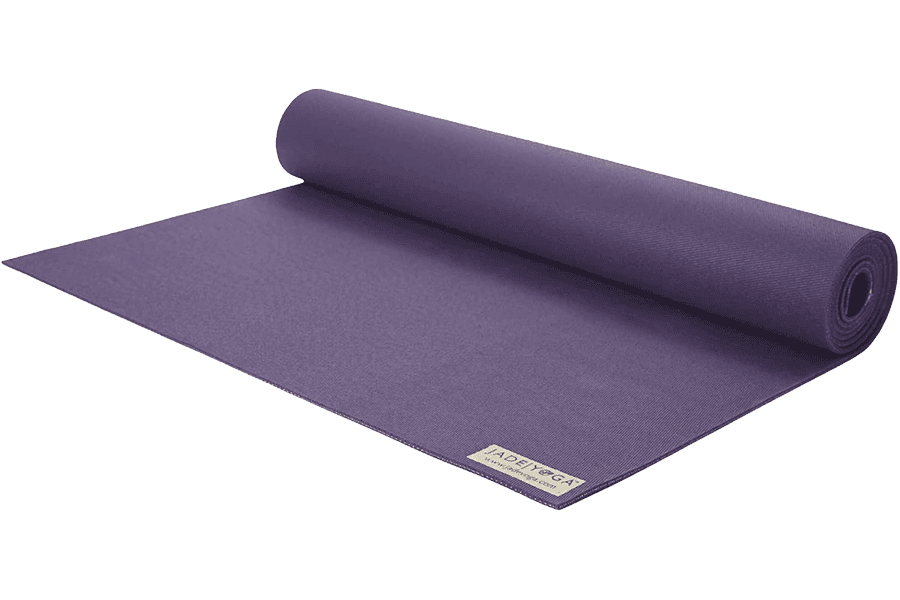
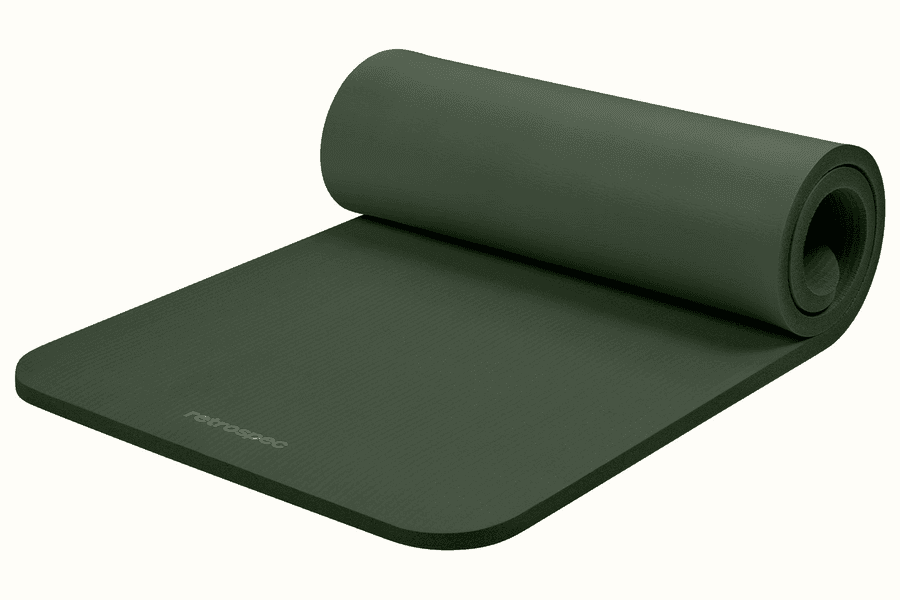
Price
The Solana 1" lists for about $60 less.
$99.95
List price · check price at Amazon
$39.99
List price · check price at Amazon
Thickness
The Solana 1" is 429% thicker.
4.8 mm0.19″
25.4 mm1″
Weight
The Solana 1" is 0.8 lbs lighter.
4.8 lbs2.2 kg
4 lbs1.81 kg
Size
The Solana 1" is 4″ longer; same width.
Same on both
- About 72 inches of usable length
- Both ship with or fit a standard carry strap
- Both need to stay out of direct sun
- Neither is designed for shoes
Full specs
Dimensions
Materials & build
Buying
A studio mat and an exercise pad
An inch of foam is more than five times the thickness of a Jade Harmony. That is not a small upgrade in cushioning, it is a different category of product. The Solana 1″ is a floor-work pad that Amazon shelves next to yoga mats; the Harmony is a natural rubber mat that has been in studios since the early 2000s.
The Harmony costs $99.95 and the Solana about $39.99. Both are around 72 inches of usable length and 24 inches wide, which is where the resemblance ends.
What 25 mm does to a balance pose
Soft foam that thick does not compress evenly. The pressure under your heel differs from the pressure under the ball of your foot, so the surface tilts under you and your ankle spends the pose managing the mat. Tree, warrior three and half moon all become harder in a way that does not improve your balance, it just makes it noisier.
The Harmony’s rubber is dense and holds still. That firmness is what people mean when they call a mat stable, and it is why the mat has outlasted a lot of trendier surfaces. Retrospec, to its credit, leads its own listing with stretching, mat Pilates and somatic work rather than yoga flows.
Grip: the Harmony absorbs, the Solana cannot
Open-cell natural rubber takes sweat into the surface rather than letting it sit on top, so traction improves as you heat up. No break in, no ritual, no salt scrub. That mechanism is the single reason the Harmony keeps getting recommended for sweaty practice, and Wirecutter has pointed at the same property.
NBR foam is closed-cell, so moisture pools on the ribs. Dry, the texture is adequate. Damp, it is not, and no amount of ribbing changes the physics. In a hot room the Solana becomes a hazard rather than a mat.
The case for the Solana is joints, and it is a real case
If your knees genuinely hurt on a hard floor, an inch of foam is a relief that no yoga mat can match. For rehab work, core work on your back, seated practice or general stretching in front of a screen, the Solana is the more comfortable place to be and it costs $60 less.
The alternative worth knowing about is a firm mat plus a knee pad or a folded blanket, which puts the padding exactly where you need it and leaves the rest of the surface stable. It also costs almost nothing if you already own a blanket.
Tree rubber against nitrile foam
The Harmony is natural rubber tapped from trees and made in the USA, and Jade plants a tree for every mat sold, over two million to date. The flip side is the allergy note: Jade calls the mats 99% latex free and does not recommend them for anyone with a latex allergy.
NBR is nitrile butadiene rubber foam, the same stuff in gym mats and camping pads. It is synthetic, latex-free, very light for its bulk, and it dents. Retrospec also lists the mat as free of BPA, phthalates and heavy metals, and warns that the foam may smell for a day or two out of the packaging.
How each one wears out
The Harmony loses tack slowly and can shed a little over years of heavy use. Sun is its real enemy: UV degrades natural rubber, and Jade’s one year warranty excludes both sun damage and harsh cleaners. Kept indoors and rinsed gently, several years of steady practice is reasonable.
The Solana takes permanent impressions where your weight sits, usually within the first year of regular use, and the edges tear before the middle fails. Retrospec covers manufacturing defects for six months and takes returns within 30 days for unused product.
Sizes and the Harmony 2.0 trap
Jade sells this mat at 68″, at 74″ and as an 80″ × 28″ XW. Retrospec offers the Solana only at 72″ × 24″, in one inch and half inch.
Check which Harmony a listing is selling. The Harmony 2.0 is a separate mat made in Spain with different certifications, and it is the version that carries the recent OutdoorGearLab award. The original USA-made Harmony is the one this page covers.
Price and value
List prices are $99.95 and $39.99. Check the current price on the Harmony and the Solana 1″ at Amazon, where the Solana carries 4.5 stars across roughly 14,900 ratings.
That rating is genuine, and it is worth reading what people bought it for. Most of the praise is about knee comfort and home workouts rather than yoga practice. At $40 as an exercise pad it is good value; at $40 as a yoga mat it is the wrong product.
Bottom line
Buy the Jade Harmony for yoga. It grips from the first class, absorbs sweat instead of pooling it, holds still under a standing foot, and it is made in the USA from natural rubber.
Buy the Retrospec Solana 1″ if what you need is padding and your session happens on the ground. If you want something in between, Retrospec’s own half inch version is steadier, and our Harmony vs Gaiam Premium comparison covers a cheap mat that still behaves like a yoga mat.
Jade Harmony
List price $99.95
Retrospec Solana 1"
List price $39.99
Frequently Asked Questions
- Can you do yoga on a one inch mat?
- You can, but you will fight it. At 25 mm the surface compresses unevenly under a standing foot, so your ankle spends the pose stabilising the mat rather than you. Retrospec's own listing leads with stretching, mat Pilates and somatic work rather than yoga flows, which is a fair account of what the mat is for. If you want cushion and yoga, the half inch Solana is the steadier option, or a firm mat with a folded blanket under your knees.
- Why is the Harmony so much grippier?
- Because it absorbs. Open-cell natural rubber pulls sweat into the surface instead of leaving a film on top, so grip improves as you warm up rather than falling apart. Closed-cell foam like the Solana's cannot do that. It is also why the Harmony needs no break-in period at all, unlike the dense PVC mats it competes with.
- Which is better if I have knee pain?
- The Solana, no question, and that is what it is built for. The trade is stability. Plenty of people with sore knees end up on a firm mat with a folded blanket or a knee pad where they need it, which keeps the footing and adds padding only in the spots that hurt. If your practice is mostly gentle and floor-based, though, an inch of foam is a genuine pleasure.
- How does each one wear out?
- Differently. The Harmony's rubber gradually loses tack and can shed a little over years of use, and Jade's one year warranty excludes sun damage and harsh cleaners, both of which kill natural rubber fast. The Solana's NBR foam takes permanent dents where your weight lands and tears at the edges; Retrospec warrants defects for six months and takes returns within 30 days.
- Does the Harmony work for hot yoga?
- It is one of the better options in its price range. The absorbent rubber keeps working as you sweat, which is why heated studios have recommended it for years. The catch is hygiene: an open-cell mat drinks everything, so it wants rinsing rather than a quick wipe, and it will age faster than a closed-cell mat under the same conditions. The Solana in a hot room is a slip hazard.
- Are there other sizes?
- The Harmony comes in a 74 inch Long and an 80 by 28 inch XW, both worth a look if 68 inches feels short. Retrospec makes the same Solana in a half inch at about $25, which is the version we would pick of the two for anyone doing actual yoga.
Related comparisons
- JadeYoga Harmony 68" vs Suga SugaMat
- Amazon Basics 1 Inch Extra Thick vs Retrospec Solana 1"
- JadeYoga Harmony 68" vs Manduka PRO Lite Terra 4.7mm
- JadeYoga Harmony 68" vs Manduka eKO Lite
- Manduka PROlite vs JadeYoga Harmony 68"
- JadeYoga Harmony 68" vs Manduka GRP Adapt 1.0
- JadeYoga Harmony 68" vs Manduka eKO Lite Long
- JadeYoga Harmony 68" vs Manduka GRP Adapt Lite 2.1 4mm
- JadeYoga Harmony 68" vs Lululemon The Mat 5mm