Jade Harmony vs Gaiam Classic Print: Which One Should You Buy?
Same 68 by 24 footprint, within a millimeter of each other on thickness, and four times apart on price. The Jade Harmony is natural rubber made in the USA and has barely changed in two decades because the surface works. The Gaiam Classic Print is the printed sticky mat that has been most people's first yoga mat for about as long. If you are wondering whether the upgrade is real, it is, and it is almost entirely about one thing.
As an Amazon Associate, we earn from qualifying purchases made through links on this page. How this works
The quick answer
Grip. Jade's open-cell rubber takes on light sweat instead of letting it bead, so it holds when your palms get damp, and it is tacky from the first minute with no break-in. The Gaiam grips fine dry and lets go as soon as you sweat, which is what every sticky PVC mat does. Add a firmer, denser platform, USA manufacturing, and longer sizes Gaiam does not offer, and the $74.97 buys real things.
None of that helps if you practice gently twice a month in a cool room, where the Gaiam is genuinely enough mat. It is also 2.7 pounds lighter and the only one of the two that is safe with a latex allergy.
Get the Jade Harmony if...
- You flow, sweat, or practice more than occasionally
- You want a surface that grips from the first session and keeps doing it
- You may want a 74″ or 80″ version; Jade makes both
- You want USA-made natural rubber rather than PVC
Get the Gaiam Classic Print if...
- You want a working mat for $24.98
- You carry your mat and 2.1 pounds beats 4.8
- You have a latex allergy; the Jade is tree rubber
- You want a printed design and no rubber smell
Side by side
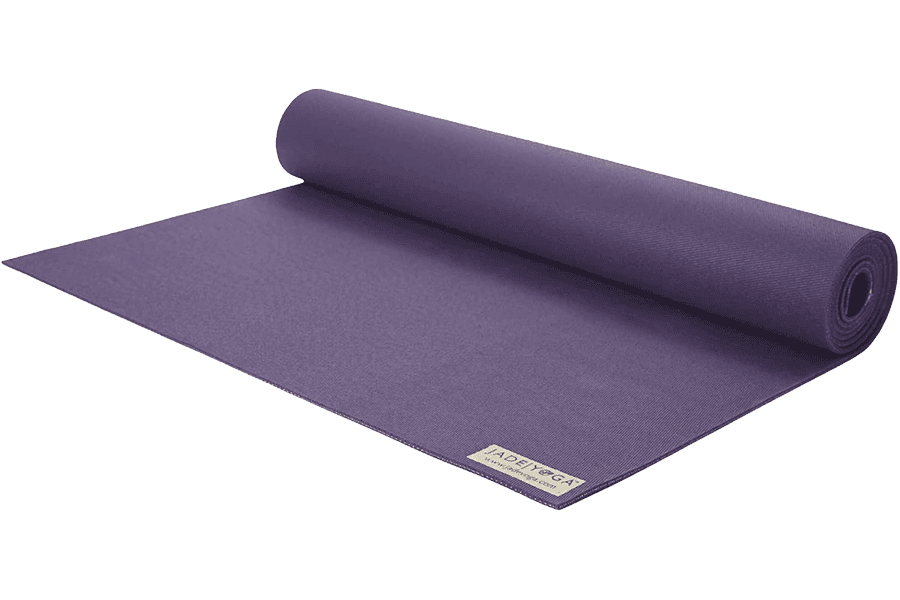
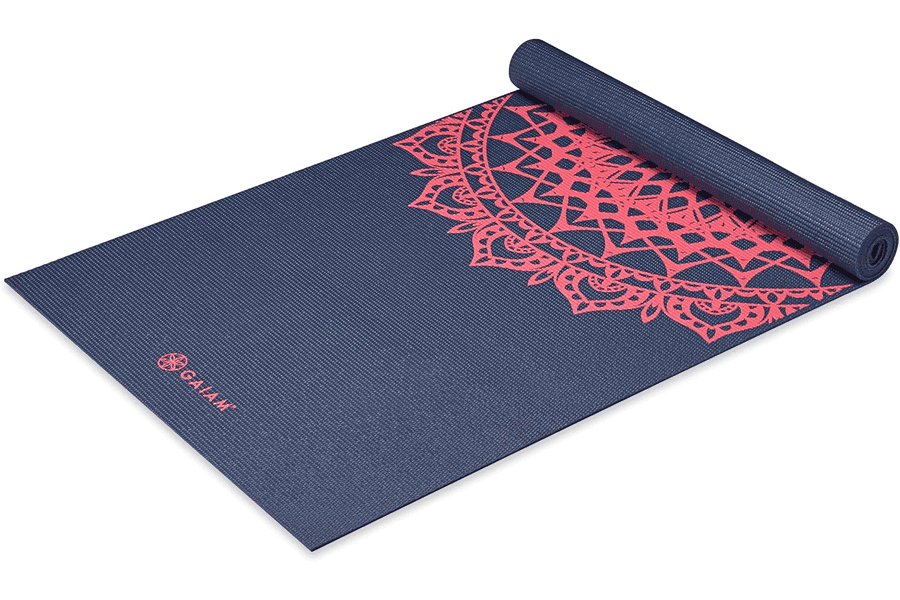
Price
The Classic Print lists for about $75 less.
$99.95
List price · check price at Amazon
$24.98
List price · check price at Amazon
Thickness
The Harmony is 20% thicker.
4.8 mm0.19″
4 mm0.16″
Weight
The Classic Print is 2.7 lbs lighter.
4.8 lbs2.2 kg
2.1 lbs0.95 kg
Size
Same length; same width.
Same on both
- Identical 68″ × 24″ footprint
- Within a millimeter of each other on thickness
- Both grip from the first session with no break-in
- Wipe-clean care; neither goes in a washing machine
Full specs
Dimensions
Materials & build
Buying
Four times the price for the same amount of floor
Both mats are 68″ × 24″. Both are within a millimeter of each other on thickness. Neither has a feature the other lacks, no alignment lines, no clever coating, nothing you could put on a comparison sticker.
The Jade Harmony is $99.95 of natural rubber made in the USA, essentially unchanged for two decades. The Gaiam Classic Print is $24.98 of printed sticky PVC and has been most people’s first yoga mat for about as long.
So the whole $74.97 rides on how the surface behaves, which is unusual and makes this one of the easier upgrade questions to answer.
The one thing the money buys
Jade’s rubber is open-cell, meaning it draws a little moisture in rather than letting sweat sit on top. In practice that is a mat which feels tacky from the first minute, needs no breaking in, and keeps holding as a room warms up and your palms go damp.
The Gaiam’s textured sticky finish is fine while everything stays dry. It is not fine after that, and no amount of wiping between poses changes it, because a sticky surface under a film of sweat is just wet plastic. Every mat of this type behaves the same way.
Whether that matters is entirely about your practice. Gentle stretching in a cool room may never get you there. A vinyasa class, or a warm living room in July, gets you there in the first ten minutes.
Which Harmony the reviews are talking about
Worth pausing on, because it trips people up. OutdoorGearLab’s dry grip award went to the Jade Harmony 2.0, which is a different product: made in Spain, listed at $110, carrying certifications the original does not.
The mat on this page is the original, USA-made Harmony at $99.95. Same material, same name, same basic design, different factory and paperwork. We treat the 2.0’s results as a reasonable indication of how the rubber behaves rather than a measurement of this mat, and we would rather flag that than quietly borrow the score.
Firmness, and why thinner can feel like more
The Harmony is 4.8 mm and the Gaiam is 4, so on paper they are nearly identical. Underfoot they are not. Dense rubber holds its shape where you load it; light PVC foam gives, and keeps giving as it compresses over months of use.
That shows up in two places. Standing balances are steadier on the Harmony because your foot is not sinking and correcting. And a year in, the Gaiam is measurably thinner exactly where your hands and heels land, which is where you need it.
Neither is a cushioned mat. If knees are the problem you are trying to solve, both are too thin and a 6 mm mat is the answer instead.
The rubber smell is real
A new Harmony smells of rubber, sometimes strongly, for a week or two before it fades with use and fresh air. It surprises people who have only owned PVC mats, and it is normal rather than a fault.
The Gaiam has a light plastic smell that clears in a couple of days. If you live somewhere small and a persistent rubber smell would genuinely bother you, that is a fair reason to stay with the cheap mat, and one of the few arguments in its favor that has nothing to do with money.
Weight, and the sizes Gaiam does not make
The Gaiam is 2.1 pounds and the Harmony is 4.8. A walk to a studio four times a week makes that gap real, though neither is heavy next to the 7 and 8 pound mats in this category.
Length is where the cheap mat simply runs out of answers. The Classic Print comes in one size. Jade makes the Harmony in 68″, a 74″ Long, and an 80″ × 28″ Harmony XW. Above about five foot eight that stops being a detail.
Where each mat comes from, and the allergy catch
The Harmony is tapped tree rubber with no PVC in it, made in the USA, and Jade plants a tree for every mat sold, past two million by its own count. That is a program rather than a certification, and it is a real one.
The catch is allergies. Jade describes its mats as 99% latex free rather than latex free, so the Harmony is not safe with a genuine latex allergy. The Gaiam is latex-free PVC and wins here by default. For those buyers the question becomes which PVC mat to buy, and the Manduka PROlite is the usual upgrade.
How long each survives, and a warranty that misleads
Gaiam advertises a lifetime guarantee. Jade writes one year and excludes sun damage and harsh cleaners. Read that quickly and you would pick the wrong mat.
Neither policy is likely to help you, because these mats do not fail with a defect you can claim on. They wear out, and the Gaiam wears out first: the foam flattens where your hands and heels land, typically inside a year or two of regular use. A Harmony kept out of hot cars and direct sunlight, both of which degrade rubber, runs for several years before the tack starts to go.
Prices and where to buy
Check the current Harmony price at Amazon and the current Classic Print price at Amazon. Gaiam discounts heavily and often, and the Harmony occasionally dips in less popular colors. Jade also sells direct.
If the Harmony appeals but the price does not, the cheaper way into Jade’s rubber is the Level One at $66.50, which is the same idea in a thinner, plainer mat with the same one-year warranty.
Bottom line
Buy the Gaiam Classic Print if you practice gently and occasionally, you carry your mat daily, latex is a problem, or you are still finding out whether this sticks. It grips fine dry and costs $24.98, and there is no shame in it.
Buy the Jade Harmony if you flow, if you sweat, or if you already know you will keep practicing. Grip is the upgrade people notice on day one and keep noticing, and at $99.95 the Harmony is close to the cheapest way to stop sliding. Accept the rubber smell for the first fortnight and the extra 2.7 pounds on your shoulder.
Jade Harmony
List price $99.95
Gaiam Classic Print 4mm
List price $24.98
Frequently Asked Questions
- Is the Jade Harmony worth four times the price?
- If you practice weekly or more, yes, and the reason is traction rather than prestige. Jade's open-cell rubber absorbs light sweat rather than letting it sit on the surface, so your hands stay put as a room warms up. The Gaiam's sticky finish depends on staying dry. If your practice is gentle stretching in a cool room, you may never reach the point where that matters, and $74.97 is real money.
- Did OutdoorGearLab test this Harmony?
- No, and the distinction matters. GearLab's dry grip award went to the Jade Harmony 2.0, a different mat: made in Spain, listed at $110, carrying certifications the original does not. The mat on this page is the original USA-made Harmony at $99.95. They share a material and a name, so the 2.0's results indicate rather than measure this one, and we would rather say that than borrow the score.
- Does the Jade smell?
- New ones smell of rubber, sometimes strongly, and it fades over a few weeks of use and airing out. It is normal for natural rubber and not a defect. The Gaiam has a lighter plastic smell that clears in a couple of days. If a rubber smell in a small apartment would genuinely bother you, that is a fair reason to stay with the Gaiam.
- Which is more comfortable?
- Neither is a cushioned mat. The Harmony is 4.8 mm of dense rubber and the Gaiam is 4 mm of lighter foam, so the Gaiam has slightly more give on day one and progressively less as it compresses where your hands and heels land. The Harmony feels firmer and considerably steadier under a standing balance. If knees are the problem, both are too thin and a 6 mm mat is the answer.
- Which lasts longer, and what is covered?
- The Harmony, by years, though the paperwork says the opposite. Jade writes a one-year warranty excluding sun damage and harsh cleaners. Gaiam advertises a lifetime guarantee on a $24.98 mat, which is worth less than it sounds because these mats fail by compressing and thinning rather than by a defect anyone will replace. Keep rubber out of hot cars and direct sun and a Harmony runs for years.
- What sizes does each come in?
- The Gaiam Classic Print is sold in one size, 68″ × 24″. Jade makes the Harmony in 68″, a 74″ Long, and an 80″ × 28″ Harmony XW. Above about five foot eight that difference stops being academic, and it is one of the few places where the cheap mat simply has no answer.
- Is either safe with a latex allergy?
- The Gaiam is; it is latex-free PVC. The Harmony is tapped tree rubber, and Jade states its mats are 99% latex free rather than latex free, so it is not safe with a genuine allergy. For those buyers the question becomes which PVC mat to buy rather than whether to spend more.
Related comparisons
- JadeYoga Harmony 68" vs Suga SugaMat
- JadeYoga Harmony 68" vs Manduka PRO Lite Terra 4.7mm
- JadeYoga Harmony 68" vs Manduka eKO Lite
- Manduka PROlite vs JadeYoga Harmony 68"
- JadeYoga Harmony 68" vs Manduka GRP Adapt 1.0
- JadeYoga Harmony 68" vs Manduka eKO Lite Long
- Amazon Basics 1/4 Inch Thick TPE vs Gaiam Classic Print 4mm
- JadeYoga Harmony 68" vs Manduka GRP Adapt Lite 2.1 4mm
- JadeYoga Harmony 68" vs Lululemon The Mat 5mm