Amazon Basics 1 Inch vs Manduka GRP Adapt 2.0: Which One Should You Buy?
This is the widest gap on our site: a $38 inch-thick foam pad against a $128 precision tool for sweaty practice. One maximizes softness, the other maximizes wet grip, and each is close to useless at the other's job. If you've narrowed a search to these two, the search terms went sideways somewhere; this page exists to route you to the right shelf.
As an Amazon Associate, we earn from qualifying purchases made through links on this page. How this works
The quick answer
For anything resembling active yoga, the GRP Adapt 2.0 is the only candidate here. Its firm 5 mm base holds standing poses steady and its absorbent top grips through sweat that would turn most mats into a slide. An inch of soft foam can't hold a warrior pose in any climate, and adding heat and sweat makes it comically worse. The 2.0's price, weight, and care routine are real costs, but they buy a genuine capability.
For floor exercise, stretching, and physical therapy comfort, the Amazon Basics is the sensible product and the 2.0 is an expensive mistake; absorbent polyurethane and plush comfort have nothing to do with each other. Sort by what you'll actually do on the mat and this pairing resolves quickly.
Get the Amazon Basics if...
- You want maximum cushion for floor-based work
- Hard floors are the problem you're solving
- You're spending about $38, not $128
- A strap-carried pad suits your gym routine
Get the GRP Adapt 2.0 if...
- Heated or sweaty classes are your practice
- You want bare-hand grip through a wet class
- You need a stable base for standing poses
- You'll maintain the air-dry, gentle-clean routine
Side by side
Price
The Amazon Basics lists for about $90 less.
$38.40
List price · check price at Amazon
$128
List price · check price at manduka.com
Thickness
The Amazon Basics is 408% thicker.
25.4 mm1″
5 mm0.2″
Weight
The Amazon Basics is 1.2 lbs lighter.
4.6 lbs2.1 kg
5.8 lbs2.6 kg
Size
The Amazon Basics is 3″ longer; the GRP Adapt 2.0 is 2″ wider.
Same on both
- Usable for gentle stretching
- Both roll up for storage
Full specs
Dimensions
Materials & build
The widest gap in our catalog
No two mats we compare are further apart than these: 25.4 mm of soft foam for about $38 against 5 mm of engineered rubber and polyurethane for $128. The Amazon Basics 1 inch exists to maximize cushion under a body on the floor. The Manduka GRP Adapt 2.0 exists to maximize grip under sweating palms in a heated room. Neither can stand in for the other even badly, which at least makes the buying advice unambiguous.
Active yoga disqualifies the foam immediately
An inch of soft NBR is the least yoga-capable surface we cover. Standing feet sink and roll, balance poses become dice throws, and planks swallow wrists whole. In a heated class it gets worse, because the non-absorbent surface goes slick the moment sweat arrives, adding slip on top of sink. The 2.0, firm and 26″ wide, holds standing work steady in any climate. If your search started with yoga in it, the foam pad should already be off the list.
What the 2.0 is actually for
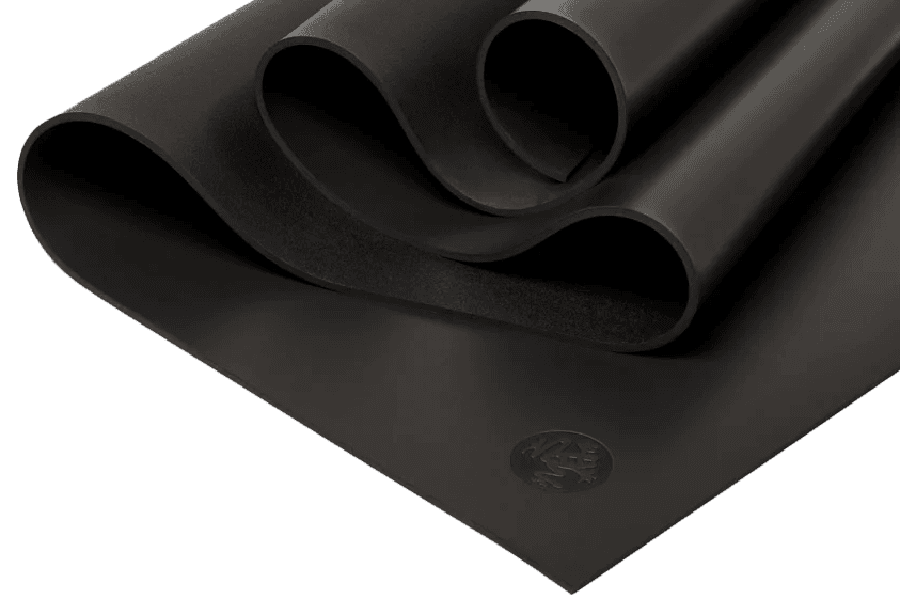
The 2.0’s reason to exist is its Satin Grip polyurethane top, which absorbs sweat into the surface so traction holds bare-handed through a dripping class, no towel involved. That single capability is why OutdoorGearLab made this generation its top hot yoga pick, and it’s what most of the $128 pays for. The rubber body adds a planted, slightly springy stability, and a 79″ Long version covers tall practitioners at $138.
What the foam pad is actually for
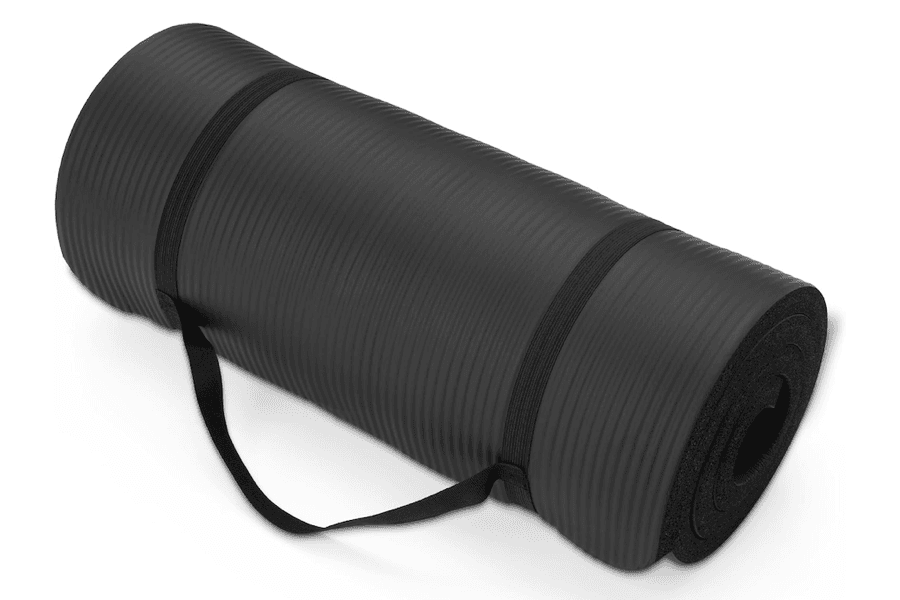
Bought for its real job, the Amazon Basics is a good product: the plushest surface in the budget aisle, 74″ long, strap included, kind to knees, hips, and spines during stretching, core circuits, and physical therapy movements. Its faults, instability underfoot and a foam that eventually flattens, barely matter to a body lying down. At about $38 it’s a cheap way to make a hard floor irrelevant, and no yoga mat at any price matches it there.
The 2.0’s running costs
The 2.0’s capabilities come with chores. It wants to air-dry fully before being rolled, needs regular gentle cleaning to keep absorbed sweat from building up, refuses harsh cleaners and long sun exposure, and weighs 5.8 pounds on the shoulder. Its natural rubber body excludes latex-allergic practitioners, and coverage stops at 30 day returns; years of heavy hot practice will eventually wear the top layer. None of this is a flaw so much as the price of the wet-grip trick, but it deserves clear-eyed accounting next to a pad that asks for nothing.
Availability and the version question
The Amazon Basics is a one-click purchase. The 2.0 currently sells through manduka.com only, in 4 colorways; at last check Amazon stocks just the older GRP Adapt 1.0, a prior generation with different specs at a lower price. The recent awards and reviews belong to the 2.0, so if a listing offers a GRP Adapt, make sure of the number after it before paying.
Price and value
List prices are about $38.40 and $128. Check current prices on the Amazon Basics 1 inch and the GRP Adapt 2.0 at manduka.com.
The $90 between them doesn’t buy an upgrade; it buys a different tool. A hot yoga practitioner gets full value from the 2.0 and none from the foam. A stretcher gets full value from the foam and would be lighting money on fire with the 2.0. The middle ground, a firm mat around $26 like Amazon’s own 1/4 inch TPE, serves everyone whose practice is dry and budget is real.
Bottom line
Heated, sweaty practice: GRP Adapt 2.0, and it earns its price there. Floor exercise and stretching comfort: Amazon Basics 1 inch, at a sixth of the cost.
And if you’re after one general-purpose yoga mat for unheated practice, buy neither; both are specialists, and the firm middle of the market will fit you better than either end of this page.
Amazon Basics 1 Inch Extra Thick
List price $38.40
Manduka GRP Adapt 2.0
List price $128
Frequently Asked Questions
- Is there anyone who should actually choose between these two?
- Rarely. They're both called yoga mats by retailers, but one is an exercise pad and the other is a hot yoga specialist. The realistic decision is usually between one of these and something in the middle: a firm budget mat like Amazon's 1/4 inch TPE for general practice, or a mid-range closed-cell mat for dry classes. If your practice is heated, the 2.0 side of this page is genuinely for you.
- Why is a 5 mm mat better for yoga than a 25 mm one?
- Stability. A standing pose needs the floor to push back predictably, and 5 mm of dense material does that while 25 mm of soft foam lets the foot sink and roll. Thickness only helps up to the point where it stops being firm; past that it actively works against balance, wrists, and ankles.
- Does sweat really justify a $128 mat?
- If you practice heated yoga regularly, it can. Closed-cell mats need a towel the moment palms sweat, and towels bunch and slide. The 2.0's polyurethane top absorbs moisture and keeps traction bare-handed, which changes how a hot class feels; OutdoorGearLab made this generation its top hot yoga pick. If you sweat lightly or practice dry, save the money.
- What are the 2.0's practical downsides?
- It weighs 5.8 pounds, needs to air-dry fully before rolling, wants regular gentle cleaning and no harsh products, contains natural rubber that latex-allergic households should avoid, has no warranty beyond 30 day returns, and its absorbent top will show wear after years of heavy sweaty use. Specialists have running costs; this is the 2.0's list.
- Where is each mat sold?
- The Amazon Basics is an Amazon product through and through. The GRP Adapt 2.0 sells through manduka.com in 4 colorways with a 79" Long at $138; at last check it has no Amazon listing, and the GRP Adapt you'll find on Amazon is the older 1.0 generation. Confirm the version before you compare any prices.
- Could the foam mat at least serve as a base under another mat?
- For restorative setups and knee-sensitive floor sequences, layering a firm mat over the foam works, and some home practitioners do exactly that. For standing practice it doesn't; the stack inherits the softness of its squishiest layer. It's a comfort accessory, not a foundation.
Related comparisons
- Manduka GRP Adapt 2.0 vs Yoga Design Lab Infinity 5mm
- Manduka GRP Adapt 2.0 vs Hugger Mugger Para Rubber 5mm
- Amazon Basics 1 Inch Extra Thick vs Retrospec Solana 1"
- Manduka GRP Adapt 2.0 vs Lululemon The (Big) Mat 5mm
- Lululemon The Mat 5mm vs Manduka GRP Adapt 2.0
- JadeYoga Harmony 74" vs Manduka GRP Adapt 2.0
- Manduka GRP Adapt 2.0 vs JadeYoga Harmony 2.0 68"
- JadeYoga Harmony XW vs Manduka GRP Adapt 2.0
- Manduka GRP Adapt 2.0 vs b, halfmoon B Mat Everyday 4mm