Manduka PROlite Long vs eKO Long: Which One Should You Buy?
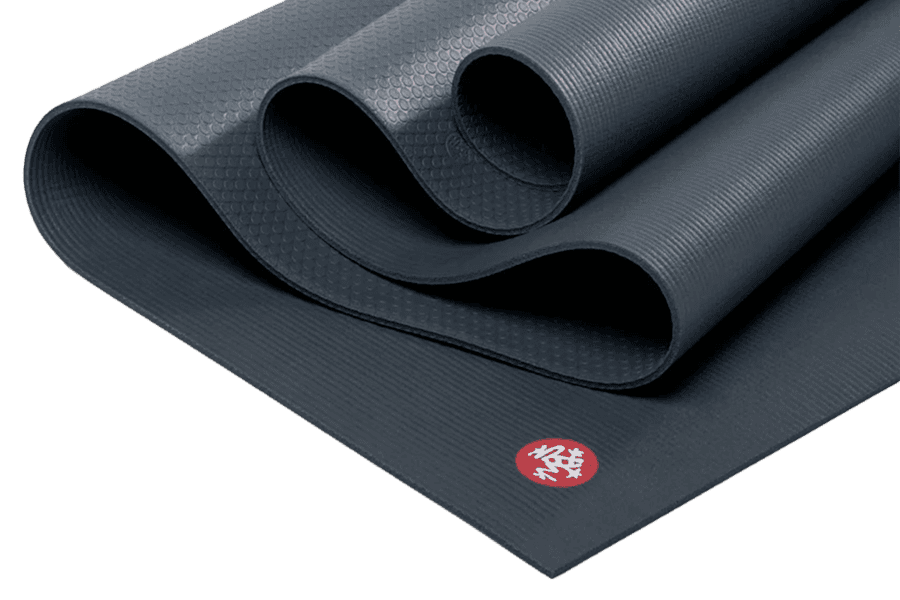
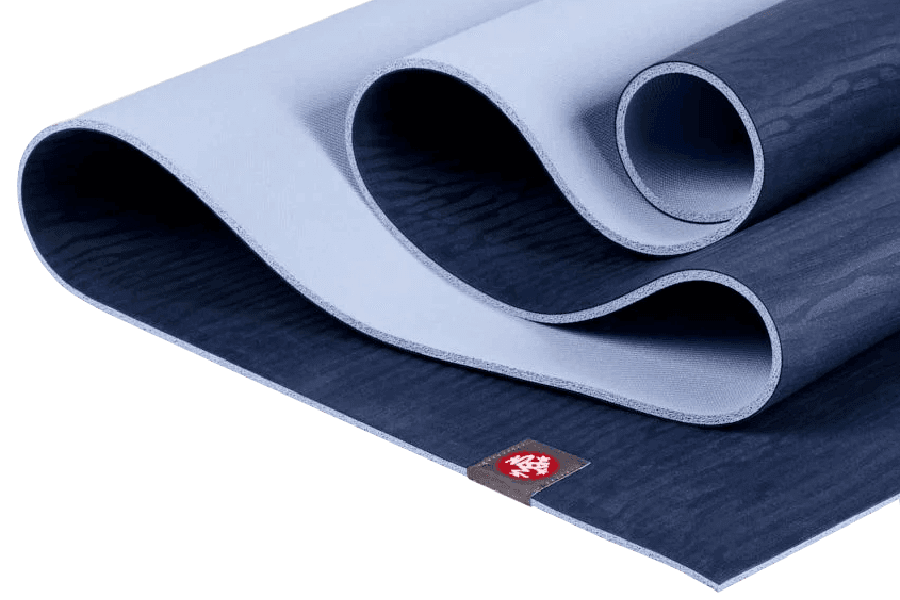
Manduka prices these two tall mats identically, so the $124 buys a choice rather than an upgrade. The PROlite Long is 79" × 24" of dense PVC: 5 pounds, slick until it breaks in, guaranteed for life. The eKO Long is 79" × 26" of natural rubber: grippy from the first class, 8 pounds, one color, covered for 30 days. Length is settled from the start; the decision is material, weight, and how far the mat has to travel.
As an Amazon Associate, we earn from qualifying purchases made through links on this page. How this works
The quick answer
These two split the tall-mat job cleanly. The PROlite Long is the practical one: 3 pounds lighter, guaranteed for roughly a decade of regular use, sold in 4 colorways, with a PVC surface that needs a few slick weeks before the grip arrives. The eKO Long is the pleasant one: real traction from the first practice, an extra 2 inches of width, and natural rubber underfoot, at 8 pounds, in Midnight only, with nothing behind it past Manduka's 30 day return window.
If the mat leaves the house, get the PROlite Long; 8 pounds gets old fast on a shoulder. If it stays on your floor and you want rubber, the eKO Long is the nicer surface to live on from day one.
Get the PROlite Long if...
- You carry the mat to class (5 pounds vs 8)
- You want the lifetime guarantee behind a $124 purchase
- You'd rather pick from 4 colorways than take Midnight
- You can wait out a few slick break-in weeks
Get the eKO Long if...
- You want grip from the very first practice
- You'd use the extra 2 inches of width
- You prefer natural rubber over PVC
- The mat mostly stays home, so 8 pounds doesn't matter
Side by side
Price
Same list price.
$124
List price · check price at Amazon
$124
List price · check price at Amazon
Thickness
The eKO Long is 6% thicker.
4.7 mm0.19″
5 mm0.2″
Weight
The PROlite Long is 3.2 lbs lighter.
4.8 lbs2.18 kg
8 lbs3.6 kg
Size
Same length; the eKO Long is 2″ wider.
Same on both
- Made by Manduka
- Same 79" length
- Same $124 list price
- Closed-cell surface (sweat can't soak in)
- Lies flat without curling
Full specs
Dimensions
Materials & build
Buying
Two answers to the same height problem
Manduka built both of these mats for the practitioner whose heels hang off a standard 71″ mat, and priced them at the same $124. From there they diverge completely. The PROlite Long is 79″ × 24″ of dense PVC at 5 pounds, with the PRO-series lifetime guarantee and the PRO-series break-in period. The eKO Long is 79″ × 26″ of natural rubber at 8 pounds, grippy from the first class, sold in one color, and covered by a 30 day return window and nothing after.
Because price and length cancel out, this page comes down to three genuine differences: how much the mat weighs, how it grips, and how long it lives.
Weight: three pounds decide the commute
The PROlite Long weighs 5 pounds, which is light for a 79 inch mat; the whole point of the PROlite formula is keeping the PRO’s density in a carryable slab. The eKO Long weighs 8 pounds, which is heavier than the famously hefty 71″ Manduka PRO, and it rolls into a wider, denser cylinder thanks to the 26″ width.
If the mat rides a shoulder to class a few times a week, that gap settles the comparison almost by itself. Owners of the eKO Long overwhelmingly treat it as a leave-it-somewhere mat, at home or at the studio, and that’s the honest way to shop it. The PROlite Long is the only one of the two that works as a daily commuter.
Grip: the eKO Long starts ready
Out of the box the eKO Long is simply the better mat to practice on. Its textured natural rubber has the warm, slightly tacky hold that makes rubber mats immediately likable, and there’s no waiting period. The PROlite Long arrives slick, and stays slick for a few weeks of regular practice while the surface breaks in. Manduka used to suggest a salt scrub to hurry this along; its current position is that use alone resolves it, which matches what owners report.
After break-in, the PROlite Long’s dry grip is very good and keeps improving for years. On sweat the two tie at mediocre: both are closed-cell surfaces, so moisture pools on top rather than soaking in, and a heated class calls for a towel on either. Sweat-heavy practices are better served by an open-cell mat like the Jade Harmony.
What the extra two inches of width buys
The eKO Long’s 26″ deck is a real amenity. Elbows stay on the mat in savasana, hands land on rubber instead of floor in wide stances, and the extra margin gets used in every practice, unlike extra length, which only matters in a handful of poses. If you’ve ever felt boxed in on a standard mat, this is the more spacious of the two by a meaningful amount.
The PROlite Long holds the standard 24″. Manduka does make a wider PVC mat in this class, the 79″ × 30″ PROlite Long & Wide, for buyers who want the footprint without switching materials.
Cushioning: firm PVC against springier rubber
On paper the eKO Long is thicker, 5 mm to 4.7. Underfoot the difference reads as character more than protection. The PROlite Long’s PVC is dense and compresses very little, so it feels firm and stable in standing balances and keeps knees off the floor despite the modest number. The eKO Long’s rubber has more spring and a warmer feel, with slightly more give under point pressure.
Neither is a plush mat, and neither should be bought as one. Practitioners with genuinely cranky knees are better off with a 6 mm slab like the PRO than with either of these.
Durability and the warranty gap
Manduka’s lifetime guarantee covers the PRO series and stops there. The PROlite Long qualifies; the fine print works out to roughly a decade of regular use with one replacement, with proof of purchase from an authorized seller. That coverage sits on top of a PVC surface that GearLab keeps finding in service many years on, with no care rules worth remembering: sun, hot cars, and any cleaner are all fine.
The eKO Long gets the 30 day return window. Natural rubber softens and shows surface wear within a few years of daily practice, direct sun damages it outright, and it wants gentle cleaners. None of that is a defect; it’s what the material is. But when the same company backs one mat for a decade and the other for a month at the same price, that difference is worth taking at face value.
Colors and the rest of each family
The PROlite Long comes in 4 colorways at last count: Midnight, Black, Thunder, and Black Sage. The eKO Long comes in Midnight, full stop. Manduka always shortens the palette on long cuts, but one option is as short as it gets, and it means the eKO Long buyer is accepting the look along with the mat.
Both mats have shorter siblings if 79 inches turns out to be more than you need: the standard PROlite at 71″ × 24″ and the standard eKO at 71″ × 26″, each around ten dollars cheaper than its long version. And if you want long rubber at a lighter weight, the 4 mm eKO Lite Long carries 5.6 pounds; we compare it directly on our PROlite Long vs eKO Lite Long page.
Price and value
Both mats list at $124. Check current prices on the PROlite Long and the eKO Long before deciding, since street prices drift.
At identical list prices, cost per year favors the PROlite Long heavily: a guaranteed decade against rubber’s few-year replacement cycle. What the eKO Long returns instead is daily quality of life, grip without a waiting period, width you feel in every practice, and a renewable material. Both are defensible ways to spend the same money; they just pay out on different schedules.
Bottom line
Get the PROlite Long if the mat travels, if you want the purchase backed for a decade, or if you’d like any say in the color. It asks for a few slick weeks up front and gives you the easier mat to own for years after.
Get the eKO Long if it will live on your floor and rubber is the point: instant traction, a wider deck, and a natural material, carried by a mat you won’t want to carry. At the same price, pick by where the mat will spend its life.
Manduka eKO Long
List price $124
Frequently Asked Questions
- Which is better for tall practitioners, the PROlite Long or the eKO Long?
- On length alone they tie. Both are 79 inches, enough that a practitioner around six foot four still fits in savasana with margin. The decision moves to everything else: the PROlite Long is 3 pounds lighter and guaranteed for life, the eKO Long is wider and grips without a break-in. Tall buyers aren't choosing between fits here, just between materials.
- Which grips better, the PROlite Long or the eKO Long?
- For the first month, the eKO Long by a wide margin. Its textured rubber holds from the opening class, while a new PROlite Long is slick until a few weeks of practice break in the surface; Manduka's current advice is simply to keep using it. Broken in, the PROlite Long's dry grip is very good and improves with age. Both are closed-cell mats, so sweat pools on top and heated classes call for a towel on either.
- Does the eKO Long get Manduka's lifetime guarantee?
- No. The guarantee covers the PRO series only, so the PROlite Long qualifies and the entire eKO line does not. The fine print on the guarantee amounts to roughly a decade of regular use with one replacement, with proof of purchase from an authorized seller. The eKO Long gets Manduka's standard 30 day return window, plus care rules PVC doesn't have: keep it out of direct sun and away from harsh cleaners.
- How much does the eKO Long's extra width matter?
- Two inches sounds trivial and isn't. On the eKO Long's 26 inch deck, elbows stay on the mat in savasana and wide-legged poses feel noticeably less precarious than on the PROlite Long's standard 24. The cost shows up in the roll: the wider, heavier mat makes a bulkier carry, which compounds the 8 pound weight. Width is a genuine reason to pick the eKO Long; it's just not a free one.
- What colors do the PROlite Long and eKO Long come in?
- The PROlite Long comes in 4 colorways at last count: Midnight, Black, Thunder, and Black Sage. The eKO Long comes in exactly one, Midnight. Manduka's long cuts always get a thinner palette than the standard sizes, but one option is the floor. If color matters and you want long rubber, the eKO Lite Long at least offers two.
- Is either mat good for hot yoga?
- Not really. Both surfaces are closed-cell, so sweat sits on top rather than absorbing, and enough of it defeats either mat. The eKO Long stays grippier a little longer as things get damp, but a dripping class wants a towel on both. If heated classes are your main practice, an open-cell rubber mat like the Jade Harmony is the better tool than either of these.
Related comparisons
- Manduka eKO Long vs Lululemon The (Big) Mat 5mm
- Manduka PROlite Long vs Lululemon The Mat 5mm
- Manduka eKO Long vs Hugger Mugger Para Rubber 5mm
- Manduka eKO Long vs Yoga Design Lab Infinity 5mm
- Manduka PROlite Long vs JadeYoga Harmony 2.0 68"
- Manduka PROlite Long vs Yoga Design Lab Infinity 5mm
- Manduka PROlite Long vs b, halfmoon B Mat Everyday 4mm
- Manduka PROlite Long vs JadeYoga Harmony 74"
- Manduka PROlite Long vs Hugger Mugger Para Rubber 5mm