Manduka GRP Adapt 1.0 vs Amazon Basics 1 Inch: Which One Should You Buy?
One mat solves slipping; the other solves hardness. The GRP Adapt 1.0's absorbent top exists so palms hold through a dripping hot yoga class. The Amazon Basics 1 inch's thick soft foam exists so knees and spines forgive a concrete floor. Nobody's practice needs both qualities from one purchase, which makes this $56 gap easy to route once you name your actual problem.
As an Amazon Associate, we earn from qualifying purchases made through links on this page. How this works
The quick answer
If your problem is sweat, or any active standing practice, the 1.0 is the only mat on this page. It plants standing poses on firm rubber, spans a generous 26" width, and its polyurethane surface absorbs the moisture that ruins ordinary mats, all at the lowest current price in Manduka's GRP line. The inch of foam fails standing work in dry rooms and fails it harder in hot ones.
If your problem is a hard floor under stretching, physical therapy, or core work, the foam wins just as cleanly: plusher than any yoga mat, a quarter the price, strap included, and its wobbliness is irrelevant to horizontal exercise. Buy the solution to your problem, not the more impressive object.
Get the GRP Adapt 1.0 if...
- Hot yoga or heavy sweat is your practice
- You want bare-hand grip through wet classes
- Standing and balance poses fill your sessions
- You'll maintain the drying and cleaning habits
Get the Amazon Basics if...
- Maximum floor cushioning is the actual goal
- Your routine is stretching, PT, or core work
- You're spending about $38, not $94
- You want the carry strap for gym trips
Side by side
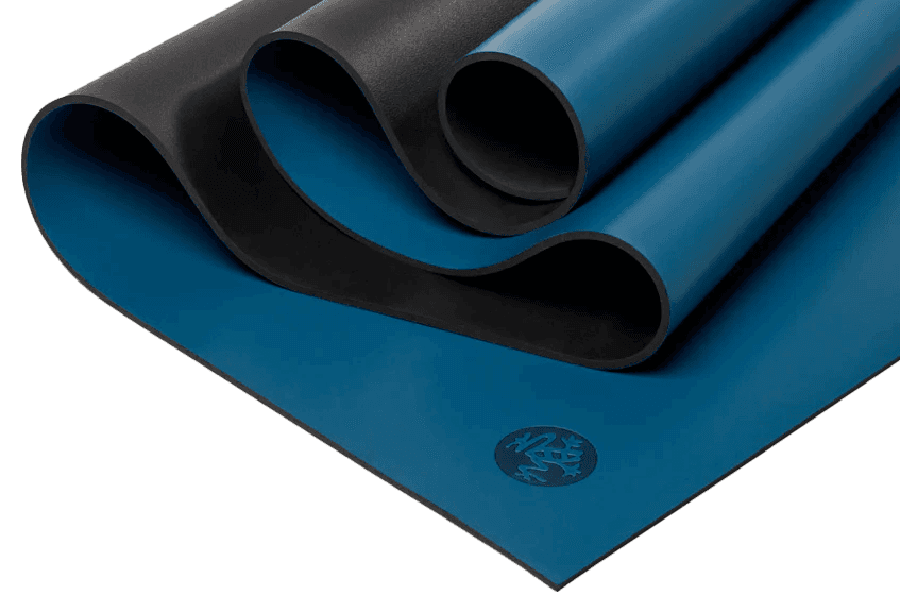
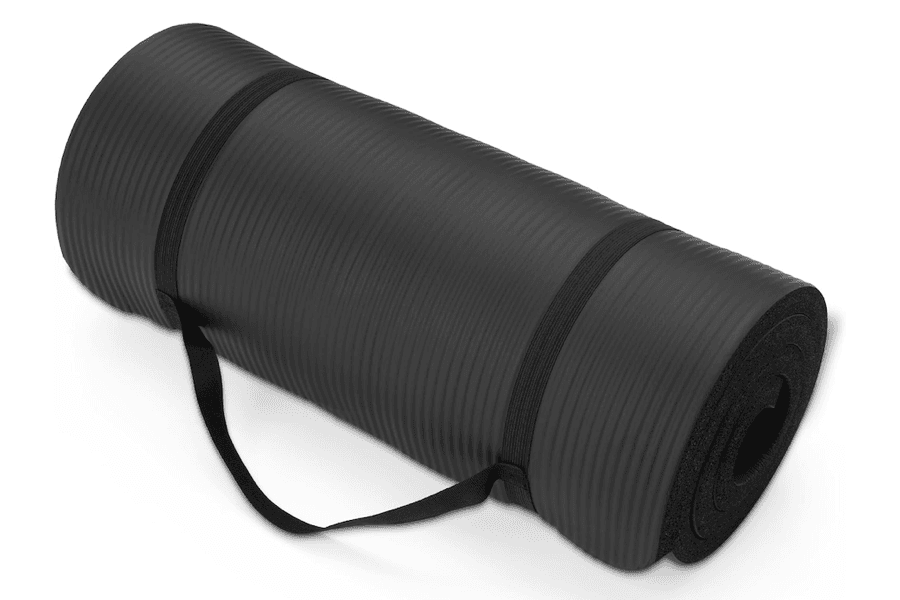
Price
The Amazon Basics lists for about $56 less.
$94
List price · check price at Amazon
$38.40
List price · check price at Amazon
Thickness
The Amazon Basics is 408% thicker.
5 mm0.2″
25.4 mm1″
Weight
The Amazon Basics is 1.2 lbs lighter.
5.8 lbs2.6 kg
4.6 lbs2.1 kg
Size
The Amazon Basics is 3″ longer; the GRP Adapt 1.0 is 2″ wider.
Same on both
- Usable for gentle floor-based exercise
- Both roll up for storage
Full specs
Dimensions
Materials & build
Buying
Two complaints about floors
Every mat is an answer to a complaint about floors. The GRP Adapt 1.0’s complaint is that floors get slippery when you sweat on them; its absorbent polyurethane top exists to keep heated practice planted, at $94. The Amazon Basics 1 inch’s complaint is that floors are hard; its 25 mm of soft NBR exists to make them stop being hard, at about $38. Your own complaint about floors picks your mat.
The yoga verdict is one-sided
An active practice can’t happen on an inch of soft foam. Standing feet sink to unpredictable depths, balance poses turn into ankle rehab, planks swallow wrists, and in a warm room the non-absorbent surface slicks over for good measure. The 1.0 is the opposite on every count: firm 5 mm rubber, a luxurious 26″ width, and a surface that grips harder as sweat accumulates. As yoga equipment, only one of these exists.
The comfort verdict is just as one-sided
Flip to stretching, physical therapy movements, and core work, and the foam collects everything: more cushion than any yoga mat sold, a 74″ length, a carry strap, and a price that rounds to lunch. The 1.0 handles floor work the way firm mats do, adequately and without charm, and its wet-grip surface contributes nothing horizontal. For a recovery corner or a PT routine, the $38 pad embarrasses the $94 specialist.
Handling and formats
Similar weights, opposite shapes. The 1.0’s 5.8 pounds roll slim and dense; the foam’s 4.6 pounds roll fat and strap-dependent. The foam commutes to a gym more agreeably; the 1.0 stays put underfoot in a way soft foam never can. The foam offers 3 colors and a cheaper 1/2 inch sibling; the 1.0 offers two colorways, La Rana or Terracotta at last count, in its single 71″ × 26″ size.
Lifespans and fine print
The foam is a short-timer under real use, flattening and tearing inside a year or two, with a matching 1 year warranty and an initial NBR smell that needs airing. The 1.0 lasts years when its rules are followed: air-dry before rolling, gentle cleaning only, no hot cars or long sun, and no latex-allergic owners. Its coverage is 30 day returns, thin paper for $94, though the construction has the track record the warranty lacks.
Price and value
List prices are $94 and about $38.40. Check current prices on the GRP Adapt 1.0 and the Amazon Basics 1 inch.
The $56 between them buys sweat-proof grip or it buys nothing, depending entirely on your calendar. Hot yoga twice a week makes the 1.0 the obvious spend and the current value play in Manduka’s GRP line. A stretching routine makes the foam the right call and the 1.0 an expensive misunderstanding.
Bottom line
Sweaty practice: GRP Adapt 1.0. It’s the affordable end of a genuinely specialized tool, and the foam can’t enter that conversation.
Floor comfort: Amazon Basics 1 inch, happily and cheaply. And a dry general practice should buy neither; a firm mid-priced mat serves it better than either specialist here.
Amazon Basics 1 Inch Extra Thick
List price $38.40
Frequently Asked Questions
- Which of these is the real yoga mat?
- The 1.0, without qualification. It has the firm base standing poses require and the absorbent surface heated classes demand. The 1 inch foam is a comfortable exercise pad that borrows the yoga label; under a standing body it sinks and wobbles, and under a sweating one it also slides.
- Is an inch of foam ever the right buy?
- Often, for the right buyer: it's the plushest budget surface for stretching, physical therapy movements, and core circuits on unforgiving floors, and at about $38 with a strap it's fairly priced for that. Its only failure mode is being asked to host standing exercise, which unfortunately is how it's most often marketed.
- Why does the 1.0 cost $56 more?
- The money is in the surface: an absorbent polyurethane layer bonded to a natural rubber body, a construction built to keep traction as sweat accumulates. That's specialist engineering with real running costs, careful drying and cleaning among them. The foam is commodity NBR priced accordingly. Neither price is wrong; they're just buying different things.
- How do weight and handling compare?
- The 1.0 is 5.8 dense pounds that roll slim; the foam is 4.6 bulky pounds that roll into a strap-dependent barrel. The foam commutes to a gym more easily despite the similar weight, while the 1.0 stays planted underfoot in a way soft foam never will. Neither is the featherweight of its category.
- What does ownership look like for each?
- The foam: air out the initial NBR smell, use it until it flattens or tears, typically a year or two of steady service, covered by a 1 year warranty. The 1.0: air-dry fully before rolling, clean gently and often, keep it from harsh cleaners, hot cars, and long sun, skip it entirely with a latex allergy, and expect years of service in exchange, backed only by 30 day returns.
- What's the middle path if neither fits?
- A firm, affordable general mat. Amazon's 1/4 inch TPE at about $26 handles dry practice and light floor work; mid-range closed-cell mats add durability. The 1.0 only earns its price when sweat is routine, and the foam only earns its spot when the workout stays horizontal.
Related comparisons
- Amazon Basics 1 Inch Extra Thick vs Retrospec Solana 1"
- Manduka GRP Adapt 1.0 vs Suga SugaMat
- JadeYoga Harmony 68" vs Manduka GRP Adapt 1.0
- JadeYoga Harmony 74" vs Manduka GRP Adapt 1.0
- Manduka GRP Adapt 1.0 vs Gaiam Performance Dry-Grip Long & Wide
- Manduka GRP Adapt 1.0 vs JadeYoga Harmony 2.0 68"
- Manduka GRP Adapt 1.0 vs 42 Birds The Robin
- Lululemon The Mat 5mm vs Manduka GRP Adapt 1.0
- Manduka GRP Adapt 1.0 vs Hugger Mugger Earth Elements 5mm