Liforme Classic vs Gaiam Performance Dry-Grip Long & Wide: Which One Should You Buy?
Both of these promise traction, and one of them has the test results to back it. GearLab scored the Liforme Classic 76 out of 100 with 9 for dry grip; it scored the Dry-Grip construction 62 with a wet grip of 3.5, second from the bottom of a field of 19. Gaiam's counter is size and price: 78 by 26 inches for $74.98.
As an Amazon Associate, we earn from qualifying purchases made through links on this page. How this works
The quick answer
The Liforme's eco-polyurethane top absorbs sweat rather than letting it film up, and it carries alignment guides etched into the surface, which earned it GearLab's award for fine-tuning alignment. It is 4.2 mm and firm. The Gaiam is coated PVC that Gaiam markets as ideal for hot yoga, a claim the independent measurement does not support, but it is longer, cushier and less than half the price.
If grip is what you are buying, the Liforme is the mat and the gap is real. If you are tall and shopping on a budget, the Gaiam covers more floor for less money than anything else we cover, and you can put a towel over it.
Get the Liforme Classic if...
- Grip is the problem you are actually solving
- You want alignment markings for home practice
- You want a firm surface rather than coated foam
- You want the mat to be good in two years, not just now
Get the Gaiam Dry-Grip Long & Wide if...
- You're tall and want 78 inches of length
- You want more cushion underfoot at 5 mm of softer PVC
- You want a lifetime guarantee on paper
- You'd rather keep about $90
Side by side
Price
The Dry-Grip L&W lists for about $90 less.
$165
List price · check price at Amazon
$74.98
List price · check price at Amazon
Thickness
The Dry-Grip L&W is 19% thicker.
4.2 mm0.17″
5 mm0.2″
Weight
The Dry-Grip L&W is 0.5 lbs lighter.
5.5 lbs2.5 kg
5 lbs2.27 kg
Size
The Dry-Grip L&W is 5.2″ longer; the Liforme is 0.8″ wider.
Same on both
- Around 26 to 27 inches wide
- Both were tested by GearLab in its 2026 round-up
- Both need to stay out of direct sun
- Both are wipe-clean rather than washable
Full specs
Dimensions
Materials & build
Buying
Two mats sold on grip, one with the numbers
Liforme builds its mat around an eco-polyurethane top that absorbs moisture; Gaiam applies a topcoat meant to wick it away and calls the result ideal for hot yoga. GearLab measured both in 2026 and the results are not close: 9 out of 10 dry and 7 wet for the Liforme, 6.5 and 3.5 for the Dry-Grip construction.
That 3.5 was second worst of the 19 mats tested. Gaiam’s answer is size and price: 78″ × 26″ for $74.98, against the Liforme’s 72.8″ × 26.8″ for $165.
A coating and a laminated layer are different things
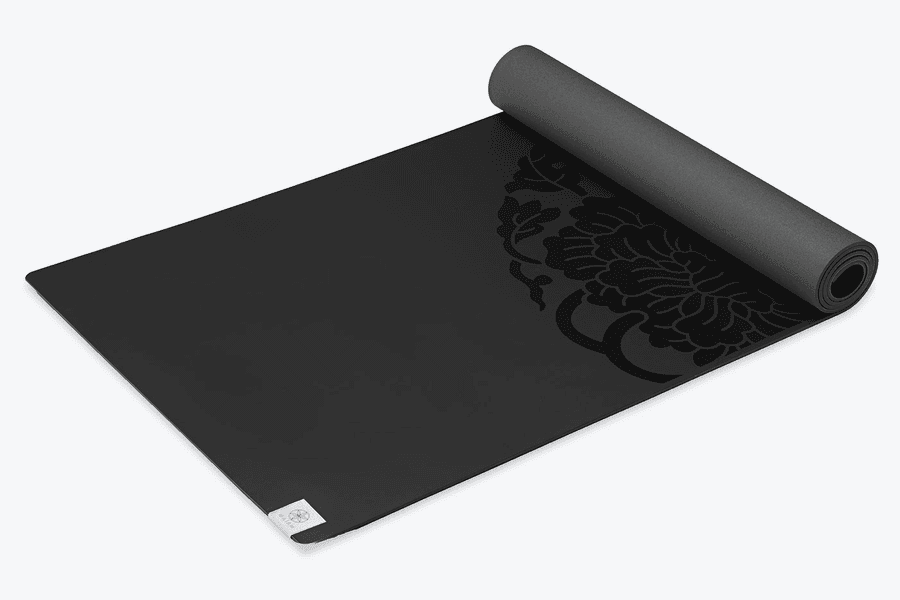
Gaiam’s topcoat is a thin treatment applied over PVC foam. It does wick a little moisture, and it thins out where hands and feet keep landing. Once it goes, you have a plain PVC mat. GearLab rated the Dry-Grip 4 out of 10 for materials, the lowest of the mats we compare here.
The Liforme’s top is a bonded polyurethane layer with the alignment guides etched into it, over a natural rubber base. It also wears, but from a better starting point, at 7 out of 10 for materials.
The thing only one of these has
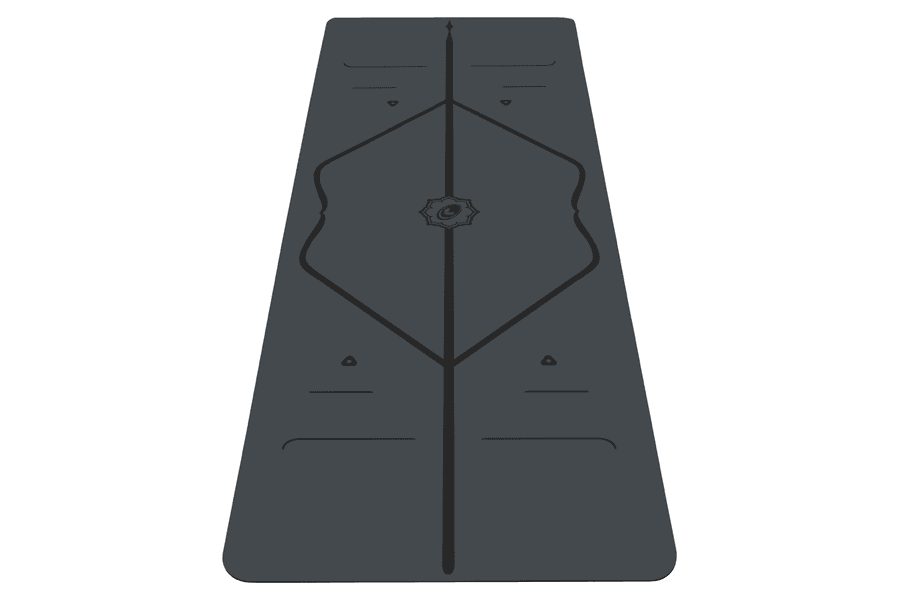
The Liforme’s centre line, hand markers and foot guides are etched rather than printed, and GearLab gave it the 2026 award for fine-tuning alignment. They are most useful when you practice alone and nobody is correcting your form.
If you take taught classes or find markings distracting, that half of the price does nothing for you, and the case narrows to grip and build quality. Both of those still favour the Liforme, just by less.
The Gaiam is the bigger mat
Five inches longer and roughly the same width. For anyone over about six foot, that is the difference between heels on the mat and heels on the floor in savasana, and no grip score compensates for a mat you do not fit on.
Liforme sells this mat in one size, so there is no larger option within the brand. If you need both length and grip, mats in the 79 to 85 inch range from Manduka and Lululemon are where to look, at a price.
Feel: thin and firm against soft and coated
GearLab rated the Gaiam Dry-Grip 8 out of 10 for comfort and support and the Liforme 7, so the cheaper mat actually wins this category. The Gaiam has more give underfoot; the Liforme is one of the thinner premium mats at 4.2 mm and it supports rather than cushions.
Which you prefer depends on your practice. Softer helps when you kneel; firmer helps when you balance, and it is what makes alignment markings meaningful in the first place.
Care and the new-mat smell
Gaiam asks you to unroll the mat and air it for two to three days before your first session, because PVC releases a strong odor when first unwrapped, and it publishes a guide about removing the smell. It also warns that extended sun exposure makes the mat brittle.
The Liforme took 9 out of 10 for care and cleaning, the highest in GearLab’s field, but polyurethane still dislikes harsh cleaners and soaking. A damp cloth, a mild spray and air drying is the routine.
A lifetime guarantee against 30 days
Gaiam’s lifetime guarantee sounds decisive and covers manufacturing defects rather than a topcoat wearing thin or foam compressing, which are the two ways the mat actually reaches the end of its life.
Liforme offers a 30 day return window and no long-term warranty at all, which is genuinely thin for a $165 mat and the strongest argument against it. Neither document should decide this purchase, but the Liforme’s is the weaker one.
Two practical notes
The Liforme has a natural rubber base, so it is unsuitable for anyone with a latex allergy. Gaiam makes a point of the Dry-Grip’s rubber-free construction for exactly that reason, which is a legitimate way to choose between them.
And check the currency before you order: liforme.com serves prices in pounds sterling, so a figure there may not be the US dollar price. The US list is $165. The Liforme was also called the Original until Liforme renamed it, so older reviews cover the same mat.
Price and value
List prices are $165 and $74.98, a gap of about $90. What that buys is grip that measures well, a build that lasts longer, and an alignment system nothing else offers. What it costs you is five inches of length and a warranty on paper.
For context, $165 is the top of the mainstream range: GearLab put the Manduka PRO at 91 out of 100 for $144 and the Manduka eKO at 87 for $114, both above the Liforme’s 76. The Liforme’s case rests on the alignment guides rather than on the total score.
Bottom line
Buy the Gaiam Dry-Grip Long & Wide if you are tall or shopping on a budget. Check the listing is set to 78 by 26 inches rather than the standard 68 by 24, and do not buy it on the hot yoga claim.
Buy the Liforme Classic or get it from liforme.com if grip is what you are paying for and the alignment system appeals. Our PRO vs the standard Dry-Grip comparison covers Gaiam’s smaller cut.
Liforme Classic
List price $165
Frequently Asked Questions
- How big is the grip difference?
- Large. GearLab measured the Liforme at 9 out of 10 dry and 7 wet. The standard Gaiam Dry-Grip, the same construction in a smaller cut, came in at 6.5 dry and 3.5 wet, second worst of 19 mats. Gaiam's listing describes the mat as ideal for hot yoga, which is company copy rather than a measured result.
- Is the Gaiam's length worth the trade?
- If you are tall, possibly. At 78 by 26 inches it is five inches longer than the Liforme, and no other mat under $80 gives you that much floor. If a standard mat leaves your heels or head on the ground, that beats a better grip score. If you fit fine on 73 inches, the Liforme's advantages are the ones you would feel.
- Which one is more comfortable?
- The Gaiam, at 5 mm of softer PVC against the Liforme's 4.2 mm of firm polyurethane and rubber. GearLab rated the Dry-Grip 8 out of 10 for comfort and support and the Liforme 7. The Liforme is thin by premium-mat standards, and many owners use a folded blanket for kneeling.
- How do the two surfaces age?
- Both wear from the top down, and the Liforme starts from a better base. GearLab rated its materials 7 out of 10 against the Dry-Grip's 4. Gaiam's topcoat is a thin layer bonded to PVC that thins where hands and feet land; once it goes you have a plain PVC mat. The Liforme's polyurethane also wears, especially if you clean it harshly.
- What do the warranties actually cover?
- Gaiam's lifetime guarantee covers manufacturing defects, not a topcoat wearing thin or foam compressing, which is how the mat ends in practice. Liforme offers a 30 day return window and no long-term warranty at all. Neither one should tip the decision.
- Any traps when buying either?
- Two. Liforme's own site serves prices in pounds sterling, so a figure there may not be the US dollar price; the US list is $165. And the Gaiam Amazon listing carries several sizes under one page, so confirm you are selecting 78 by 26 inches and not the standard 68 by 24.
Related comparisons
- Manduka X vs Gaiam Performance Dry-Grip Long & Wide
- Hugger Mugger Earth Elements 5mm vs Gaiam Performance Dry-Grip Long & Wide
- Manduka GRP Adapt 1.0 vs Gaiam Performance Dry-Grip Long & Wide
- Suga SugaMat vs Gaiam Performance Dry-Grip Long & Wide
- JadeYoga Level One vs Gaiam Performance Dry-Grip Long & Wide
- IUGA Eco Friendly Non Slip PU vs Gaiam Performance Dry-Grip Long & Wide
- JadeYoga Harmony XW vs Liforme Classic
- Manduka Begin vs Gaiam Performance Dry-Grip Long & Wide
- JadeYoga Harmony 68" vs Gaiam Performance Dry-Grip Long & Wide