Manduka PRO Squared vs Jade Fusion 74": Which One Should You Buy?
At $199.95 the Jade Fusion 74" is already a luxury mat, a 74 inch cut of the thickest, grippiest rubber Jade makes. The Manduka PRO Squared sits $150 above it and is not really a mat at all: a 26 pound, 78 inch square of PVC that becomes the floor of a home studio. Both are for practitioners done with entry-level gear. The split is what you want the money to do: protect your joints, or hand you a room.
As an Amazon Associate, we earn from qualifying purchases made through links on this page. How this works
The quick answer
The Fusion 74" carries 8 mm of dense natural rubber with the best wet-and-dry grip GearLab has measured, fits practitioners past six feet, and at 8.8 pounds it can still get to a class. Rubber's terms apply: keep it out of the sun, expect a slow dry after sweaty sessions, and plan on years of service rather than decades, with 1 year of warranty. The Squared trades all the softness away for area and permanence: firm 6 mm PVC, 6,084 square inches, two-person capacity, a break-in period, and a lifetime guarantee.
Buy the Fusion 74" if comfort under your knees and hips is the reason you are spending this much. Buy the Squared if your body is fine on firm ground and what you want is room to practice without ever reaching an edge.
Get the PRO Squared if...
- A dedicated home practice space is the goal
- You practice with a partner, or roam while you flow
- You want the purchase to last ten-plus years, guaranteed
- Firm support suits your joints better than sink-in cushion
Get the Fusion 74" if...
- Your knees and wrists want 8 mm under them, not 6 firm ones
- You are tall and still take your mat places
- Grip that works sweaty, on day one, decides it for you
- You'd rather keep about $150
Side by side
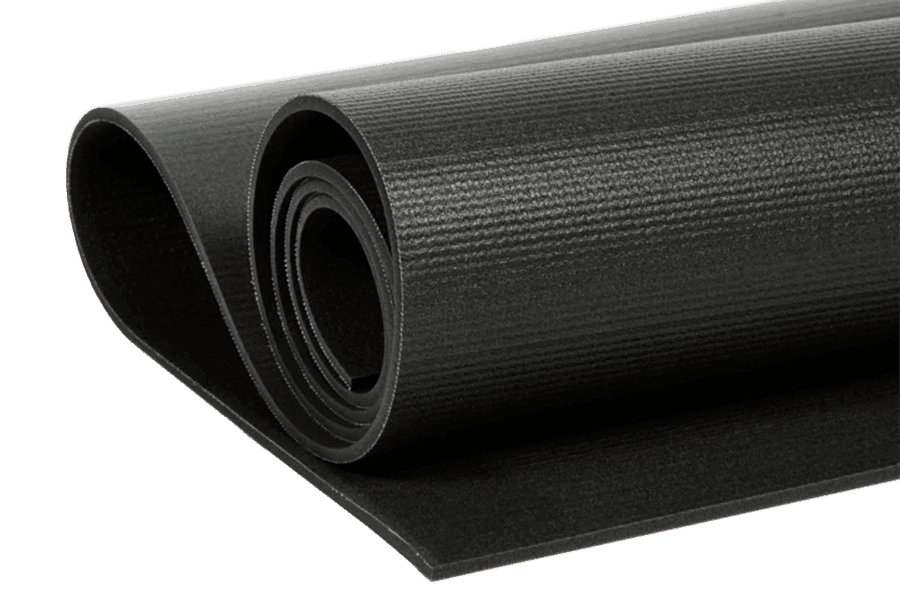
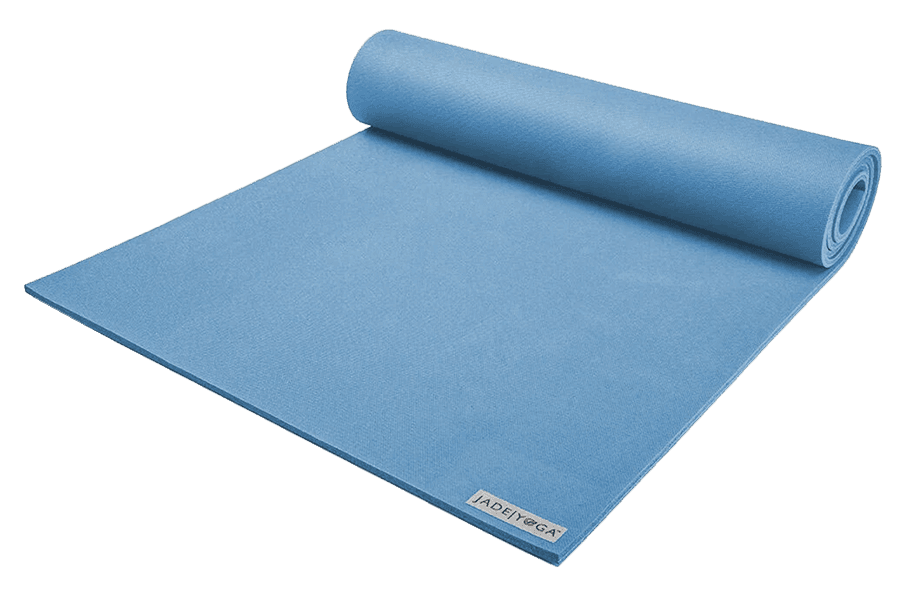
Price
The Fusion 74" lists for about $150 less.
$350
List price · check price at Amazon
$199.95
List price · check price at Amazon
Thickness
The Fusion 74" is 33% thicker.
6 mm0.24″
8 mm0.31″
Weight
The Fusion 74" is 17.2 lbs lighter.
26 lbs11.8 kg
8.8 lbs4 kg
Size
The Squared is 4″ longer; the Squared is 54″ wider.
Same on both
- Room for practitioners over six feet
- Among the heaviest options their brands sell
- Serious builds priced for committed practice
Full specs
Dimensions
Materials & build
Buying
- Short68" × 26"
- Standard71" × 26"
- Long85" × 26"
- Long & Wide79" × 52"
Two luxuries, one budget
Nobody needs either of these mats, which is what makes the choice interesting. The Jade Fusion 74″ is comfort spending: $199.95 for 8 mm of the grippiest, most cushioned rubber in yoga, cut long enough for a six-footer. The Manduka PRO Squared is space spending: $350 for a 78 inch square of PVC that gives a home practice more ground than any mat can. Both are endgame purchases. They just do different jobs.
The $150 between them matters less than it looks, because neither mat does the other’s job at any discount. What matters is whether your practice is asking for a softer landing or a bigger stage.
Both fit tall practitioners
The Fusion 74″ exists because the standard 68 inch Fusion runs short past about five foot eight. Its 74 inches carries a practitioner to roughly six foot one lying flat. The Squared measures 78 inches in whatever direction you choose, so height is solved on both sides of this page and neither mat should be picked for length alone.
Width is where they separate: 24 inches of Fusion against 78 of Manduka, a strip against a surface. The Fusion practices like every mat you have ever used, just plusher. The Squared removes the edges from your practice entirely and will hold two people at once, each with more room than a standard mat.
Comfort: deep rubber against dense PVC
The Fusion 74″ is the mat you buy when kneeling hurts. Its 8 mm of open-cell rubber has real give with a springy return, OutdoorGearLab scored the Fusion construction a flawless 10 for comfort, and Yoga Journal made the line its best thick mat pick for 2024. Long holds on knees, forearms, and hips are its home turf, and no firm mat matches it there.
The Squared runs 6 mm of PVC so dense it barely registers body weight. That density is protection of a different kind, holding joints above a hard floor instead of cradling them, and it makes the Manduka the steadier base for standing balances, where the Fusion’s depth costs a little stability. Comfortable, yes. Cushioned, no.
Grip: the Fusion works wet; the Squared needs time and a towel
The Fusion’s open-cell surface took GearLab’s best traction scores wet or dry, holds from the first practice, and absorbs sweat as it goes. Heavy classes leave it damp, and a soaked Fusion needs 2 to 3 days to dry in the shade, since sun-drying damages rubber. That drying cycle is the one real tax on the mat.
The Squared follows the PRO script: slick out of the box, a few weeks of practice to break in, then excellent dry grip for the rest of its long life. Manduka has retired its old salt-scrub advice and now says the slickness resolves with use, which owners confirm. Nothing ever soaks in, though, so sweat sits on the surface and heated practice keeps a towel in the room permanently.
Portability: 8.8 pounds against no
The Fusion 74″ weighs 8.8 pounds and rolls into a thick cylinder that most straps refuse, and it remains a mat: you can carry it to a class you care about, shift it between rooms daily, and store it rolled. It is inconvenient, not immobile.
The Squared is immobile in every sense that matters. Twenty-six pounds, a rolled diameter closer to a rug than a mat, no bag made for it, and a design that assumes one unrolling per room. Plan for a clear six-and-a-half-foot square of floor that stays claimed; the footprint, more than the weight or the price, is what buyers underestimate.
Durability: the decade mat and the years mat
The Squared inherits the PRO family’s absurd longevity record, with GearLab’s testers regularly finding specimens five to twenty years old still working, and a lifetime guarantee whose fine print promises roughly ten years of regular use and one replacement, given proof of purchase from an authorized seller. Amazon counts when the mat is sold and shipped by Amazon itself. Care amounts to wiping it down.
The Fusion 74″ wears the way natural rubber wears: surface softening and shedding under hard use, faster with sweat, and outright hardening if sunlight gets at it. Jade’s 1 year warranty excludes sun and harsh-cleaner damage, cleaning is a damp cloth or diluted vinegar, and a hot car is a small disaster. Owners who practice hard replace Fusions in a handful of years, which at $199.95 is a genuine cost to plan around.
The rubber upside and its one asterisk
The Fusion is tapped from trees, made in the USA, and each sale plants a tree, a program past two million trees by Jade’s count. The Squared is 26 pounds of PVC whose defense is that you buy it once per decade or two, manufactured under OEKO-TEX Standard 100 certification. If material sourcing decides your purchases, the Jade is your mat and this section is your whole comparison.
The asterisk: 99% latex free is Jade’s own figure, and the missing 1% matters to allergies. Jade does not recommend its mats for latex-allergic practitioners, which hands that group to the Manduka regardless of every other section on this page.
Price, colors, and the sanity checks
List prices are $350 and $199.95, a $150 gap. Check the current price on the PRO Squared and the Fusion 74″ before deciding. The Fusion 74″ offers three colorways at last count; the Squared, Black or Black Sage.
Two cheaper sanity checks before spending either amount: if the Fusion appeals but the length premium does not, the standard 68″ Fusion is $25 less; if the Squared appeals but a square room does not, the PRO Long & Wide gives 79″ × 52″ of the same PVC for $288.
Bottom line
Buy the Fusion 74″ if the luxury you want is physical: a tall cut of the deepest, grippiest rubber sold, working from day one, portable when it has to be. Its costs are rubber’s usual ones, slow drying, sun sensitivity, and a lifespan in years.
Buy the PRO Squared if the luxury you want is spatial: a permanent practice floor no mat can imitate, firm underfoot, effectively immortal, and able to host two practices at once. Its costs are the break-in, the towel, the footprint, and the certainty that it is never coming to class with you.
Jade Fusion 74"
List price $199.95
Frequently Asked Questions
- What does the extra $150 for the PRO Squared actually buy?
- Area and lifespan, not comfort. You go from a 74" × 24" strip to a 78 inch square, from 1,776 square inches to 6,084, and from a 1 year warranty on rubber to a lifetime guarantee on PVC that plausibly runs decades. What you give up is the Fusion's cushioning and its portability, and if those are why you were shopping, the extra money works against you.
- Which is more comfortable to practice on?
- Depends on the pose. For kneeling work, low lunges, yin, and anything where a joint presses into the floor, the Fusion's 8 mm of springy rubber is the most comfortable surface in serious yoga gear; OutdoorGearLab gave it a perfect comfort score. For standing and balance poses the Squared's firm PVC is steadier and less wobbly. Neither mat loses this outright, but bodies that hurt choose the Fusion.
- Is the Fusion 74" portable at nearly 9 pounds?
- Barely, but yes. It rolls into a fat cylinder that most standard straps will not close around, and you will feel it on a walk to the studio, but it goes in a car and moves around the house without ceremony. The Squared does not: 26 pounds, rolled to the size of a small rug, moved occasionally with both arms. One is inconvenient to transport; the other is not transported.
- How does grip compare between them?
- The Fusion grips immediately and keeps gripping when wet; its open-cell rubber took GearLab's top traction marks in testing. The Squared ships slick, needs a few weeks of practice to break in, and its closed-cell top never absorbs sweat, so hot classes want a towel indefinitely. Manduka has retired the old salt-scrub break-in trick and now says the slickness resolves with use, which owner reports confirm. Dry and broken in, the Manduka grips fine; sweaty, the Jade wins big.
- What are the care and durability differences?
- The Squared is nearly carefree: wipe it down occasionally, ignore sunlight, expect it to outlast the decade its guarantee describes. The Fusion is a plant product and acts like one. It needs a damp cloth or diluted vinegar rather than harsh cleaners, must stay out of the sun, and dries slowly after a sweat-heavy class, sometimes taking days when truly soaked. Its 1 year warranty excludes exactly the sun and cleaner damage that kills rubber mats early.
- What color options do these come in?
- The Fusion 74" runs three colorways at last count, Midnight Blue, Purple, and Jade Green. The PRO Squared comes in Black or Black Sage. If color range matters, both brands keep it in their standard sizes; the 68" Fusion has four and Jade's regular Harmony line has around a dozen.
Related comparisons
- Manduka PRO Long vs JadeYoga Fusion 74"
- JadeYoga Fusion 74" vs Öko Living Herbal Yoga Mat 5mm
- JadeYoga Fusion 74" vs Liforme XL 4.2mm
- JadeYoga Fusion 74" vs Yoloha Unity Pro Cork
- Manduka PRO vs JadeYoga Fusion 74"
- JadeYoga Fusion 74" vs Manduka PRO Terra 6mm
- JadeYoga Fusion 74" vs Alo Warrior
- JadeYoga Fusion 74" vs Liforme Classic
- JadeYoga Fusion 74" vs b, halfmoon B Mat Strong 6mm