Manduka GRP Adapt 1.0 vs Liforme Classic: Which One Should You Buy?
These two are built the same way: a moisture-absorbing polyurethane top bonded to a natural rubber base, the construction that handles sweaty hands better than anything else on the market. The Liforme Classic is $165 and adds etched alignment lines and a larger surface. The GRP Adapt 1.0 is $94 and is on its way out, dropped from manduka.com and available as Amazon runout stock. That last fact changes how you should think about it.
As an Amazon Associate, we earn from qualifying purchases made through links on this page. How this works
The quick answer
For grip in a hot room, both are the right kind of mat and neither has been shown to beat the other. OutdoorGearLab tested the Liforme, scored it 76 of 100, rated its wet and dry grip among the best in the group, and named it best for fine-tuning alignment. It never tested the GRP Adapt 1.0, and the hot yoga award Manduka advertises belongs to the newer 2.0.
Buy the GRP Adapt 1.0 if the $71 matters and you want absorbent grip on a budget, accepting that stock is finite and you are buying a discontinued mat. Buy the Liforme if you want the alignment lines, the extra size, and a mat that will still be for sale in two years.
Get the GRP Adapt 1.0 if...
- You want absorbent hot yoga grip for $71 less
- Alignment lines are something you would never look at
- You prefer the slightly softer 5 mm platform
- You are comfortable buying discontinued runout stock
Get the Liforme Classic if...
- You would use etched alignment guides for placement and form
- You want the bigger surface at 72.8″ × 26.8″
- You want a carry bag included and a mat that stays in production
- You want a mat with published independent test results behind it
Side by side
Price
The GRP Adapt 1.0 lists for $71 less.
$94
List price · check price at Amazon
$165
List price · check price at Amazon
Thickness
The GRP Adapt 1.0 is 19% thicker.
5 mm0.2″
4.2 mm0.17″
Weight
The Liforme is 0.3 lbs lighter.
5.8 lbs2.6 kg
5.5 lbs2.5 kg
Size
The Liforme is 1.8″ longer; the Liforme is 0.8″ wider.
Same on both
- Polyurethane top over a natural rubber base
- Built to keep grip when your hands are wet
- Absorbent surfaces that stain with heavy use
- Not safe with a latex allergy
- No warranty beyond a 30 day return window
Full specs
Dimensions
Materials & build
Buying
The same construction, $71 apart
Both of these are a moisture-absorbing polyurethane top bonded to a natural rubber base. That build is the reason either mat exists: it is the approach that keeps working when your hands are wet, which sticky PVC and closed-cell rubber both fail at.
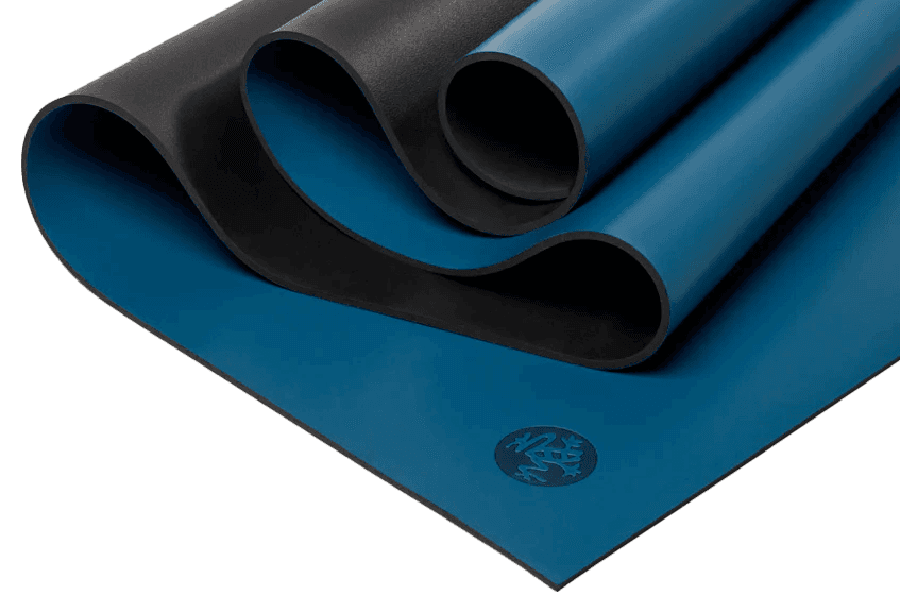
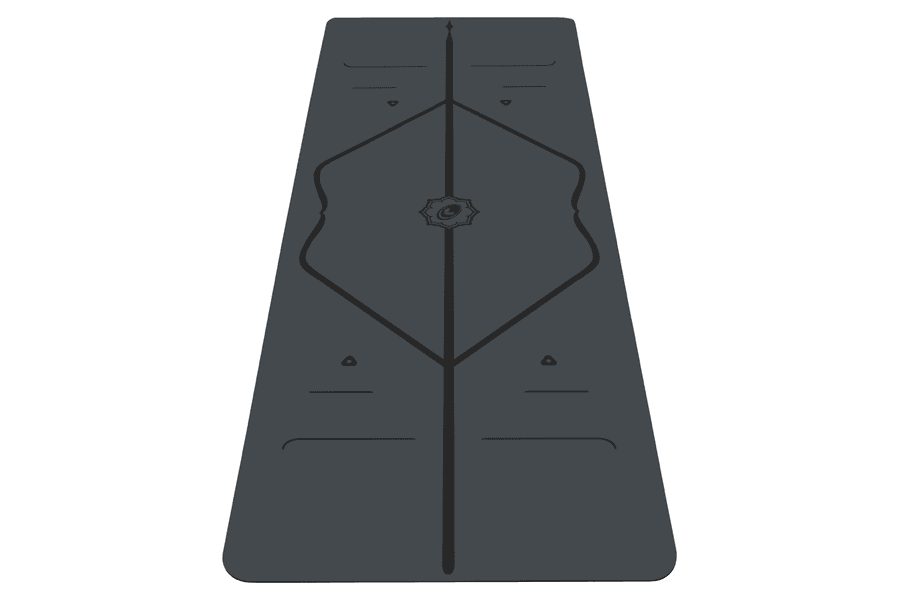
The Liforme Classic is $165, 72.8″ × 26.8″, with an alignment grid etched into the surface. The Manduka GRP Adapt 1.0 is $94, 71″ × 26″, plain-surfaced, made in Spain.
The GRP Adapt 1.0 is on its way out
Manduka has dropped it from its own site in favor of the GRP Adapt 2.0, and what is left is Amazon runout stock at $94 in a couple of remaining colorways, la rana or terracotta at last count.
That is worth knowing rather than worrying about. The mat is the previous generation of a current product, not a defective one, and at $71 under the Liforme it is a real discount into absorbent-grip yoga. What you should not expect is a choice of colors, a replacement in two years, or a longer size.
If you would rather buy something that will still be in production, the 2.0 is the direct successor at $128.
Grip: what we can and cannot tell you
OutdoorGearLab tested the Liforme and rated it 9 out of 10 dry and 7 wet, with excellent wet and dry grip listed among its pros and an award for fine-tuning alignment. Its overall score was 76 out of 100.
It has never tested the GRP Adapt 1.0. Manduka’s hot yoga award from the same publication belongs to the 2.0, a different mat with a reworked surface, and borrowing it for this page would be wrong.
What we can say is that both use the same absorbent approach, both grip from the first practice with no break-in, and both are the right category of mat for a heated room. Anyone claiming a measured winner between these two specific mats is guessing.
The etched grid is the Liforme’s real feature
An etched center line, placement markers for hands and feet, and angled guides for stance direction. Etched rather than printed, so they do not fade, and quiet enough that they stop reading as a diagram once you are moving.
They answer specific questions in the moment: is the back foot at the angle you meant, are your hips square, are your hands symmetrical about the center. GearLab named the Liforme the best mat in its test for exactly this. Teachers and detail-minded practitioners get real value from it.
The GRP has a plain surface. If you already practice without checking your feet, that is $71 you keep.
Size and feel
The Liforme is bigger in both directions, 72.8″ × 26.8″ against 71″ × 26″, and thinner, 4.2 mm against 5.
In practice that means more room for a wide stance and a firmer, crisper read in balances on the Liforme, and a slightly softer landing under a knee on the GRP. Weight is nearly identical, 5.5 pounds against 5.8, so carrying is not a factor either way.
The Liforme also ships with a full-length carry bag. The GRP does not.
Both wear at the same place
The polyurethane top is what goes on either mat: it scuffs, takes on marks, and stains where hands and feet land session after session. GearLab noted the Liforme is not as durable as other high performers in its test, and Liforme states that its materials are designed to biodegrade.
Plan on a few years of regular practice from each rather than a decade. At $94 and $165 these are performance purchases you will replace eventually, and that is the trade for a surface that works when you sweat.
Neither one is covered for long
Manduka gives the GRP Adapt 1.0 a 30 day return window and no warranty. Liforme gives 30 days too, with no warranty on a $165 mat. The warranty terms line up with how these materials wear, which is to say they do not cover it.
Buying runout stock adds one wrinkle worth thinking about: if a defective GRP arrives six months from now, a replacement may simply not exist. That is not a reason to avoid it, but it is a reason to check the mat properly when it lands rather than leaving it rolled in a cupboard.
Care is identical and it is not optional
Wipe the top with water or a very diluted mild soap after sweaty sessions, let the mat dry fully before rolling it, keep it out of hot cars and direct sun, and never machine wash it. Strong cleaners damage the polyurethane surface and the rubber underneath.
Despite that list, GearLab gave the Liforme the best care and cleaning score in its whole test, 9 out of 10, so the routine is not a burden. Both mats are natural rubber underneath, so neither is safe with a genuine latex allergy.
Where to buy, and what to check first
The GRP Adapt 1.0 is Amazon-only now; check the current price and remaining stock before committing, and confirm the listing is the 1.0 rather than the newer version, since both have appeared under similar titles.
The Liforme sells on liforme.com and Amazon, with the carry bag included either way, in gray, blue, purple and several more colorways.
Bottom line
Get the GRP Adapt 1.0 if you want absorbent hot yoga grip for as little as possible and alignment lines are something you would never look at. You are buying discontinued stock, which is fine at this price as long as you go in knowing it.
Get the Liforme Classic if you would use the grid, want the bigger surface and the carry bag, or simply prefer a mat with published independent testing behind it. It is the more expensive mat and it is the one we would keep if we had to pick one to still own in three years.
Liforme Classic
List price $165
Frequently Asked Questions
- Is the GRP Adapt 1.0 discontinued?
- Effectively, yes. Manduka has dropped it from its own site in favor of the GRP Adapt 2.0, and what you can buy now is Amazon runout stock at $94 in a couple of remaining colorways. The mat is not defective or old design in any troubling sense; it is simply the previous generation. Buy it knowing that replacements and color choices will keep shrinking.
- Which one grips better when wet?
- We cannot tell you with confidence, and we would rather say so. OutdoorGearLab rated the Liforme 7 out of 10 for wet grip and 9 dry, and listed excellent wet and dry grip in its pros. It never tested the GRP Adapt 1.0. What we can say is that both use the same absorbent polyurethane approach, both grip from the first practice, and owners of both report the surface holding up in heated classes. Anyone claiming a measured winner here is guessing.
- Are the Liforme's alignment lines worth $71?
- If you would use them. The etched center line, placement markers, and angled guides give you fixed reference points for stance width, foot angle, and whether your hips are square, and GearLab named the Liforme its best mat for fine-tuning alignment. They are etched rather than printed, so they do not wear off. The GRP has a plain surface, and if you already practice without checking your feet, that is $71 you can keep.
- How do they compare on size and feel?
- The Liforme is bigger and firmer: 72.8 by 26.8 inches at 4.2 mm against the GRP's 71 by 26 at 5 mm. In practice the Liforme gives you more room for a wide stance and a crisper read in balances, while the GRP is slightly softer under a knee. Neither feels thin. Weight is almost identical, 5.5 pounds against 5.8.
- Should I just get the GRP Adapt 2.0 instead?
- It is worth considering. The 2.0 is the current version at $128, it has the reworked Satin Grip top, more colorways, a 79 inch Long option, and it holds OutdoorGearLab's current award for hot yoga grip. What no one has published is a measured comparison of the two surfaces, so the case for the 2.0 over the 1.0 rests on availability, colors, sizes, and award coverage rather than a proven grip advantage.
- How long do these mats last?
- A few years of regular practice, not a decade. Both wear at the same place: the polyurethane top scuffs and stains where your hands and feet land, and GearLab noted the Liforme is not as durable as other high performers. Neither brand offers more than a 30 day return window. At $94 and $165 these are performance purchases you will eventually replace.
- How should I clean them?
- The same way, and more carefully than a PVC mat. Wipe the top with water or a very diluted mild soap after sweaty sessions, dry the mat fully before rolling it, keep it out of hot cars and direct sun, and never machine wash. Strong cleaners damage the polyurethane surface and the rubber base underneath. GearLab gave the Liforme the best care and cleaning score in its test, so the routine is not onerous.
Related comparisons
- Manduka GRP Adapt 1.0 vs Suga SugaMat
- JadeYoga Harmony 68" vs Manduka GRP Adapt 1.0
- JadeYoga Harmony 74" vs Manduka GRP Adapt 1.0
- Manduka GRP Adapt 1.0 vs Gaiam Performance Dry-Grip Long & Wide
- Manduka GRP Adapt 1.0 vs JadeYoga Harmony 2.0 68"
- Manduka GRP Adapt 1.0 vs 42 Birds The Robin
- Lululemon The Mat 5mm vs Manduka GRP Adapt 1.0
- JadeYoga Harmony XW vs Liforme Classic
- Manduka GRP Adapt 1.0 vs Hugger Mugger Earth Elements 5mm