Jade Harmony XW vs Jade Fusion 74": Which One Should You Buy?
Tall practitioners shopping Jade tend to land on this exact pair. The Harmony XW at $149.95 spends its premium on size: 80" × 28" of the classic 4.8 mm rubber at 6.7 pounds. The Fusion 74 at $199.95 spends it on depth: 8 mm of cushioning in a 74" × 24" cut at 8.8 pounds. Grip, care, and warranty are identical, so you're weighing room against padding with $50 and about two pounds attached.
As an Amazon Associate, we earn from qualifying purchases made through links on this page. How this works
The quick answer
The Harmony XW is the bigger, lighter, cheaper, and firmer mat: better for standing and balance work, better for broad frames, and the only one of the two that fits practitioners over about six foot one, where the Fusion 74's length gives out. The Fusion 74 is the therapeutic one: OutdoorGearLab's perfect comfort score is the line's whole argument, and for sore knees on hard floors nothing in the Harmony family competes with it.
Buy for your joints first. If floor work hurts and you're six foot one or under, take the Fusion 74. Otherwise the Harmony XW covers more bodies and more kinds of practice for $50 less.
Get the Harmony XW if...
- You're over six foot one; the Fusion 74 tops out around there
- Broad shoulders or wide stances need the 28" width
- Your practice leans standing, balance, and vinyasa work
- You'd rather carry 6.7 pounds than 8.8 and keep $50
Get the Fusion 74 if...
- Kneeling lunges and long floor holds hurt on 4.8 mm
- Your practice leans restorative, yin, or Pilates
- Home practice happens on concrete or tile
- You want a color besides Midnight Blue
Side by side
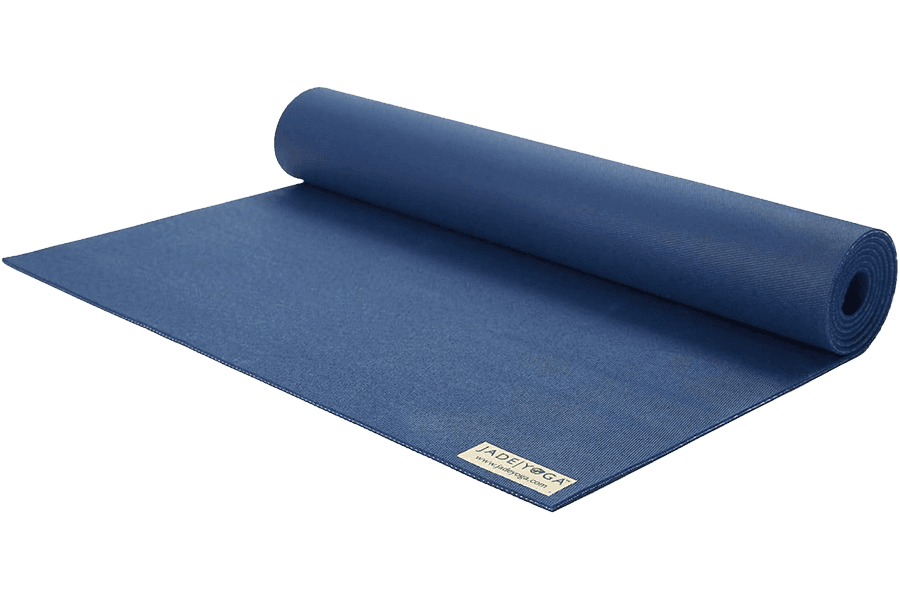
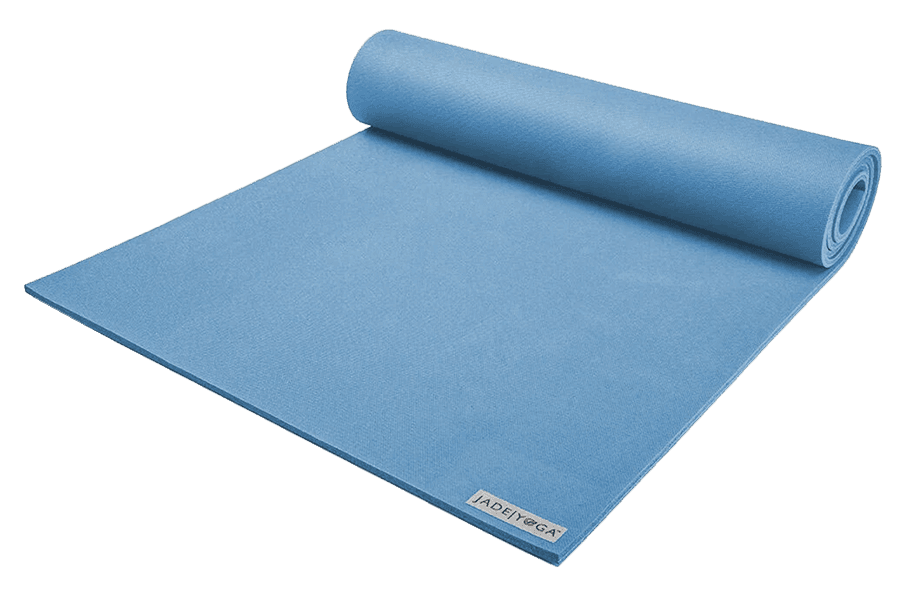
Price
The Harmony XW lists for $50 less.
$149.95
List price · check price at Amazon
$199.95
List price · check price at Amazon
Thickness
The Fusion 74" is 67% thicker.
4.8 mm0.19″
8 mm0.31″
Weight
The Harmony XW is 2.1 lbs lighter.
6.7 lbs3 kg
8.8 lbs4 kg
Size
The Harmony XW is 6″ longer; the Harmony XW is 4″ wider.
Same on both
- Identical tacky open-cell rubber surface and grip
- Made in the USA
- 1 year warranty, sun damage and harsh cleaners excluded
- A tree planted per mat sold, past two million
- Same care rules: no sun, gentle cleaners only
Full specs
Dimensions
Materials & build
Where these two mats compete
This pairing usually shows up on a tall practitioner’s shortlist. Both mats are Jade’s tacky open-cell rubber, made in the USA with the same 1 year warranty and the same day-one grip, and both cost more than a standard mat because they offer more of something. The Harmony XW offers more area: 80″ × 28″ of the classic 4.8 mm Harmony, at 6.7 pounds and $149.95. The Fusion 74 offers more depth: 8 mm of rubber on a 74″ × 24″ cut, at 8.8 pounds and $199.95.
Since surface and care are identical, you are weighing room against cushioning, with $50, two pounds, and a colorway choice riding alongside. Which way to lean depends mostly on your height, your joints, and your floor.
Start with whether the Fusion 74 fits you
The Fusion 74 covers practitioners to about six foot one with reasonable savasana margin, at the standard 24″ width. The Harmony XW’s 80″ length covers any height you’re likely to have, and its 28″ width is the spec tall shoppers overlook: broad shoulders and splayed elbows stay on the mat lying down, and hands stay on rubber in wide-legged stances instead of finding the floorboards.
This makes height a filter, not a tiebreaker. At six foot two or beyond, the Fusion 74 quietly leaves the running, and your real choice becomes the Harmony XW against the 80″ × 28″ Fusion XW at $249.95 and 11 pounds. Between about five-nine and six-one, both mats on this page fit, and the rest of the article is for you.
The 8 mm case: joints and hard floors
The Fusion line earns its price with bodies that hurt on firm mats. OutdoorGearLab rated the Fusion’s comfort a perfect 10, noting it evens out uneven floors, and Yoga Journal has listed it among the best thick mats. If kneeling lunges sting, if your practice leans yin or restorative, if you do Pilates floor work, or if home practice happens on concrete or tile, the extra 3.2 mm is the whole reason to spend $50 more and carry 2 more pounds.
The Harmony XW is the standard firm Jade feel spread across a bigger canvas. Most practitioners with untroubled joints find 4.8 mm entirely comfortable on a wood or carpeted floor, and firmness has real advantages covered below. But it is not a therapeutic surface, and no amount of extra width makes it one.
One middle path worth naming: a firm mat plus a cushioning accessory. A kneeling pad or doubled blanket under the tender joint costs little and travels light, and it turns the Harmony XW into a workable option for someone with a single sore knee. Where that trick runs out is a practice that spends whole sessions on the floor; padding one contact point at a time gets old, and that’s the buyer the Fusion 74 was made for.
Firmness pays off standing up
The thinner mat wins the poses where you’d least expect a mat to matter. On the Fusion 74’s 8 mm, the standing foot sinks a touch before it finds solid ground, and one-legged balances feel slightly softer underfoot. Dense rubber keeps the effect modest, far from the instability of thick foam, but reviewers and owners of thick Jades mention it consistently. If tree pose, warrior three, and standing sequences are the heart of your practice, the Harmony XW’s firmer platform is the better daily experience.
The width helps here too, in a small way: on 28″ there’s room to adjust a wobbling stance without stepping off the rubber onto slick flooring, which is its own kind of stability insurance for wide-set poses.
Same grip in sweat, different recovery
Grip separates nothing here. Both surfaces are the same open-cell rubber that stays tacky as palms get damp, absorbing light sweat instead of letting it pool. Where they part ways is cleanup: the Fusion 74’s deep pour holds moisture, and GearLab measured 2 to 3 days of drying time for a soaked Fusion, with sun-drying off the table because UV hardens rubber. The Harmony XW turns around overnight. Occasional sweaty classes are fine on either; a multiple-times-a-week hot practice deserves a towel on top and, frankly, a different mat under it.
The drying gap matters more than it sounds because of what damp storage does to rubber. Rolling up an open-cell mat before it has dried through is how these mats develop a lasting smell, so a Fusion 74 in heavy rotation needs somewhere to lie flat or hang between sessions. With the Harmony XW that logistical question barely comes up.
Carrying: 6.7 pounds against 8.8
Neither mat commutes gracefully, so be honest about where it will live. The Fusion 74 is the heavier of the two by about two pounds, and it rolls into a thick cylinder that strains ordinary mat bags. The Harmony XW rolls slimmer but wider; a 28″ roll fits no standard sling, so it travels under an arm or in the trunk. Either one manages an occasional trip to class. As a daily carry, both lose to Jade’s standard cuts, and owners of both tend to leave them wherever practice happens.
Storage tips the same direction for different reasons. Rolled, the Fusion 74 stands as a dense 24″ column you can tuck in a closet corner; the Harmony XW’s 28″ roll wants a wider spot but weighs noticeably less when you lift it onto a shelf. Left unrolled, both need a strip of floor longer than six feet, so factor in the room as well as the body.
Three colorways against one
The Fusion 74 comes in Midnight Blue, Purple, and Jade Green at last count, one fewer option than the standard 68″ Fusion carries. The Harmony XW comes in Midnight Blue only. Neither is a rich palette; the wide choice in Jade’s catalog lives with the standard 68″ Harmony and its roughly dozen colorways. But if Midnight Blue leaves you cold, only the Fusion 74 offers an alternative.
Price and value
List prices are $149.95 for the Harmony XW and $199.95 for the Fusion 74. Check current prices on the Harmony XW and the Fusion 74 at Amazon; specific colorways dip on sale more often than the line as a whole.
The $50 gap is real but secondary. Both mats replace on the same natural rubber schedule, so neither buys extra years, and each spends its premium on a feature the other lacks. Paying for the Fusion’s cushion you don’t need, or for XW acreage your five-ten frame won’t use, wastes more than $50 either way. Match the feature to your body first and let the price difference ride.
If you’re genuinely torn, err toward the Harmony XW. Cushioning you don’t use costs $50 up front and two extra pounds every time the mat moves, while room you don’t use costs nothing once the mat is unrolled. The reverse mistake at least has a cheap patch: a kneeling pad on top of the XW covers a single sore joint for a few dollars.
Bottom line
The Harmony XW is the pick for the big-bodied or space-hungry practitioner with healthy joints: room in every direction, the steadier surface for standing work, two fewer pounds, and $50 kept. It’s also the default past six foot one, where the Fusion 74 simply stops fitting.
The Fusion 74 is the pick when floor work is the problem to solve. Its 8 mm is a genuine remedy for sore knees and hard floors, something no standard-thickness mat matches, and the 74″ length covers most tall practitioners. Accept the fat roll, the slow drying after soaked classes, and the slightly softer footing in balances, and it will earn its price every practice.
Jade Harmony XW
List price $149.95
Jade Fusion 74"
List price $199.95
Frequently Asked Questions
- How tall can I be for the Fusion 74?
- About six foot one with reasonable savasana margin; beyond that, heels or head start finding the floor. The Harmony XW's 80" length covers essentially any height. If you're over six-one and specifically want the Fusion's 8 mm cushioning, the Fusion XW at 80" × 28" is the only Fusion that fits, at $249.95 and 11 pounds.
- Is the Fusion 74 worth $50 more than the Harmony XW?
- Only if you'll use the cushioning. Both mats wear out on the same natural rubber schedule, so the extra money buys a feature rather than extra years. For a practitioner with sore knees or a floor-heavy practice, the 8 mm earns its price every session. For a practitioner with healthy joints, the Harmony XW is the better mat and the cheaper one at once.
- Does 8 mm make balance poses harder?
- Slightly. On the Fusion 74 the standing foot settles a touch before finding firm support, and practitioners who spend a lot of time on one leg notice it. Dense rubber keeps the effect mild, nothing like thick soft foam, but the Harmony XW's 4.8 mm is the steadier platform. If standing sequences dominate your practice, that's a real point in the XW's favor.
- Which handles hot yoga and sweat better?
- Both grip well damp thanks to the open-cell surface, but recovery differs: the Harmony XW dries overnight, while GearLab found a thoroughly soaked Fusion can take 2 to 3 days, and sun-drying isn't an option because UV hardens rubber. For frequent heated classes, the XW with a towel on top is the more practical setup, though honestly neither mat is ideal for that routine.
- What colors do the Harmony XW and Fusion 74 come in?
- The Fusion 74 offers three colorways at last count: Midnight Blue, Purple, and Jade Green. The Harmony XW comes in Midnight Blue only. If palette matters, the wide selection in Jade's catalog lives with the standard 68" Harmony, which carries around a dozen colorways.
- Are these mats safe for someone with a latex allergy?
- No. Both are tapped natural tree rubber, and Jade describes its mats as 99% latex free, which means trace latex proteins remain. Jade itself says they shouldn't be used by people with latex allergies. If that's you, look at TPE or PVC mats instead of anything in this comparison.
Related comparisons
- Manduka PROlite Long & Wide vs JadeYoga Harmony XW
- JadeYoga Harmony XW vs Alo Warrior
- JadeYoga Harmony XW vs Manduka GRP Adapt 2.0 Long
- JadeYoga Harmony XW vs Manduka PRO Terra 6mm
- JadeYoga Harmony XW vs Yoloha Unity Pro Cork
- Manduka PRO vs JadeYoga Harmony XW
- JadeYoga Harmony XW vs Lululemon The (Big) Mat 5mm
- JadeYoga Harmony XW vs Liforme Classic
- JadeYoga Harmony XW vs b, halfmoon B Mat Strong 6mm