B Mat Everyday vs Gaiam Classic Print: Which One Should You Buy?
The B Mat Everyday and the Gaiam Classic Print are the same 4 mm thick, so the $93 between them buys no extra padding. It buys grip, a denser feel and a bigger footprint. The Gaiam is lighter, latex-free, easier to care for and easier to return, and plenty of beginners never need more.
As an Amazon Associate, we earn from qualifying purchases made through links on this page. How this works
The quick answer
The Classic Print is $24.98 of printed PVC that owners like for its designs and fault for thinness and slipping: 350 of 614 grip mentions in its Amazon summary are negative. The B Mat Everyday is $118 of tacky rubber that GearLab, in a separate 2023 review, made its pick for sweaty hands. At the same thickness it feels denser and it is wider and longer, but it weighs twice as much, collects lint, contains latex and can't be returned once it leaves its packaging.
If your hands slide on PVC and you practice several times a week, buy the B Mat. If you're new, practice gently, need a latex-free mat or want to spend less than $25, buy the Classic Print.
Get the B Mat Everyday if...
- Your palms slide on cheap PVC mats
- You practice often and grip matters more than cushion
- You want 26 inches of width and 71 of length
- You'd rather avoid PVC
Get the Gaiam Classic Print if...
- It's your first mat or you practice gently in a cool room
- Anyone at home is allergic to latex
- You want a mat that weighs 2.1 pounds
- You'd rather keep about $93 and choose a print
Side by side
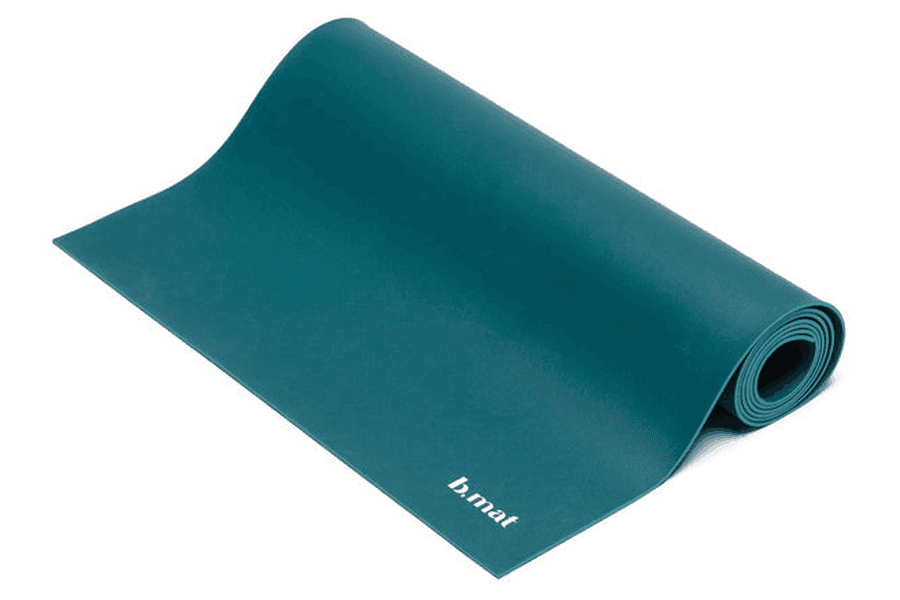
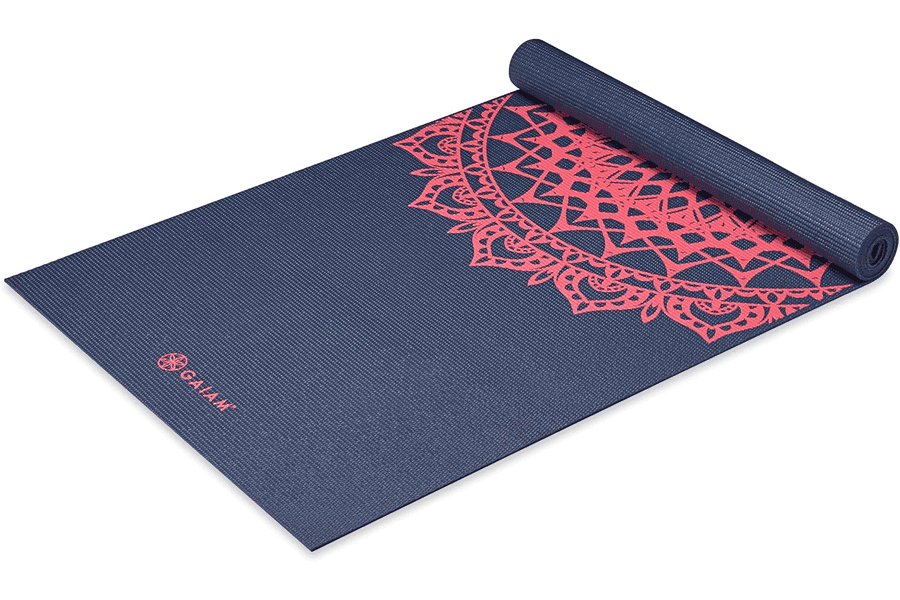
Price
The Classic Print lists for about $93 less.
$118
List price · check price at bhalfmoon.com
$24.98
List price · check price at Amazon
Thickness
Identical thickness.
4 mm0.2″
4 mm0.16″
Weight
The Classic Print is 2 lbs lighter.
4.1 lbs1.86 kg
2.1 lbs0.95 kg
Size
The B Mat Everyday is 3″ longer; the B Mat Everyday is 2″ wider.
Same on both
- 4 mm thick
- Sweat stays on top instead of soaking in
- A strong smell when new that fades with airing
- Brand warns against long sun exposure
Full specs
Dimensions
Materials & build
Buying
- Everyday Long85" × 26"
Both 4 mm, and $93 apart
The B Mat Everyday and the Gaiam Classic Print are both 4 mm thick, and that is where the overlap ends. The B Mat is tacky rubber made in Spain, 71″ × 26″, sold only by b, halfmoon at $118. The Classic Print is printed PVC, 68″ × 24″, listing at $24.98.
So the $93.02 buys no extra padding. It buys grip, a denser feel underfoot and a bigger footprint. You give up a latex-free build, about half the weight, low-effort care and the easier return, since b, halfmoon accepts a return only if the mat never left its packaging.
Light tack against heavy tack
Gaiam’s own Amazon description calls the Classic Print’s surface a light-tack, non-slip texture. Some owners say it has just the right stickiness, but 350 of 614 grip mentions in Amazon’s review summary are negative. PVC absorbs nothing, so damp palms end up on a film of sweat.
The B Mat sits at the other end of the scale. In a 2023 review kept separate from its roundup, published under the brand’s former B Yoga name, GearLab wrote that if traction is your main concern there is no better option, and made it its pick for sweaty hands. Sweat collects on top instead of sinking in, yet GearLab found the traction held even when a palm sat in pooled sweat.
Sticking, lint and two owner verdicts
GearLab’s testers felt stuck when they slid a hand or foot between poses, and many switched to stepping. Its reviewer suspects light sweaters will find it overly grippy, especially in gliding Ashtanga or vinyasa flows.
Reviews on b, halfmoon’s own site pull both ways. One owner who had only used cheap PVC mats before calls the B Mat far more durable and says its non-slip surface makes practice much more enjoyable. Another says the grip went away once they sweated in a heated flow, that the stickiness bothered them in an unheated class, and that every piece of hair, lint and dust ended up on the mat. GearLab saw the lint problem too and suggests keeping the B Mat in a bag.
Denser rubber at the same depth
Thickness is the Classic Print’s other sore spot: 410 of 594 mentions in Amazon’s summary are negative. The B Mat won’t add depth. It weighs nearly twice as much with only a slightly bigger footprint, and GearLab, which tested this 4 mm version, said the dense, springy rubber makes the gap to thicker top mats barely noticeable. It scored comfort and support 8.
GearLab also found it a solid base for standing sequences, with better support than most thin mats on grass, sand or carpet. The Classic Print is thin enough to stay steady in a balance, as one owner points out, but offers little once a knee lands on tile.
Wider and longer, and twice the weight
The B Mat is 26 inches wide to the Classic Print’s 24, and 71 long to its 68. b, halfmoon offers a long version at 85″ × 26″; the Classic Print comes in one size.
Weight runs the other way, 4.1 pounds against 2.1. GearLab still calls the B Mat light enough to carry to class, rolling to 3.5 to 4 inches across.
Latex, vinyl and certification
A latex allergy settles this pair quickly. The B Mat is rubber that b, halfmoon’s FAQ describes as natural and synthetic components, and GearLab tells anyone with the allergy to skip it. The Classic Print is PVC with no latex, and Gaiam says it leaves out the six most harmful phthalates.
If leaving vinyl behind is the goal, only the B Mat does it: it is PVC-free and certified to OEKO-TEX Standard 100.
Airing, water marks and sun
Both smell when new. Gaiam calls the new-mat odor very strong but harmless and asks for two to three days of airing; the Classic Print’s owners are less forgiving, with 282 of 368 odor mentions negative. GearLab compared the new B Mat to rubber tires, a smell that had cleared within two days.
After that, the B Mat is more work. b, halfmoon asks you to clean it with neutral soap and water, let it dry fully, roll it logo side out and keep it out of the sun, and says to leave the mat packaged until first use to prevent oxidation. GearLab noticed water marks on its test mat afterward and recommends a darker color. The Classic Print needs only a wipe with mild detergent, and Gaiam warns that long sun can leave it faded and brittle.
Peeling reports, warranties and returns
Owners of both mats report peeling. GearLab’s market research found B Mat owners describing peeling at the hand and foot spots and grip fading with long use. Classic Print owners are mostly positive on durability, 210 of 306 mentions, and the complaints there describe the plastic peeling too.
b, halfmoon’s warranty runs one year and excludes sun damage, dirt and stains, plus normal wear, a category it says covers marks at the hand and foot spots. Gaiam backs the Classic Print for life but doesn’t publish the terms, which we’d read as cover for defects.
GearLab suggests daily vigorous practitioners consider something more durable. On returns, b, halfmoon takes back only unused mats in their original packaging within 30 days. Gaiam’s direct returns also need an unopened, unused mat; Amazon orders follow Amazon’s policy.
Buying each, and a cheaper rubber mat
The B Mat Everyday is $118 from b, halfmoon in seven colorways at last count. It isn’t sold on Amazon, and it rates 4.8 from 173 reviews on b, halfmoon’s site. The Classic Print lists at $24.98; check the Classic Print at Amazon.
If the Gaiam’s grip is the problem but $118 is too much, rubber comes cheaper at the same 4 mm: our Jade Level One vs Classic Print page covers Jade’s $66.50 mat. For more cushion under the B Mat’s surface, the 6 mm Strong is $144; see B Mat Strong vs Classic Print.
Bottom line
The B Mat Everyday makes sense if your palms slide on printed PVC and you practice often enough to justify $118. It grips wet or dry, it is longer and wider, and it feels denser at the same thickness. Expect lint, a rubber smell at first, stains on light colors, and a mat you can’t return once unwrapped.
Buy the Classic Print if you are new, practice gently in a cool room, need a latex-free mat or want the lighter carry. It does the basic job for about a fifth of the price, and a blanket covers the thin spots under your knees.
B Mat Everyday 4mm
List price $118
Gaiam Classic Print 4mm
List price $24.98
Frequently Asked Questions
- Is the B Mat Everyday worth $118 over a Gaiam Classic Print?
- If grip is your problem, it can be. Both are 4 mm, so you're not buying cushion; you're buying traction and a denser, steadier feel. GearLab's separate 2023 review made the B Mat its pick for sweaty hands, while 350 of 614 grip mentions in the Classic Print's Amazon summary are negative. If you practice gently in a cool room, the Classic Print does the job for about a fifth of the price.
- Which is better for hot yoga?
- The B Mat, usually. GearLab found its traction held even with a palm in pooled sweat, though one owner on b, halfmoon's site says the grip went away in a heated flow, so results vary. The Classic Print's PVC absorbs nothing, and owners report slipping in hot yoga. Keep a towel handy on either in a very sweaty class.
- Is the B Mat too grippy?
- For some people. GearLab's testers felt stuck when sliding a hand or foot between poses, and its reviewer thinks light sweaters may find it overly grippy in gliding vinyasa or Ashtanga flows. It also picks up hair, lint and dust, so GearLab suggests storing it in a bag. If you step between poses rather than slide, the tack matters less.
- Which is better for a latex allergy?
- The Gaiam Classic Print. It is latex-free PVC, and Gaiam says it's made without the six most harmful phthalates. The B Mat is rubber with natural components, and GearLab tells anyone with a latex allergy to avoid it.
- Can I return the B Mat if I don't like it?
- Only if you haven't used it. b, halfmoon accepts returns within 30 days of receipt only if the mat is unused and still in its original packaging, and sale items are final. Gaiam's direct returns likewise require an unopened, unused mat; if you buy the Classic Print on Amazon, Amazon's policy applies.
- Which one lasts longer?
- Neither brand publishes a lifespan, and owners of both report peeling. GearLab's market research found B Mat owners describing peeling where hands and feet land and grip fading with long use, and b, halfmoon's one-year warranty excludes that kind of wear. Classic Print owners are mostly positive on durability, though some report the plastic peeling, and Gaiam doesn't publish the terms of its lifetime guarantee.
Related comparisons
- Yoga Design Lab Combo 3.5mm vs b, halfmoon B Mat Everyday 4mm
- b, halfmoon B Mat Everyday 4mm vs Manduka GRP Adapt Lite 2.1 4mm
- Manduka PROlite vs b, halfmoon B Mat Everyday 4mm
- Lululemon The Mat 5mm vs b, halfmoon B Mat Everyday 4mm
- Manduka PROlite Long vs b, halfmoon B Mat Everyday 4mm
- b, halfmoon B Mat Everyday 4mm vs Manduka PRO Lite Terra 4.7mm
- b, halfmoon B Mat Everyday 4mm vs JadeYoga Harmony 2.0 68"
- Amazon Basics 1/4 Inch Thick TPE vs Gaiam Classic Print 4mm
- JadeYoga Harmony 74" vs b, halfmoon B Mat Everyday 4mm