Jade Harmony XW vs Jade Fusion XW: Which One Should You Buy?
These are the only two 80" × 28" mats Jade makes, and they differ by exactly one spec. The Harmony XW is 4.8 mm of the classic firm rubber at 6.7 pounds and $149.95. The Fusion XW pours the same footprint 8 mm deep at 11 pounds and $249.95, making it the thickest, heaviest, priciest mat in Jade's catalog. Grip, care, warranty, and the single Midnight Blue colorway are all shared, so the $100 question is purely whether your practice needs the cushioning.
As an Amazon Associate, we earn from qualifying purchases made through links on this page. How this works
The quick answer
The Harmony XW is the oversized Jade most people should buy: same grip, same generous footprint, firmer footing for standing work, dry by the next morning, and light enough to leave the house when needed. The Fusion XW spends its extra $100 and 4.3 pounds on exactly one thing, the 8 mm cushioning OutdoorGearLab scored a perfect 10, delivered across one of the largest premium mats sold anywhere.
If floor work doesn't hurt, get the Harmony XW and keep the $100. If sore knees, wrists, or hips are the reason you're shopping and the mat gets a permanent spot on a hard floor at home, the Fusion XW is the only mat that does its particular job.
Get the Harmony XW if...
- You want the big footprint without the therapeutic depth
- Standing balances and vinyasa flows are the core of your practice
- The mat needs to leave the house sometimes; 6.7 pounds still moves
- You'd rather keep $100
Get the Fusion XW if...
- Floor work hurts on a standard-thickness mat
- Your practice is restorative, yin, or rehab-focused
- The mat gets a permanent home on a hard floor
- You want maximum size and maximum cushioning in one mat
Side by side
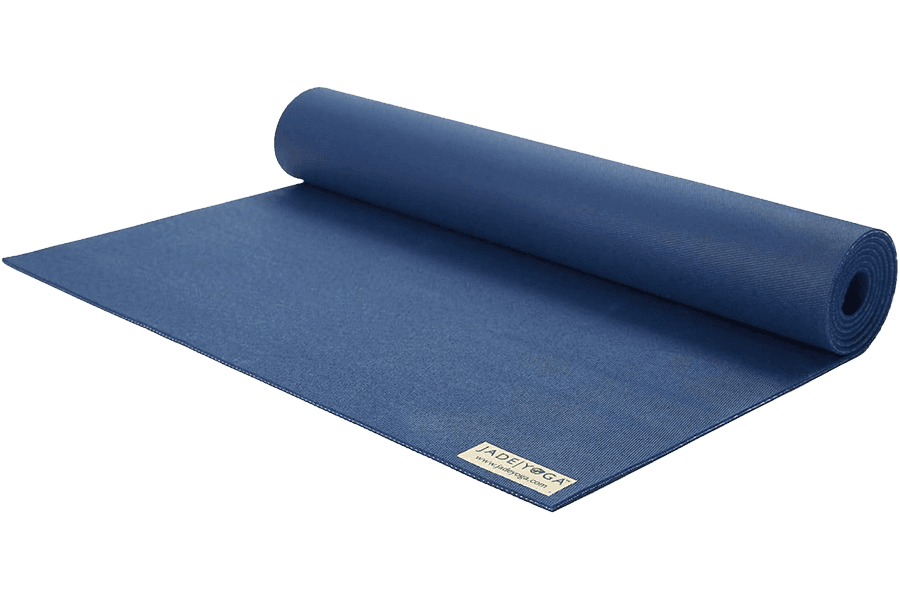
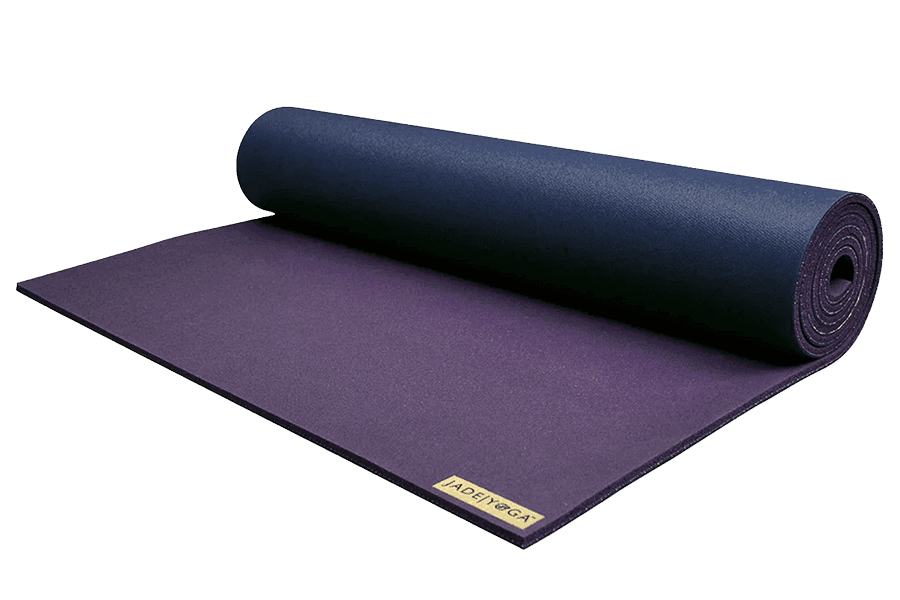
Price
The Harmony XW lists for $100 less.
$149.95
List price · check price at Amazon
$249.95
List price · check price at Amazon
Thickness
The Fusion XW is 67% thicker.
4.8 mm0.19″
8 mm0.31″
Weight
The Harmony XW is 4.3 lbs lighter.
6.7 lbs3 kg
11 lbs5 kg
Size
Same length; same width.
Same on both
- Identical 80" × 28" footprint
- Same tacky open-cell natural rubber surface
- Midnight Blue is the only colorway on both
- Made in the USA, 1 year warranty
- A tree planted for every mat sold
Full specs
Dimensions
Materials & build
Identical footprints, one variable
Few mat comparisons are this clean. Jade’s two XW cuts share the same 80″ × 28″ footprint, the same tacky open-cell natural rubber, the same US factories, the same 1 year warranty, and the same single Midnight Blue colorway. Every practical difference between them flows from one number: the Harmony XW is 4.8 mm thick, the Fusion XW is 8.
That one number carries consequences. The Fusion XW weighs 11 pounds to the Harmony’s 6.7, and it lists at $249.95 to the Harmony’s $149.95, a $100 premium for the thickest, heaviest, most expensive mat Jade makes. You already know you want the oversized footprint or you wouldn’t be here; what’s left is deciding whether your practice needs the depth.
What the extra 3.2 mm does
The Fusion formula is Jade’s cushioning specialist, and the reviews back it up: OutdoorGearLab scored the Fusion line a perfect 10 for comfort alongside the best traction of any mat it tested, and Yoga Journal has named the Fusion a best thick mat. On the XW’s expanse that cushioning serves a particular kind of practice: restorative and yin sessions, Pilates floor work, physical therapy exercises, and long kneeling holds, especially over concrete, tile, or thin carpet. For a sore-jointed practitioner building a home floor practice, it may be the most comfortable mainstream surface money buys.
The Harmony XW is firm. That’s the classic Jade feel, and for practitioners without joint complaints it’s comfortable through a full practice on most floors. It just isn’t therapeutic, and if your knees are the reason you’re shopping, 4.8 mm won’t change their mind.
It helps to picture the actual buyer of each. Harmony XW owners are usually tall or broad vinyasa practitioners who wanted room to move without changing anything else about the classic Jade experience. Fusion XW owners skew toward home practitioners rehabbing something, sharing a mat for assisted stretching, or running a daily restorative routine where the mat doubles as general exercise flooring. The footprint is the only thing those two lives have in common.
Where the thinner mat is better
Firmness is a feature the spec table undersells. Standing balances feel more planted on the Harmony XW because the foot reaches solid support almost immediately; on 8 mm there’s a moment of settling first. The Fusion XW’s density keeps that mild, nothing like the sway of cheap thick foam, but a practice centered on standing sequences and one-legged work runs better on the thinner mat. Jumps and transitions also feel crisper with less rubber to compress underfoot.
Practitioners who split time between styles sometimes want a ruling, so here is ours: default to firm. Cushioning you lack can be added locally with a folded blanket under a knee or hip; firmness you lack cannot be added to a soft mat at any price. The Fusion XW makes sense when the floor-heavy share of your practice is large enough that padding piecemeal would be constant.
Eleven pounds changes how you own it
The Harmony XW is already an awkward mat to move: 6.7 pounds rolled into a 28″ wide cylinder that no standard sling holds. It still moves, though. Under an arm or in a trunk, it can visit a studio or a friend’s house without drama.
The Fusion XW mostly doesn’t. At 11 pounds, heavier than the famously substantial Manduka PRO, rolled into a wide, thick cylinder, it is a mat you set up once and practice on where it lies. Owners treat it as part of the room. If any part of your routine involves transporting a mat regularly, that alone decides this page in the Harmony’s favor, no matter what your knees would prefer.
Even at home the mass shapes daily life with the mat. Repositioning the Fusion XW to vacuum under it is a chore, wrangling it flat after storage takes both hands, and its rolled form claims closet space like a piece of luggage. Most owners solve this by never rolling it up at all, which works fine if a six foot eight strip of floor can stay claimed. Be sure that space exists before the mat does.
Grip ties; drying goes to the Harmony
Both mats grip identically: tacky from the first practice, no break-in, with the open-cell absorption that keeps traction through a damp class. Sweat is where they diverge. All that absorbed moisture has to leave, and GearLab found a soaked Fusion needs 2 to 3 days to dry fully; the Fusion XW is the largest version of that problem Jade sells, and sunning it dry would damage the rubber. The Harmony XW is ready again by the next morning. Neither mat loves a heavy hot-yoga schedule, but the Harmony at least keeps up with one.
In fairness to the Fusion XW, its natural habitat softens the problem. A mat that lives unrolled in a home practice room airs out continuously and rarely gets drenched the way a hot-studio mat does, so many owners never meet the multi-day dry-out. It becomes a real annoyance mainly for heavy sweaters, which is worth weighing if that describes you.
The middle options worth ruling out first
Before spending $249.95, make sure you need both dimensions of what the Fusion XW offers. If the cushioning is the point but the giant footprint isn’t, the Fusion 74 delivers the identical 8 mm at $199.95 and 8.8 pounds, and the standard Fusion does it for $174.95 if 68″ covers you. If the size is the point and your joints are fine, that’s just the Harmony XW, which is why this comparison exists. The Fusion XW should be the answer only when both boxes are checked.
It’s also fair to ask whether you need an XW at all. Practitioners under six feet with ordinary shoulders often land on these pages out of a more-is-better instinct, and for them the Harmony 74 at $109.95 keeps the same rubber in a mat that fits bags, studio rows, and budgets. Oversized mats reward the bodies and rooms that need them and mildly punish everyone else.
Price and value
List prices are $149.95 for the Harmony XW and $249.95 for the Fusion XW. Check current prices on the Harmony XW and the Fusion XW at Amazon.
The $100 buys cushioning and nothing else: not extra grip, not extra lifespan, not an extra colorway. For a body that hurts on firm mats and a practice that lives on the floor at home, that cushioning is used every session and the premium is defensible. For everyone else, the Harmony XW delivers the entire reason to buy an XW, the room, at 60% of the price and weight. Put another way, the gap between these two mats almost covers a whole second Harmony 68 at $99.95, a spare mat for travel or a partner, which is a useful yardstick for how much cushioning you’d be buying.
Bottom line
Get the Harmony XW unless floor work hurts. It has the same celebrated grip, the same generous footprint, better footing for standing practice, overnight drying, and enough portability to leave the house occasionally, all for $100 less.
Get the Fusion XW if you’re furnishing a permanent home practice space and your knees, wrists, or hips demand the depth. Nothing else in natural rubber combines this much surface with this much cushion, and the people it fits tend to keep it for years. Just buy it knowing it weighs 11 pounds, dries slowly, and comes in exactly one color.
Jade Harmony XW
List price $149.95
Jade Fusion XW
List price $249.95
Frequently Asked Questions
- What's actually different between the Harmony XW and the Fusion XW?
- One spec: thickness, 4.8 mm against 8. Everything else people ask about, the grip, the footprint, the colorway, the warranty, the care rules, is identical. But that one spec drives the weight from 6.7 pounds to 11 and the list price from $149.95 to $249.95, so the practical differences in daily use are bigger than the spec sheet makes them look.
- Is the Fusion XW too heavy to take to a studio?
- Effectively yes. At 11 pounds, heavier than a Manduka PRO, rolled into a wide thick cylinder no sling holds, it's a mat that stays where you unroll it, and most owners leave it flat permanently. The Harmony XW is awkward too, since its 28" roll doesn't fit standard bags, but at 6.7 pounds it manages occasional trips under an arm.
- Which is better for balance and standing poses?
- The Harmony XW. Its 4.8 mm gives a standing foot almost immediate solid support, while the Fusion XW's 8 mm compresses slightly first. The Fusion's density keeps the softness mild compared to foam mats, but for a practice built around one-legged work and quick transitions, the firmer mat is noticeably the better platform.
- Is the Fusion XW good for bad knees and restorative practice?
- It's about the best natural rubber option there is for that. The Fusion line took a perfect 10 for comfort from OutdoorGearLab alongside best-in-class traction, and the XW cut adds enough surface for full-body floor work, assisted stretching, and physical therapy exercises at home. If that describes your practice, the price starts to make sense.
- How long does the Fusion XW take to dry after a sweaty session?
- GearLab found a soaked Fusion can need 2 to 3 days to dry through, and the XW is the largest version of that problem; you also can't speed it up in the sun without hardening the rubber. In practice most Fusion XWs live unrolled in a home space and air out continuously, which keeps this manageable. The Harmony XW recovers overnight.
- Do reviews of the Jade Harmony 2.0 apply to the Harmony XW?
- No. The Harmony XW is part of the original US-made Harmony line. The Harmony 2.0 is a different mat made in Spain, with FSC and OEKO-TEX certifications and a recent OutdoorGearLab award that the original line doesn't carry. When you read a Harmony review, check which of the two mats it's describing before applying it to this page.
Related comparisons
- Manduka PROlite Long & Wide vs JadeYoga Harmony XW
- JadeYoga Harmony XW vs Alo Warrior
- JadeYoga Harmony XW vs Manduka GRP Adapt 2.0 Long
- JadeYoga Harmony XW vs Manduka PRO Terra 6mm
- JadeYoga Harmony XW vs Yoloha Unity Pro Cork
- Manduka PRO vs JadeYoga Harmony XW
- JadeYoga Harmony XW vs Lululemon The (Big) Mat 5mm
- JadeYoga Harmony XW vs Liforme Classic
- JadeYoga Harmony XW vs b, halfmoon B Mat Strong 6mm