Jade Harmony XW vs Jade Fusion: Which One Should You Buy?
The Harmony XW and the Fusion are both answers to the standard Jade Harmony feeling like not quite enough mat, and they solve it in different directions. The XW spreads the classic 4.8 mm rubber across an 80" × 28" footprint at 6.7 pounds and $149.95. The Fusion keeps the standard 68" × 24" size and deepens the pour to 8 mm at 8 pounds and $174.95. Surface and care are identical, so you're choosing floor space against cushioning.
As an Amazon Associate, we earn from qualifying purchases made through links on this page. How this works
The quick answer
Everything that makes a Jade a Jade is shared here: the day-one grip, the US-made open-cell rubber, the 1 year warranty. The Harmony XW gives you roughly 37% more mat and stays firm underfoot, which suits tall or broad practitioners and standing-heavy practices. The Fusion gives your joints the 8 mm cushioning OutdoorGearLab scored a perfect 10, in exchange for a heavier, slower-drying mat with a smaller footprint.
If your body overruns a standard mat and your knees are fine, get the Harmony XW. If floor work hurts, get the Fusion, provided its 68" length actually covers your height.
Get the Harmony XW if...
- You're tall or broad and keep running out of mat mid-pose
- Standing balances matter; 4.8 mm is the steadier surface
- You want the lighter mat: 6.7 pounds against 8
- You'd rather keep $25 and lose nothing in grip
Get the Fusion if...
- Kneeling and floor work hurt on a standard-thickness mat
- You practice on concrete, tile, or thin carpet
- 68" × 24" already fits your height and build
- You want a color choice: 4 options against Midnight Blue only
Side by side
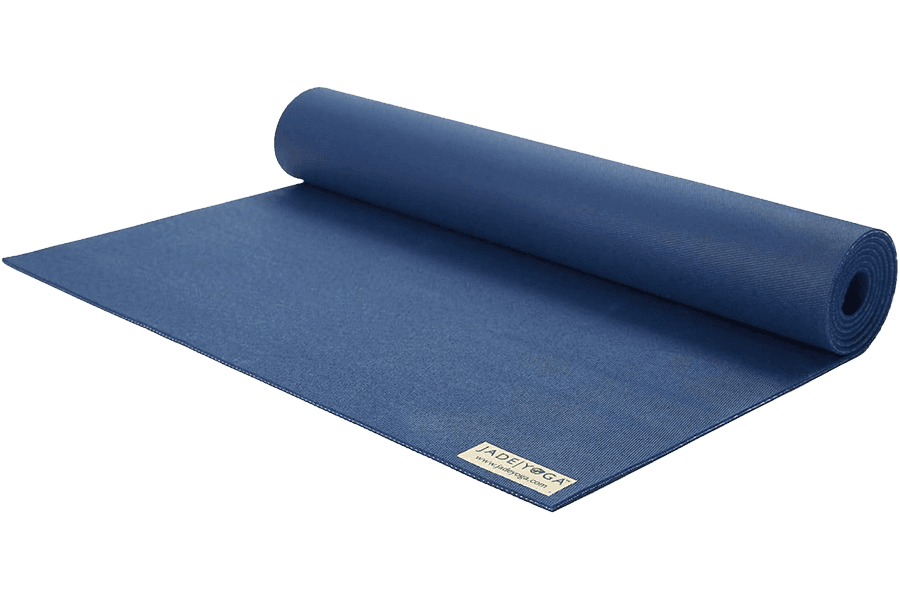
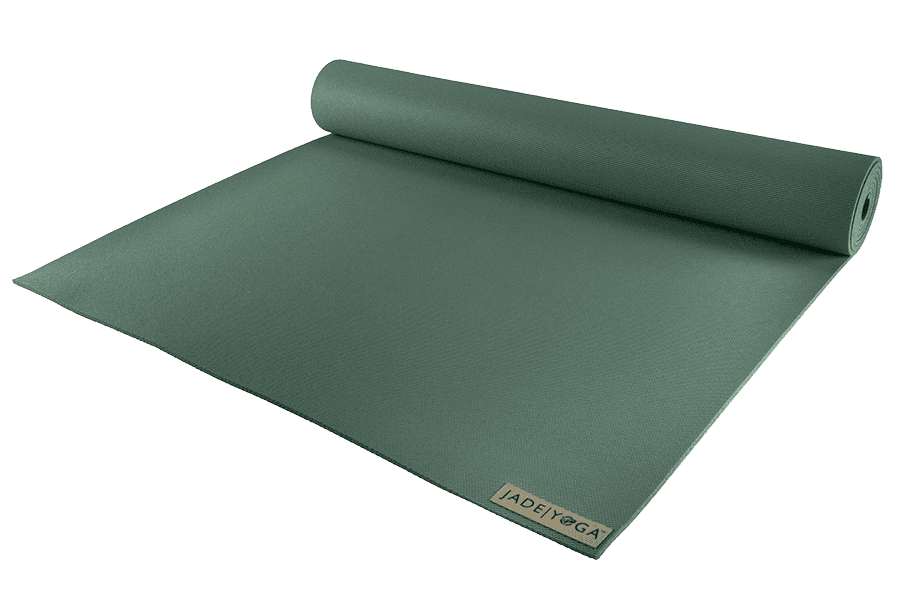
Price
The Harmony XW lists for $25 less.
$149.95
List price · check price at Amazon
$174.95
List price · check price at Amazon
Thickness
The Fusion is 67% thicker.
4.8 mm0.19″
8 mm0.31″
Weight
The Harmony XW is 1.3 lbs lighter.
6.7 lbs3 kg
8 lbs3.6 kg
Size
The Harmony XW is 12″ longer; the Harmony XW is 4″ wider.
Same on both
- Same tacky open-cell natural rubber surface
- Grip from the first practice, no break-in
- Made in the USA by JadeYoga
- 1 year warranty excluding sun damage and harsh cleaners
- A tree planted for every mat sold
- Not safe for latex allergies
Full specs
Dimensions
Materials & build
Two upgrades that fix different complaints
Both of these mats are what happens after someone outgrows the standard $99.95 Jade Harmony, and Jade built each one to fix a different complaint. The Harmony XW keeps the classic 4.8 mm thickness and enlarges the footprint to 80″ × 28″, a foot longer and four inches wider than standard. The Fusion keeps the standard 68″ × 24″ footprint and deepens the pour to 8 mm, which is where all of its extra weight and cost go.
Everything else carries over from the Harmony formula on both: tacky open-cell natural rubber that grips from the first practice, US manufacturing, a 1 year warranty, a tree planted for every mat sold. So the decision reduces to which shortage bothers you on a normal mat: not enough mat under your body, or not enough padding between your joints and the floor. The prices sit close enough, at $149.95 and $174.95, that money rarely settles it.
What the 80″ × 28″ footprint is worth
The XW carries roughly 37% more surface than the Fusion. The length half of that matters for tall practitioners: 68″ covers bodies to about five foot eight before heels or head start finding the floor in savasana, while 80″ covers essentially everyone. The width half matters for broad ones, and for more poses than people expect. Elbows splay off a 24″ mat lying down, hands land on hardwood in wide stances, and side-lying and restorative shapes spill over the edges. On 28″ they don’t.
Two caveats before falling for the acreage. First, measure your practice space; an 80″ × 28″ rectangle plus room to move around it asks more of an apartment than people expect, and in a packed studio class those four extra inches of width come out of your neighbor’s space. Second, if your interest in the Fusion survives this article but the 68″ length doesn’t fit you, the comparison shifts: the Fusion 74 at $199.95 covers heights to about six foot one, and the Fusion XW matches the Harmony XW inch for inch at a steep premium. This page assumes the standard Fusion’s size works for your body.
What 8 mm of rubber is worth
The Fusion is Jade’s answer for the practitioner whose knees, wrists, or hips file objections during floor work. OutdoorGearLab’s testers gave it a perfect 10 for comfort and noted it smooths out uneven floors, and Yoga Journal has named it a best thick mat. Kneeling lunges, long yin holds, forearm stands, and Pilates floor sequences all land more gently on 8 mm of dense rubber, and on concrete or tile the difference is not subtle.
The Harmony XW gives you the standard Harmony experience: firm, with the slight give of natural rubber, and comfortable for most practices on most floors. What it cannot do is make a long kneeling hold on a hard surface painless for a sensitive joint. A folded towel or a kneeling pad under the sore spot closes some of that gap for a few dollars, which is worth knowing before you pay for thickness across the whole mat.
Thickness cuts the other way in balance work
Extra depth is not free even before you lift the mat. On 8 mm, a standing foot compresses the surface slightly before it finds firm support, and practitioners who spend a lot of time on one leg tend to notice. Because the Fusion is dense rubber rather than spongy foam the effect stays mild, well short of the wobble a cheap thick foam mat produces, but the Harmony XW’s 4.8 mm is the steadier platform of the two. A practice heavy on standing balances argues for the thinner mat; a practice heavy on floor time argues for the thicker one.
The same physics applies to fast transitions. Chaturanga pushups, jump-backs, and quick vinyasa flows feel a touch more precise on the firmer surface, since less energy disappears into the rubber. Nobody fails a pose because they bought a Fusion, but the practitioners happiest on it are the ones who spend most of class below standing height.
Grip is identical; drying speed is not
There is no grip decision here. Both mats wear the same tacky open-cell surface, sticky from the first down dog with no break-in period, and both absorb light sweat rather than letting it slick the surface, the trait Wirecutter credits for the Harmony’s traction in damp classes.
The difference arrives after class. Open-cell rubber holds what it soaks up, and GearLab found a thoroughly soaked Fusion can need 2 to 3 days to dry, with no shortcut available since sunlight hardens natural rubber. The XW presents more surface area to the air but holds far less water per square inch, and it recovers on a normal overnight schedule. Neither mat is the right tool for hot yoga several times a week; if that’s your practice, plan on a towel over whichever one you buy.
Both are awkward to carry, differently
The spec sheet says the XW is lighter, 6.7 pounds against 8, and it is, but neither of these travels like a normal mat. The XW’s problem is shape: rolled, it stands 28″ wide, which overwhelms standard slings and mat bags, so you end up hauling it under an arm. The Fusion rolls to a normal 24″ width but into a fat cylinder, and GearLab scored its portability 3 out of 10. Owners of both mostly stop commuting with them.
If your mat rides to a studio every day, the standard 68″ Harmony or the 74″ remains the practical Jade. These two are best bought for a home practice, or a studio that lets you store a mat on site.
One care sheet covers both
Same material, same rules, same fine print. Keep both out of direct sun and hot cars, clean with a damp cloth or diluted vinegar rather than anything harsh, and expect the surface to soften and shed with years of hard use. Jade’s 1 year warranty applies equally and excludes sun damage and harsh cleaners on both. CNN Underscored puts the ceiling for a gently kept natural rubber mat around ten years; sweaty daily practice shortens that for either mat.
The latex caveat is also shared: Jade calls its mats 99% latex free, which means trace latex proteins remain, and neither mat is safe for someone with a latex allergy.
Four colorways against one
The Fusion currently offers four colorways: Midnight Blue, Purple, Slate Blue, and Jade Green. The Harmony XW comes in Midnight Blue, full stop. That has been stable for a while, and it follows Jade’s usual pattern of trimming the palette as the cuts get bigger. If color choice matters to you, the Fusion is the only mat on this page that offers any.
One naming clarification while we’re on the catalog: both of these are the original US-made Jade lines. The Harmony 2.0, a newer Spain-made mat with FSC and OEKO-TEX certifications and a recent OutdoorGearLab award, is a separate product, and reviews of it describe neither mat on this page. Check which version a source is talking about before letting it sway you.
Price and value
List prices are $149.95 for the Harmony XW and $174.95 for the Fusion. Check current prices on the Harmony XW and the Fusion at Amazon; Jade’s pricing holds fairly steady, though individual colorways go on sale.
A footnote for anyone puzzled that the physically bigger mat costs $25 less: rubber is priced by volume, and the Fusion’s 8 mm pour actually contains more of it than the XW’s wide, thinner sheet. Both prices are fair for what they are. The mistake to avoid is buying either as a general upgrade; each one is specialized, and the $25 gap should play no part in choosing which specialty you need.
Bottom line
Buy the Harmony XW if your body outruns a standard mat: taller than about five foot ten, broad through the shoulders, or simply tired of managing edges in floor poses. You keep the firm surface that makes balance work easy, save $25, and carry 1.3 fewer pounds.
Buy the Fusion if floor work hurts. Nothing in Jade’s standard line, XW included, does what its 8 mm does for sore knees on a hard floor, and GearLab’s perfect comfort score is deserved. Just confirm the 68″ length actually fits you, accept the 8 pound reality, and give it time to dry after sweaty sessions.
Jade Harmony XW
List price $149.95
Jade Fusion
List price $174.95
Frequently Asked Questions
- Which is better for bad knees, the Harmony XW or the Fusion?
- The Fusion, clearly. Its 8 mm of dense rubber is the reason the line exists, OutdoorGearLab gave it a perfect 10 for comfort, and Yoga Journal has named it a best thick mat. The Harmony XW is the standard firm 4.8 mm feel on a bigger footprint. A kneeling pad or folded towel can protect one sore joint on the XW, but if floor work hurts broadly, the Fusion is the real fix.
- Who actually needs the Harmony XW's 80" × 28" size?
- Practitioners taller than about five foot eight start outgrowing a 68" mat in savasana, and anyone broad through the shoulders benefits from the 28" width in lying and wide-stance poses well before that. If you're average-height with an ordinary build, the standard 68" Harmony at $99.95 does everything the XW does for $50 less and comes in far more colors.
- Why does the smaller Fusion cost more than the bigger Harmony XW?
- Rubber is priced by volume, not footprint. The Fusion's 8 mm pour over 68" × 24" contains roughly 20% more rubber than the Harmony XW's 4.8 mm spread over 80" × 28", so the thicker mat is the more expensive one to make. Neither price is out of line for what you get.
- Do the Harmony XW and Fusion grip differently?
- No. Both wear Jade's tacky open-cell surface, which grips from the first practice with no break-in and absorbs light sweat rather than letting it pool. GearLab rated the Fusion's traction the best of any mat it tested, and the Harmony's surface is the same formula in a thinner pour. Pick based on size and cushioning; the grip comes along either way.
- Which one is easier to carry to class?
- Neither is good at it, in different ways. The Harmony XW is lighter at 6.7 pounds, but rolled it stands 28" wide, which doesn't fit standard slings or mat bags. The Fusion rolls to a normal width but into a fat 8 pound cylinder, and GearLab scored its portability 3 out of 10. If you commute with a mat daily, Jade's standard 68" and 74" Harmony cuts are the practical choices.
- Is the Harmony XW the same mat as the Jade Harmony 2.0?
- No. The Harmony XW belongs to the original US-made Harmony line. The Harmony 2.0 is a separate mat made in Spain, with different pricing, FSC and OEKO-TEX certifications, and the recent OutdoorGearLab award. Reviews and specs don't transfer between the two, so check which version a source covers before relying on it.
Related comparisons
- Manduka PROlite Long & Wide vs JadeYoga Harmony XW
- JadeYoga Harmony XW vs Alo Warrior
- JadeYoga Harmony XW vs Manduka GRP Adapt 2.0 Long
- Manduka PRO vs JadeYoga Harmony XW
- JadeYoga Harmony XW vs Yoloha Unity Pro Cork
- JadeYoga Harmony XW vs Lululemon The (Big) Mat 5mm
- JadeYoga Harmony XW vs Liforme Classic
- JadeYoga Harmony XW vs b, halfmoon B Mat Strong 6mm
- JadeYoga Harmony XW vs Manduka GRP Adapt 2.0