Jade Fusion vs Manduka eKO: Which One Should You Buy?
Both of these are serious natural rubber mats that mostly live where you practice: the Fusion weighs 8 pounds, the eKO 7. From there they specialize. The Fusion pours 8 mm of open-cell rubber and sells cushion; the eKO spreads 5 mm of firmer closed-cell rubber across a bigger 71" x 26" footprint and sells stability. The $61 between them buys a specific comfort, so the question is whether your joints will use it.
As an Amazon Associate, we earn from qualifying purchases made through links on this page. How this works
The quick answer
The Fusion is the cushioning specialist: 8 mm of springy rubber that took a perfect comfort score at OutdoorGearLab, with the tacky open-cell surface GearLab called the best traction it tested, and a 1 year warranty. The eKO is the generalist: a wider, longer 71" x 26" platform that's firmer under balance poses, wipes dry after class instead of drinking sweat, includes over 30% recycled content, and costs $61 less on Amazon terms the Fusion also enjoys.
If floor work hurts, your practice leans restorative, or your floor is tile or concrete, get the Fusion. For general vinyasa and standing practice, the eKO's firmer, bigger surface is the better daily platform, and the cheaper one.
Get the Fusion if...
- Knees, hips, or forearms complain on hard floors
- Your practice leans restorative, yin, or Pilates
- You want grip that holds when palms get damp
- A written 1 year warranty matters to you
Get the eKO if...
- Standing and balance work anchor your practice
- You want the bigger 71" x 26" footprint
- You'd rather wipe a mat dry than air it for days
- You'd rather keep about $61
Side by side
Price
The eKO lists for about $61 less.
$174.95
List price · check price at Amazon
$114
List price · check price at Amazon
Thickness
The Fusion is 60% thicker.
8 mm0.31″
5 mm0.2″
Weight
The eKO is 1 lbs lighter.
8 lbs3.6 kg
7 lbs3.2 kg
Size
The eKO is 3″ longer; the eKO is 2″ wider.
Same on both
- Natural rubber (not for latex allergies)
- Grip from the first practice, no break-in
- Heavy mats that mostly live where you practice
- Must stay out of direct sun and hot cars
- Longer sizes available
Full specs
Dimensions
Materials & build
Two rubber heavyweights, two jobs
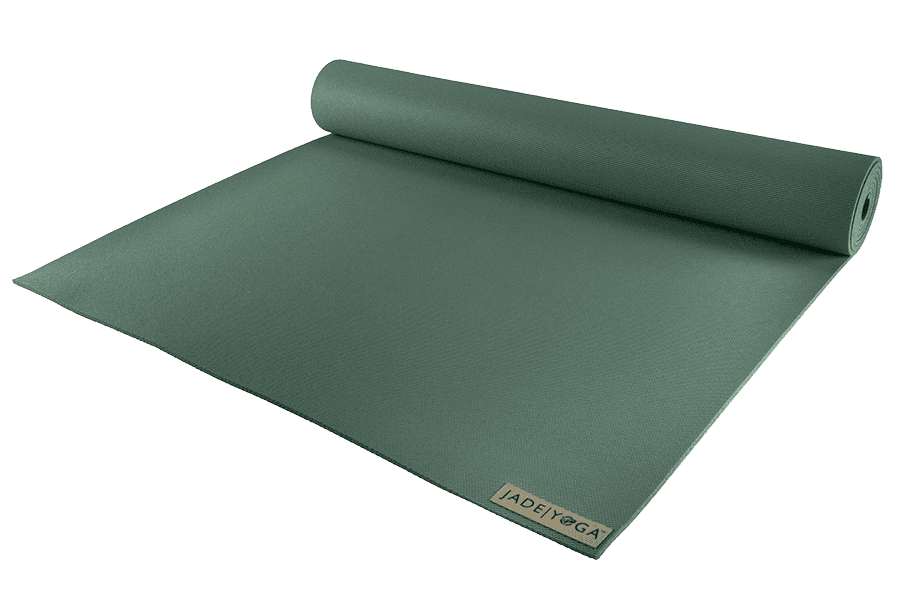
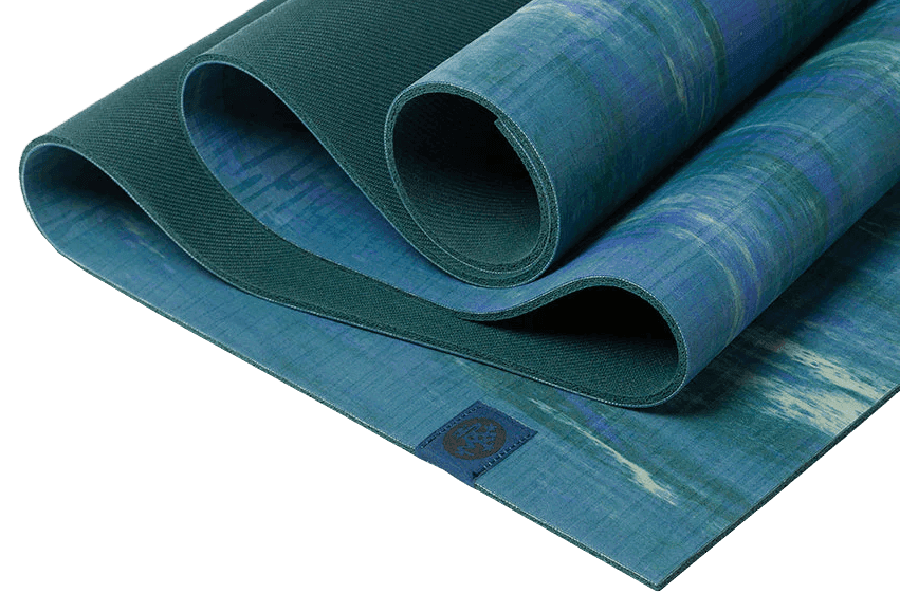
Nobody carries either of these mats across town for long. The Fusion weighs 8 pounds, the eKO 7, and both are natural rubber slabs that settle into a practice space and stay. That’s where the family resemblance ends. The Fusion is Jade’s cushioning specialist, 8 mm of springy open-cell rubber for bodies that hurt on hard floors. The eKO is Manduka’s general-purpose rubber mat, 5 mm of firmer closed-cell material spread across a bigger 71″ × 26″ platform.
At $174.95 against $114, the Fusion asks about $61 more, and every dollar of that premium is buying thickness. So start with your joints: if they’re the reason you’re shopping, the Fusion’s case is strong. If they’re not, the eKO’s is.
Cushioning: no contest, by design
The Fusion’s 8 mm earned a perfect comfort score at OutdoorGearLab, and Yoga Journal has named it a best thick mat. Kneeling lunges, hip openers, forearm stands, long yin holds on tile: this is the practice the Fusion was poured for, and nothing mainstream does it much better. It even smooths out uneven floors, which owners of old houses come to appreciate.
The eKO’s 5 mm is a normal amount of premium mat: firm, pleasant, perfectly adequate on a wood floor, and thin comfort for bone against concrete. Manduka describes its cushion as soft with a gentle rebound, which is accurate as far as 5 mm goes. It simply isn’t playing the Fusion’s game, and buyers whose knees have opinions should notice that.
Stability: the eKO’s counterargument
Thickness cuts both ways. On the Fusion, a standing foot settles into the rubber before it finds solid ground, and balance poses read subtly softer, closer to grass than pavement. Jade’s density keeps it far from cheap-foam wobble, but practitioners who anchor their practice in standing sequences consistently prefer a firmer platform, and the eKO is exactly that: 5 mm of dense rubber that gives your foot one honest answer.
The eKO is also simply more mat to stand on, 3 inches longer and 2 wider than the Fusion’s 68″ × 24″. Wide-stance flows and broad shoulders use that extra real estate every session.
Grip and sweat: opposite constructions
Both mats grip well from the first practice, but they’re built on opposite theories. The Fusion’s open-cell surface absorbs moisture, keeping traction as palms dampen; GearLab called its grip the best of any mat it tested, wet or dry. The eKO’s closed-cell surface is excellent while dry, and Manduka itself frames it that way, because sweat has nowhere to go but the surface.
Then class ends and the argument reverses. The eKO wipes dry in seconds. A thoroughly sweated-on Fusion holds that moisture in its cells and can take 2 to 3 days to dry fully, and sunning it dry isn’t an option because sunlight hardens natural rubber. Neither mat is the right tool for hot yoga several times a week; between these two it’s a question of whether you’d rather manage damp palms or a damp mat.
Durability and the warranty gap
Both wear the way natural rubber wears: surfaces soften and shed over a few years of hard practice, faster with sweat, with CNN Underscored’s roughly ten year ceiling available to gentle owners. The eKO’s specific failure mode is surface flaking after a few years of heavy use; the Fusion’s cushion slowly loses loft to compression. Call lifespan a wash.
Coverage isn’t a wash. Jade writes the Fusion a 1 year warranty against defects and premature wear; Manduka gives the eKO a 30 day return window, since its lifetime guarantee stays with the PRO series. A year isn’t long, but on a $175 mat it’s worth something that the maker will answer the phone.
Materials and values
Two good citizens here. The Fusion is tapped tree rubber made in the USA, with Jade’s tree-per-mat planting program past two million trees by its count. The eKO is tree rubber made in Taiwan with over 30% recycled content in a process Manduka promotes as zero-waste. Pick whichever story you’d rather fund; neither embarrasses you.
The shared warning stands: both are latex-bearing natural rubber, with Jade explicitly not recommending its mats for latex allergies and Manduka’s 99% latex free wording meaning the same thing. Allergic practitioners need PVC or TPE, full stop.
Sizes, colors, and options
The eKO offers its standard 71″ × 26″ in around 5 colorways plus a 79″ Long at $124. The Fusion runs 68″ × 24″ in 4 colorways, with a 74″ at $199.95 and the oversized 80″ × 28″ Fusion XW above it. Neither rack is colorful by brand standards; buyers wanting choice should note Jade puts around 12 colorways on the thinner Harmony.
Price and value
List prices are $174.95 for the Fusion and $114 for the eKO. Both sell first-party on Amazon, so check current prices on the Fusion and the eKO before deciding.
The $61 gap prices one feature: 3 millimeters of additional rubber. For a body that hurts on hard floors, that’s the cheapest relief in premium yoga and worth every cent. For a body that doesn’t, it’s $61 for comfort you won’t register, spent on a smaller, heavier mat. The eKO is the sensible default; the Fusion is the specific remedy.
Bottom line
Get the Fusion if floor work hurts, your practice leans restorative or Pilates, or you practice on tile or concrete. It’s the best cushioning either brand makes with no grip penalty, and the only mat here with a warranty. Let it live at home and give it drying time after sweaty sessions.
Get the eKO for everything else. It’s bigger where mats should be bigger, firmer where standing practice wants firm, easier to keep dry, greener by recycled content, and $61 cheaper. Most practices are better served by the generalist, and this is a good generalist.
Jade Fusion
List price $174.95
Manduka eKO
List price $114
Frequently Asked Questions
- Which is more comfortable for bad knees, the Jade Fusion or the Manduka eKO?
- The Fusion, and it isn't close. Its 8 mm of springy open-cell rubber earned a perfect comfort score from OutdoorGearLab, and cushioning bone against hard floors is the mat's entire reason to exist. The eKO's 5 mm is a normal firm premium mat: fine on wood, thin comfort for long kneeling holds on tile or concrete. If joint pain brought you to this page, the Fusion is the answer.
- Is the Jade Fusion too thick for balance poses?
- It's softer than ideal, not unusable. Your foot settles into 8 mm of rubber before finding solid ground, so tree pose and standing sequences feel subtly less planted than on a firm 5 mm mat like the eKO. The Fusion is dense enough to avoid cheap-foam wobble, but practitioners who live in standing work consistently prefer the firmer platform, and between these two that's the eKO.
- How do the sizes compare?
- The eKO is the bigger surface: 71" x 26" against the Fusion's 68" x 24", which means 3 more inches of length and 2 of width. Both lines scale up, the eKO with a 79" Long at $124 and the Fusion with a 74" at $199.95 plus the oversized 80" x 28" Fusion XW. At the standard sizes, taller and broader practitioners fit the eKO better out of the box.
- Which handles sweat better?
- During practice, the Fusion: its open-cell surface absorbs moisture and keeps traction with damp palms, part of why GearLab rated its grip the best it tested. After practice, the eKO: its sealed surface wipes dry in seconds, while a sweat-soaked Fusion can take 2 to 3 days to dry fully and can't be sunned dry, since sunlight hardens rubber. Frequent hot yoga is really neither mat's job.
- Do these mats have warranties?
- Only the Fusion. Jade covers it for 1 year against defects and premature wear, excluding sun damage and harsh cleaners. The eKO gets Manduka's 30 day return window and nothing after, because the lifetime guarantee applies to the PRO series only. On mats at $114 and $174.95, Jade's paper is a real point in the Fusion's favor.
- Is either mat safe for a latex allergy?
- No. Both are natural tree rubber. Jade says its mats are 99% latex free but may carry trace latex proteins and doesn't recommend them for latex allergies, and Manduka's rubber carries the same caveat. Allergic buyers should look at PVC or TPE mats instead; nothing else on this page changes that.
Related comparisons
- Manduka eKO vs Lululemon The (Big) Mat 5mm
- Lululemon The Mat 5mm vs Manduka eKO
- JadeYoga Harmony 74" vs Manduka eKO
- Manduka eKO vs JadeYoga Harmony 2.0 68"
- Manduka eKO vs Suga SugaMat
- JadeYoga Harmony 68" vs Manduka eKO
- Manduka eKO vs Yoga Design Lab Combo 3.5mm
- Manduka eKO vs b, halfmoon B Mat Everyday 4mm
- Manduka PRO Long vs JadeYoga Fusion 68"